Showing posts with label Haydn. Show all posts

Sunday, June 3, 2012

Wallpapering

I tend to change my PC's desktop background (known colloquially as 'wallpaper') about every month. Almost always the image is a picture I've snapped on a recent trip, having got into the habit of trying to take a shot or two that contains a large area of the same colour suitable for displaying icons and a calender on top of. However, recently I had the nice idea to create a series of Great Composer wallpapers which could be easily made from 'found' objects on the internet (a la Berio) and knocked up in an hour or two using fairly simple tools in a graphics programme. Here I'm going to show you how it's done, should you wish to copy the concept yourself or just are curious.

The basic idea consists of using a portrait of the composer, their signature and a suitable excerpt of their music. All of these objects could be found from open-source websites, chiefly Wikipedia and IMSLP, and then with a little bit of experimentation arranged to fill the screen space. Depending on the images used and direction the portrait faces, there is scope for some variation with the composition.  The program I used for the project was Paint.NET, a free open-source raster graphics program that was initially developed by Microsoft as a replacement for the standard Windows Paint but then dropped and left in the hands of a community of internet users. It would be an excellent program even if it were payware - it does nearly everything that Photoshop or Coral Draw will, although if you want vector graphics you'll have to get the equally excellent Inkscape. The reason for not using this instead (vector graphics, should you be curious, are a system whereby the pixels become infinitely small as you zoom in and so images don't get blurred) is partly that file sizes will be much larger and that I have a much greater level of proficiency on Paint.NET. Also, it has a number of plugins included that we will be using for this project.

Setting up/Portrait:

The first stage is to set up the canvas for the wallpaper.  As I'm creating this background for a standard 17" flatscreen monitor, I will be using a resolution of 1024x468 pixels, so I create a new document in Paint.NET and alter the canvas size to these dimensions (choose Image - Canvas Size).  (If you are unsure how big your screen is, right click on your desktop, choose 'Properties' and look at the 'Settings' tab. There will be a slider half-way down which will show your current resolution - most likely this is already at 1024x468).  The next thing is to choose a subject for our wallpaper. The composer I settled on was Haydn: definitely one of the 'greats'; and with several portraits to choose from available in high-resolution. As we need to show both the portrait and some music, I intended to divide the space about half-and-half. This also means that when our background is 'in situ', desktop icons can all fit over one side or the other depending on what offers the best contrast and visibility. A little searching on Wikipedia Commons brought me to the Thomas Hardy portrait which I copied and pasted into Paint, and then resized to fit just the head into the frame.

At this point we need to introduce a new concept which is one of the best features of Paint.NET and similar programs: layers. In ordinary MS Paint, everything is on the same layer and only one colour can be displayed as 'on top'. If you draw over something, it disappears. Cut an area out and you cut down to the background. But with Paint.NET, we can have multiple layers of a drawing superimposed on top of each other. This means you can draw a background and then create another layer (or several) on top, on which you can draw, move, cut, paste and alter anything without affecting the layer(s) below or above.  We're going to exploit this feature in making our wallpaper.

The Haydn portrait I've just copy-pasted will sit on top of a background layer, which we'll create in a minute. What we need to do first is to 'cut out' his head so we can add a background to avoid an untidy difference between the square portrait and the rest of the screen (I experimented with stretching the painting's background to fill the space, and the result was some way from satisfactory).  There is no easy way of doing this other than to get out the eraser tool and carefully go round the edge of the wig and features with a small tip size. My tip is to release the mouse frequently; this means if you make a mistake and have to hit 'undo' you'll only lose a small amount of correct erasing.

The result of somewhat painstaking work with the Eraser tool.
I decided to leave 'Papa' Haydn's hand and pen in, as it makes a nice touch and would have looked a little odd otherwise.  I have also left in the painted background behind him as this serves our purpose quite well already.  Once all this is complete, I name the layer 'Portrait' or something similar for clarity (select the layer and choose 'Layer Properties' from the small menu at the bottom of the Layers window) and save. We're not quite finished with this layer yet, but for now let's move on to creating the background.

Background:

Create a new layer from the window and name it 'Background'. Then - and this is important - move it down using the arrows to below the portrait layer we already have. Anything we draw in this new layer will be visible only where the portrait layer is transparent - the chequered space in the screenshot above. (This is possible due to the file having something called an 'alpha layer', but we don't need to worry too much about the workings of this for our current project).  Rather than a single colour background, I wanted something slightly mottled that matched the oil paint of the portrait. To get this, in the background layer I stretched a rectangle over the entire canvas (make sure it's set to 'Draw filled shape' at the top when the polygon tool is selected) and then in the visible area scribbled a load of wiggles over it in green, brown and tan.  Making sure only this background layer was selected, I then used the Gaussian Blur tool (Effects-Blurs-Gaussian Blur) on this layer in two separate passes, turning up the blur radius until the wiggles were very subtle. I also ran the 'Oil Painting' effect on this layer, although I'm not sure how much difference this actually made after all the blurring.  The finished effect is very subtle but looks much more classy than a plain colour.


The next thing to do is to return to the portrait layer and run another plugin from the Blurs tab called 'Feather'. It may appear at first glance that this has done nothing, but look again at the edges with the background layer displayed. They will have been blurred outwards a little, removing the 'hard' join between layers. We're done with the portrait layer now.

Music:

Create another new layer and name it 'Music'. It needs to be moved down between the two existing layers - it will be on top of the background but beneath the portrait. At this point I needed to choose a suitable excerpt form the literature to represent the composer. I settled on a passage almost immediately - The Heavens are Telling from The Creation, which is possibly his most famous and masterly work.  I decided just to use the vocal lines rather than including the orchestral accompaniment, but this is a personal judgement.  The staves can be captured by taking a screen shot of the vocal score from IMSLP and pasting it into a new document. To get the music to sit on top of the background we're going to need to cut out all the spaces. Trim using the 'Crop to selection' tool and then get to work with the Magic Wand tool to remove anything that isn't ink. The Wand selects any area bounded by the same colour and will allow us to erase the 'holes' between ledger lines and notes far neater than we could ever do by hand.  Again, there is no quick way of doing this: we're going to have to just keep clicking until all the white on the page is removed and we can see the chequers of the alpha layer.

Having done this, there was one little addition I wanted to make: the score only showed the words in English, and I rather wanted to have the German text as well. Apart from personal satisfaction and an acknowledgement of Haydn's nationality, this would also better make the staves fill the space. The German text was copied from another score and then typed in Paint.NET using the text tool, getting the font as close as possible to the existing type. I also put it into italics just to be on the safe side. Unfortunately the program's text editor does not not seem to have any provision for special characters, so to get the umlauts in 'erzählen' and 'Hände' I had to manually draw pairs of dots and position them over the letters. They've come out rather faint but they're there. I also had to move the existing staves to fit the new lines of text in. This was done by moving all the text to a new drawing, then very carefully selecting each part with the lasso tool and copy-pasting it into a new layer.  I then moved this selection up a few pixels and copy-pasted the German text (already aligned with the notes) into the layer before manoeuvring the whole lot in position so it was aligned above the rest of the staves. This was done separately for each voice until I had four layers which could be merged back into one (we'll cover merging at the end). The only problem that now remained was to fill in the gaps in the stave brace: this was done by selecting the existing area and stretching it over the gap from each side like elastic. Done!

Having added the additional text, the lines of the staves were manoeuvred back into position.

As the wallpaper has a dark background we need a light image on top. To do this for the music I selected the image and used the 'Invert colours' tool to turn the black to white, then copy-pasted the whole lot back over to the 'Music' layer of the original file. I also reduced the transparency of this layer a little and added a very slight blur to avoid the harsh contrast created by sharp pure white. It serves as a sort of 'semi-background' and also seems to match the colour of Haydn's wig...


The result is very satisfactory. I enlarged the layer and moved it across to position the music tucked slightly behind the portrait - again personal taste.  The inclusion of the line 'The wonder of his work/displays the firmament' seems particularly fitting, and I would like to think this could be seen as alluding to the mastery of Haydn's music as well as the creation text. All that remains now is to place Haydn's signature and dates in a new 'Text' layer. The signature (there are two different Haydn signatures, I chose the one with his initials in) was found on IMSLP and adapted in much the same way as the music: white background cut out using Magic Wand, then the colours inverted and moved into position at the bottom left on Joe's shoulder . The name and dates were done in Paint.NET's own text tool and positioned top right.

Finishing:

The final stage is to make this into a usable picture file by flattening it. If we've been saving our work regularly, as wise precautions advise, the default file type will be one with a .pdn extension. This is Paint.NET's own file format, one which supports the layering we've been using. However, we can't use a file like this as a normal picture because no other program can actually display a Paint. NET file with layers, so we need to change it into a .png, .jpeg, .gif or similar format.  To do so, we need to merge all the layers together into one. Paint.NET makes this easy for us by including a 'Merge layers down' tool in the Layers window, but first we need to double-check what goes on top of what and move them up or down if necessary. The order of layers in the window should be Text- Portrait- Music-Background. Starting with the top layer, hit the 'Merge down' button and the two layers will combine into one. When you've finished, the drawing will be a single-layer image that can be saved in any picture format. I would recommend using a png or a jpeg to keep the file size down, but check the quality is turned up to maximum. I saved it as 'Haydn desktop'.

All that remains is to navigate to the new file, right-click and choose 'Set as Desktop Background'. Give the cogs a moment or two to whirr and you should have Haydn sitting as your background screen.
The finished article in use.

A few concluding thoughts:

  • This concept is highly versatile as long as one has a portrait image and another work example to use. It could easily be adapted for any figure or object of history. As mentioned, there is scope for variation of the basic idea: the portrait could be bigger, smaller, face the other way, the signature could be elsewhere, different fonts, etc.
  • Oil paintings will probably produce a more satisfactory result than colour photographs, as they are easier to merge with other colours and avoid overly sharp edges when cut around.
  • Using a fairly dark colour scheme seems to have worked well with the bright icons and calendar that sit on top of it. All are still legible and easy to locate, one of the design principles of desktop wallpaper.
  • Be aware that with a system tray at the bottom of the screen, some of the image will be obscured. Luckily, this doesn't seem to create any adverse effect in this case.
  • The next one of these will probably be Mozart. I plan to offer these as free downloads from this blog once I have a small collection.

Sunday, January 29, 2012

The Problem with Big Tunes

Everyone loves a great, memorable tune.  We're talking here not about just melody, but melody that can be elevated to being called a tune. Such things are usually tonal, regularly phrased, and featuring a melody-and-accompaniment texture, often chorale-like and generously orchestrated.  They are instantly recognisable, make audiences feel good and can assure a composer a place in musical history.  And yet they are also quite rare beasts.  So why doesn't every composer write one?

Well, for a start, coming up with a really good Big Tune is potentially a laborious process.  In a classic example of the symbiosis involved in composition, the effectiveness of the melody goes hand-in-hand with the skillful use of harmony - both must be devised simultaneously to compliment one another, Since a great number of Big Tunes are felt to arouse feelings of national pride or other gushing emotions, the achievement of sincerity in such an entity can only be achieved by a relatively narrow repertoire of gestures - for example starting with a stable harmony to establish gravitas, or later a move to the minor in one of the phrases, returning to the major as if in reassurance.  On the most simple level it can be hard to consciously set out to 'write a Big Tune like the one in [piece x]' and avoid sounding like a pale imitation of it.

Second, the definition of a Big Tune will confine a composer to a relatively narrow musical style unless the music is deliberately a college or pot-pourri of different influences.  Stravinsky couldn't simply introduce a four-square anthem into, say, Rite of Spring, as it would sound ridiculous in this context and be completely contrary to the aims of the music. 

Structurally and technically speaking, they present several problems. Chief amongst these is that the attraction of the thing is its completeness - that is, the tune is a sixteen-bar entity which one can sing along to and which follows recognisable lines.  This is fine if the tune is to be a thing-in-itself, but less so if it is to be used as part of a wider form such as a movement of a symphony. Percy Grainger's famous quip that 'the trouble with folk songs is that when you've played it once the only thing you can do is repeat it' rings true, for good tunes are awkward to do anything else with. The more memorable a tune is in itself, the more 'closed' an entity it is likely to be, probably ending with a nice neat cadence in the tonic.  For use in a larger form, it usually comes to just too satisfying and complete an end, meaning that the music has to stop and re-start, and that there is a lack of tension around which to build the remainder of the piece.  Apart from anything else it can be difficult to chop up the tune into smaller segments with which any development will be facilitated; particularly for the listener who, having been drawn to the piece by tune, will probably find the fragmented version less appealing than the initial whole. It is possible - the finales of Tchaikovsky's Fifth and Nielsen's Third, the first and last movements of Elgar's First and several parts of Dvorak's Ninth are famous examples that manage it by various means, mostly by following it with something contrasting and then eventually bringing the Big Tune back at the end to satisfy listeners.  Sibelius pulls it off in Finlandia, in oh-so-Sibelian fashion building the preceding material from fragments of the theme, then juxtaposing the last note of it with the start of the next section (cleverly avoiding the stasis that would have resulted from bringing it to a close) and finally presenting only the first phrase of the melody in the coda. Even when the theme is allowed to run in the central section of the piece it is carefully varied in orchestration and not allowed to become sentimentalised.

Actually, Finlandia throws up a number of interesting avenues related to this topic.  The work was originally introduced, in a slightly extended form, as the finale of the rather uninspiringly titled suite Music for the Press Celebrations.  As the general feeling of the time was explicitly nationalistic, it is no surprise that the stirring tone poem quickly became performed on its own as an anthem of independence, and was as quickly banned by the Russians for this reason.  With all this national feeling contained within, it was assumed that the work had been composed with the intent of being as 'Finnish' as possible and thus included national folk music.  Sibelius had to repeatedly state that both the theme and the rest of the piece were categorically not based on any folk-songs.  The assumption of this is quite telling.  Folk music is not all melody and even rarer still the neat four-in-a-bar, major-key type (Finnish music often features five beats in the bar).  Did the symphonic content making up the other 3/4 of the piece actually matter or would it have been enough to have just written the famous tune?  Was the big tune even written as a crowd-pleaser or just for structural purposes in the first place?  Sibelius went on to arrange the central theme for choir (twice, in fact) setting the patriotic 'Finland Awakes' and thus joining a tradition that continues to this day of putting words to likely tunes, appropriate or not.

And that brings us on to the English equivalent of Finlandia, and another issue with Big Tunes - they become appropriated for hymns, songs, 'crossover' cover versions, etc, regardless of the composer's personal beliefs or the original context of the cultural artefact - and also become overplayed.  Having seen his suite become a rare hit amongst his output, Gustav Holst eventually grew to hate the incessant elevation of The Planets to the neglect of his other music (despite it justifiably being his best work) and in particular the setting of the famous melody in Jupiter to the text of I Vow To Thee, My Country and its subsequent use at every kind of pompous nationalistic occasion. Apart from the fact that the work is more concerned with astrological connotations from Indian mysticism than the fruits of the scientific advancements of the European Enlightenment, Holst was both a pacifist and an atheist and conspicuously from an immigrant background - Sweden via Latvia.  He would have been either horrified by or, more likely, resigned to, today's appropriation of this melody by jingoistic military occasions and flag-waving nationalism, and the assumption that it was written by a Very British composer.  Elgar's Pomp and Circumstance March No.1 and the 'Nimrod' movement of the Enigma Variations suffer much the same problems.  Elgar was also born an outsider (a working-class Catholic, making the patriotic 'Land of Hope and Glory' text somewhat out of place) and the Enigma Variations written as a highly personal piece, albeit in a generally light vein.  Worse, in such an extended work as this, everyone wants to hear the Big Tune to the exclusion of the rest of the piece, and because the particular excerpt is what is most readily associated with the composer, they are in danger of alienating audiences with anything that departs from this.  Returning to an earlier example, if you only knew the tune from Finlandia, then Sibelius' final two symphonies and The Tempest music must sound mightily strange on a first hearing.  Holst put off audiences simply by not re-writing The Planets in subsequent orchestral outings, a perfectly natural thing for a composer to do.

There are two happy upshots from all this.  Film music manages to use the idea of the Big Tune more successfully, largely due to its role as accompaniment.  If the audience needs to attach a particular recognisable theme to a character then this is a highly effective way to do it without having to worry about symphonic development (which would be too distracting for the medium). Indeed, the skillful writing of Leitmotif that works both as a film soundtrack and as concert excerpts is what constitutes the craft of John Williams and similar composers.

Secondly, it had been demonstrated on numerous occasions (in fact the majority of frequently-performed symphonic output) that it is not at all necessary to write a Big Tune in order to compose a first-rate piece that will not only be melodic but have audiences positively singing along. Haydn repeatedly proves that motivic writing can still sound tuneful and produce a technically stimulating work. Verdi writes almost totally melodically, yet actual four-square tunes as described above are confined to one or two choruses per opera, maximising their effectiveness in music that sets out to be crowd-pleasing (yet loses no integrity or intellectual appeal in the process).

Edit: Curiously, contemporary pop music, which is also generally populist (if not by definition), seems to be equally shy of using easily memorable Big Tunes. With a few notable exceptions, it is older popular styles which tend to be more melodic, possibly as a result of their shorter evolutionary path from blues and music-hall genres, and the notion of a hummable melody is clearly anathema to punk, rap, metal and other such styles.

Sunday, September 11, 2011

What Happened in Hungary: Day Three Part Two

The staff of ITM return from a summer break to relate the remainder of the epic tale of the trip to Hungary. It gets interesting and perhaps controversial from now on, honest...

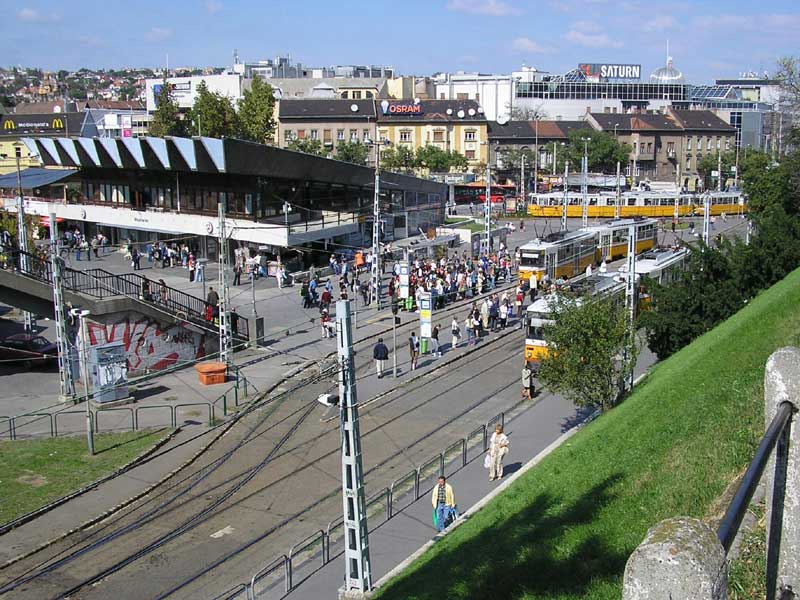
Despite the limitations of even strong coffee becoming very apparent, I left the rehearsal felling mostly optimistic about the prospects for the concert.  What did it matter that we were severely lacking in rest and concentration; we could, as far as I could tell, still play with most of our skill and bravado intact.  Anyway, there was no time to analyse the prognosis as we were being ushered out of the hall for whatever event was taking place that afternoon.  Back onto the bus (hurrah, I get to carry the cello up literally millions of steps to the room designated for instrument storage) and a short drive down the switchback road on the north side of the hill to Széll Kálmán tér (Moscow Square until six months ago).  Here we would have an hour or so to eat before the bus took us back to our hotel in the third district. A group of us headed for the Mammut shopping centre close by. Happy as I was to be walking the streets of Budapest for the first time, there was not much in this area to appreciate besides the slim view of the castle hill, and the overgrown model railway that was the tram terminus occupying most of the square.

Mammut is depressingly like most other shopping centres in the world; glass, faux marble, lifts, adverts, toilets, predictable assortment of shops, cinema as you find in US malls; but it did have a supermarket in the basement and so I bought some apples and water (opportunity to try out Hungarian; seemed to work).  I had by good fortune got hold of some sandwiches, a lunch which had been made up by our fixer in expectation of our timely arrival the afternoon before and handed out in the small hours as a welcome present.  Being of the 'pack sandwiches and a flask' upbringing which had served me well over several hundred miles of hill walking, I'd brought them with me and now consumed an interesting mix of what I gradually realised to be soft cheese and paprika.  By the time I'd finished, the people I came in with (and because my memory is still shot at this stage, I now can't remember at all who they were) had installed themselves in a Greek restaurant, which I tagged along with. Whether the following is a trait of Hellenic or Magyar cooks I am unsure, but by the end of the modest meal we had been given both complementary liqueur and watermelon slices by the staff, which pleased me much. By the time I was back on to the bus for the return journey to the hotel my sleep clock had returned to around the level of this time the day before - livable-with for now, but with short-term memory and some decision-making starting to suffer, wouldn't feel safe driving, etc. Startlingly, I recall being thrown into a rap improvisation somewhere on the way back and doing rather well at it, despite being on autopilot. That is to say, I appear - somehow -to have come up with some rhyme witty enough to raise a torrent of mirth and applause from my audience.

I decided not to try to sleep immediately but instead go for a wander round the neighbourhood.  This ended up as having no sleep at all, although I can rationalise this in that I was doing moreorless alright at the time, and it would be better to sleep only at night.  A large assortment of people were heading to a swimming pool at the end of the road (in fact it gives its name to the street; Pünkösdfürdő utca means 'street of the Pentecost Baths') so I moved with them.  The street* had looked somewhat unattractive from the limited number of pictures I had seen prior to the trip, and indeed was still not the most endearing neighbourhood what with all the Soviet-era blocks and parched grass typical of Warsaw Pact suburbs, but neither was it a crime-racked dump (the 3rd district is considered one of the more affluent in the city) and it was quickly apparent there was no danger in walking the streets here. The Danube (the link is to a 360 panorama) dictated the end of the east-west street and beyond the point at which we stopped I could just make out the long island dividing the Szentendre channel from the river's main course.  Just as I was contemplating striding over the mini-earthworks to have a proper look at the riverside (why am I so easily led away when there might be something interesting to look at round the corner?), a sub-group walked up to us and announced with visible annoyance that the open-air pool was closed 'because it had been raining earlier', something which was clearly not the case now. Anyway, there seemed to have been no possibility of persuading the place to re-open (I lacked the Hungarian to explain the shortcomings in this business model) so we set off back up the street.

And what should we happen upon, yards from our hotel, but a...bar.

Now this was in many ways a Good Thing, because hotel bars the world over are a rip-off, and now here was a place not two minutes' walk away where a korso of beer (about a pint) was 290Ft (less then £1) and the wine equally inexpensive.  And it was also equally cheap to buy coffee - proper strong Hungarian kave like a double espresso in a little cup - which I decided then to be the best course of action.  But- there's a butdo not be drunk at concerts and rehearsals.  The climax of this paragraph is probably crashingly predictable. That's not to say everyone behaved irresponsibly, but let's not beat about the bush: people drank, some significantly, before a concert, which I just can't endorse as being advisable.

I've got a slight confession to make here. Having learned the 'ordering in a restaurant' section of my Complete Hungarian book, I bought my coffee using the vernacular, which pleased the barmaid greatly, This was overhead by a member of my party, who first tried to copy the sounds I told him would result in him getting beer, and then when this failed, me making these sounds to order his drinks for him. Having then clarified the vocab to my 'student' (he did pay, by the way) I can only assume I had now taught the entire orchestra the Hungarian for various alcoholic beverages, which somewhat contradicts the tone of the last paragraph. On the other hand, the bar staff understood the English terms too, so I'm not sure I really have much to be guilty about.

Actually, I didn't really stay long enough to find out. Having spun out the coffee and then increasingly abandoned any hope of conversation (Companion was nowhere to be seen, and I think she had done the sensible thing and slept for a bit) I quietly returned to my room to get concert clothes and other items necessary for the public performance of music on the violoncello. I do seem to have some kind of knack for leaving without being noticed when I want to, which comes in useful now and again. There is the usual rigmarole of forming-up in the lobby when departure nears; somebody is late, several people now rather merry, me glad I won't have to fight my instrument on to a bus this time.

The journey through the suburbs is more familiar now and I can remember the route and landmarks from this morning, except now they are subtly different in the light of the late afternoon. It seems something of a mystery why there was no major school of Hungarian painting in the late nineteenth-century, for the quality of light would seem to be just as facilitating as that of Tuscany or northern France. Budapest castle was particularly conducive as can be seen from the pictures I took whilst we were waiting to enter the concert venue. The courtyard of the museum had a scattering of trees, statues and an old field gun which looked particularly good when framed artfully. There was also the strange intermingling of an English orchestra half in concert dress, instruments still in cases, mixing with the tail end of the Hungarian police, also half in uniform, half on ceremony. No conflict, you understand, but the sense of a transition between two very different cultures.  Once we were inside the hall the atmosphere was relaxed.  There was enough time to prepare for the concert gradually - indeed I sat and played through some Bach for a bit, partly to try and keep the skill in my fingers awake but partly for the hall's acoustic.  Upstairs, the dressing room overlooked the northern side of the city, the Buda Hills (which I wanted to climb on the free day) and, perfectly installed as the foreground subject of a photograph, a single flagpole with the red, green and white flag of the Republic at its head. I waited until the breeze unfurled it against the sunset and pressed the shutter button for a 500th of a second. Perfect.

After a little conversation, I waited downstairs for us to walk on, gradually joined by the rest of the band.  The hall had filled up considerably - in fact we were, to my delight, actually having to find extra chairs to allow the whole audience to fit in the hall. It was later explained to me that the concert was free and had been publicised hard by our Fixer, but this turnout was still something you would never expect in the UK, especially for a student orchestra. People simply don't care enough about the sort of music we perform back home, blighted by apathy, being told they must consider it snobbish and being too overworked to have enough time for culture. Tonight's programme: Beethoven Prometheus Overture; Haydn 'Clock' Symphony and Beethoven's Seventh.  Perfect for the size of orchestra we're taking, and hopefully nobody will notice the second horn is actually a flugelhorn.

There is loud and warm applause from the assembled Hungarians as we enter. I notice something almost immediately - there is no conductor's podium. As I sit down in the principal cello's seat, I assume somebody must have forgotten bring it on and speculate how the Conductor will probably make a joke of having to carry it on himself.  But no, here he comes, striding down to the semicircle of chairs with the projection of confidence that all musicians learn as part of our 'act', still with no podium in sight. Christ, I realise: he's actually going to conduct it from memory. The whole gig.  All of it.

Now, as a sort of freeze-frame before the baton goes down, let's make it clear that I'm not, on principle, opposed to this. There is a long history of conductors doing ridiculously complicated pieces sans partition - Boulez and Rite of Spring is the most arresting example - but, as our conducting teacher impressed on us, the guy with the stick absolutely, positively has to have a completely watertight knowledge of the dots. It's a bit like overtaking: if you are even slightly in doubt about it, do not do it, because you have to be utterly certain there is going to be no possibility of failure.  You will note that at this point I do not doubt our Conductor's intentions nor am I suggesting that he did not fulfil the above caveat; but the thing about Boulez and Rattle and all the others is that the musicians they had were crack professionals who had had as much rehearsal as they needed (admittedly that isn't much), had had normal sleep levels and knew the piece inside out. We were a student orchestra, doing this on our first, rushed, rehearsal in half a week, having had probably no more than about 6 hours' proper sleep in the last two or even three days and without having been forewarned of this.  Oh, and did I mention some people had been drinking a couple of hours earlier...?  What it comes down to is this: however prepared the Conductor might have been, we the players simply didn't have the mental resources at our disposal to deal with this at a whim, and cast aside our natural instinct that something was wrong here. What we needed in this situation was certainty and extra security. Just play it safe this time.

I won't lie: when the beat went down I was scared. Not quite as scared as the night I suddenly found myself speeding towards enough surface water to make my friend aquaplane into a tree a few minutes later, nor the occasion my housemate nearly choked to death on her own vomit after a horrific night's binge, but still decidedly uncomfortable.  My thought process (sparing what mental RAM I could from the effort of translating dots into arm movements in my increasingly lethargic state) kept circling round 'I don't have confidence in the direction even though I should have, so I'm going to end up thinking about it so much and worry about making some massive error that I will actually make a massive error.'  After a while I hit upon the idea of watching the leader rather than the conductor.  I don't know if this improved my playing but it got me to focus enough that I avoided any serious mistakes and leading my section astray.  I will refrain from speculating on how well other members of the orchestra were coping, although I couldn't spare much to watch for signs of danger.

There was, however, one definite high point, which was a truly extraordinary few minutes before the start of the Haydn symphony. For various reasons, one of our number, a gifted arranger, had made a version of the Tuba Mirum from Verdi's Requiem for nine trumpets, horns, bassoons and timpani.   In the resonance of the hall it sounded like the end of the world, incredibly loud and spectacular and creating all the more astonishing an effect by segueing straight into the start of the Clock Symphony (the above video is, regrettably, not of us, but is about as close to conveying the awesomeness of the movement as any I could find.  The Haydn began at 2'06). Incredibly (at least it seemed to me) we got through it all without communal mishap. I have no idea who bailed who out or if there was any bailing-out happening at all, but the Haydn danced along as it should (you know my opinions on Haydn) and the final chord was followed by as great a round of applause as had begun proceedings. We've made it this far - indeed a mantra that seems to sum up the tour.

Beethoven's Seventh was the second half.  Yes, also directed from memory.  The cello part is a monster at times with all the dotted triplet rhythms and string-crossing and it was probably a good thing I'd played most of it before, because I really wasn't enjoying the level of concentration I was having to put it by the end. This, too, was judged to be a success by the assembled throng, and meant we cold play an encore (I have little knowledge of how clap-happy audiences are in different countries, but am working on Hungarians needing the same quality of performance to demand an further items as we would back home).

The piece we played for the next three minutes changed everything. It made every event of the last three days worthwhile. The diminutive but perfectly crafted orchestration Béla Bartók made of his piano miniature Este a Székelyeknél contains little more than a few held notes for the violoncello section to play, but this mattered not. The simple melody, hung over a few carefully chosen chords, seemed to me far more poignant and pertinent than anything else I had heard in the concert. I don't know whether it was because it was closer to my own idea of what music should sound like, or simply that I had played and loved the piece in its many incarnations for years and years, but it caught my attention like nothing else, and offset every trial and setback we had suffered to get this far. And when we had finished, the audience simply wouldn't let us go, which I would like to think was because of their love of the piece and delight at hearing their own country's music, as well as for the rest of our playing.  We bowed, the conductor bowed, walked off and back on; we stood up again, he bowed again; he stood up different sections individually, bowed again, walked off and on again, and still the whole hall applauded. I was thinking we'd have to play part of the Haydn again, but eventually we simply had to leave because we had a meal booked. I'm sorry, citizens of Budapest; we would gladly have played more but we were just too tired that night.  Our appreciation of you is not diminished, rest assured.

It was dark by the time we were back on the bus. Dinner would be served presently on a river cruise on the Danube, although right at that moment I wouldn't have cared if it had been the nearest McDonald's because I was really starting to get hungry, a state in which I start to get profoundly uncomfortable in (an unholy alliance of metabolism and blood sugar levels if you must know, not helped by the potency of the coffee earlier). The civilised strains of the concert hall had given way to the furious noise of a student group gearing up for the evening, now amplified in the ugly acoustic of a MAN bus. I grabbed the frontmost seats and put the cello at the window side so I could grab it round corners. It turned out that we had a little time in hand, so before dinner we would drive up to the Citadella, on the great rock overlooking Budapest. I'd been up here on my last visit at night but didn't remember much apart from being told the place was crawling with pickpockets and quickly learning that there was no way I was going to take any serviceable photos with my primitive film camera in the dark. I'd been judicious with the cello, for the drive down Budai vár and up Gellért Hill to the fortifications felt like a rally special stage as we swayed round hairpin bends.  I was first off the bus and followed our Fixer to the viewpoints.  It was a clear night and here was the city spread out before me; the castle, the great river and its bridges, the dome of the St. István Basilica, the long avenues and lights of Pest and the peaks of Buda.  I steadied my Olympus on some conveniently situated benches, turned the dial to 'night' and did the breathing-out thing to keep it steady whilst depressing the shutter. (The pictures came out alright). The rest of the group seemed equally impressed with the view.

Back onto the bus, noise level to bad-closing-on-torrid, and down the hill again, across the new bridge and along the embankment of downtown Pest. Presently we stopped somewhere upstream of the parliament building and were told not to get run down legging it across the road to a waiting river boat. It was a reasonably large vessel; bigger than anything you'd get up the Thames to the bit we'd come from, and on the lower deck we found a huge spread of hot and cold foodstuffs. I had to positively restrain myself from scoffing the whole table whilst the system for purchasing wine was explained.  As it was after the concert, I had no qualms whatsoever about sharing a bottle of white with the friends I was sitting with, which turned out to be a very good decision because the stuff was delicious. As was the cuisine - I ate my first proper hot food in days; soup, meats, vegetable sides, cheese, fruit, all of it both welcome and satisfying.  This was better. We shared the glasses of bőr around, me raising laughter by going through the motions of sniffing and chewing it (no, I don't know what wine buffs really get from these actions that you can't get just by drinking it normally) and made comments to the general opinion that the food was fairly excellent. Presently the deck cleared a little and we drifted upstairs, where our party were spread out round the open-sided observation deck. There were fantastic views to be had here to, albeit from a different angle, along with me obligingly photographing others to swell their Facebook albums (I really don't mind doing this though). 

I was feeling decidedly better about things now, assuming that I would have a proper night's sleep ahead of me and that the rest of the tour would consist of spectacular concerts and memorable socialising and culture-soaking. OK, it's a shame one of our number vomited on the boat, and now enough individuals were fuelled with drink the din on the coach back was deafening, but I assumed this would be only a temporary foible.  And yet...remind me, what's that quote about assumption from the (otherwise risible) film Under Siege?

Something was about to happen that would bring the whole chain of events to a head, and almost push me over the edge.  But it happened after midnight, so it must wait until the next post...

Next time: Some decisive stuff happens, and I become intimately acquainted with the biggest acoustics in the world.

*This link is to possibly the most hilarious and pedantic blog I have ever come across, that of an irate Budapest resident who feels the need to share examples of outstandingly bad parking in his city with the world.

Wednesday, August 10, 2011

On chamber playing

 Last week I spent one of the most enjoyable seven-day periods of the year, at a small town in Wiltshire. This wasn't because I was a refugee whilst my hometown was being looted (that still hasn't happened) but because the town's large private school was hosting the Grittleton Chamber Music Course, and I was signed up for the first week.

This wasn't a professional engagement, by the way. I'd paid to be there (minus a discount for some work on the evening bar, in common with most of the under-thirties) purely on the recommendation by a long-attending friend and subsequent invitation by the course organisers, and purely for the enjoyment of playing and for the group coaching sessions.  It was a very good decision to go. The format of the course is that every morning is spent in two pre-formed groups, each studying a particular piece with a coach, with the rest of the day free. I say 'free', but the idea is actually that you organise sight-reading sessions with other members during this time. Needless to say I did so much of this that by the end of the week I had spent less than six hours of the total evenings and afternoons not actually playing one of my instruments or listening to others in concert.  I was playing for eight of nine hours a day, and this pleased me much despite at one point wondering if my fingers were capable of keeping it up.

Space does not permit a full list of all the highlights - our heroic reading of Schubert's monumental last quartet, particularly on the part of out violist; the late-night attempt at Janacek and Haydn; adding extra notes whilst sight-reading a Vivaldi cello concerto because it wasn't hard enough already; the concert given by the coaches - but one thing I have definitely taken away from the eperience is the vital importance of the person at the head of the group, especially when sight-reading.  It's not something I had actually given much thought to previously.

It is crucial to the success of any group to have an effective leader. It was noticeable how my own and others' technical faculties and the ease of playing seemed markedly better in groups which I felt had a good individual in charge.  In fact, the very best ensembles were those in which all the members were taking a share of the responsibility for maintaining the stability of the playing.  If every player is reliable in such things as maintaining the tempo of the music, matching to a reasonable degree the expressive and dynamic demands, rhythmic precision, and playing with musical expression that reinforces these things, it reduces the workload on the other members, allowing them to expend greater concentration on their own playing. On the other hand, if they must be constantly aware that they may have to react to something unexpected, it affects even the most technically able players because decisions have to be made more urgently and more concentration has to be diverted. It may sound odd, but in effect good intonation is to a large extent determined by how well the group is counting.

It should be remembered that the ability to lead is distinct from technical ability on one's instrument, although the two usually develop simultaneously. I have played with plenty of individuals whose technique was less than perfect but who understood what was necessary to play well in a chamber group (indeed I would - modestly - put myself in this category) with the result that any shortcomings were not an obstacle to the effectiveness of the ensemble. That said, I think that allowing technique to overrule and become an obstacle is the chief cause of a breakdowns within the ensemble, and it is a particular responsibility of a group leader to ensure this is not a danger. In other words, it is much better to scramble those difficult semiquavers and enter the first note of the next bar accurately, on the beat, than try to hit every pitch perfectly, slow up (even if one is not aware of it) and pull the group apart by doing so. In addition, a good technique allows a player to interpret the music in a way that maintains control and communicates with others. A good example of this is in a ritardando - the more accurately the player leading the rit. can place the notes, the more predictable the rate of slowing down is and thus the better then ensemble will hold together. Similarly, when moving off again, a technically able leader will be able to nuance the phrase in a way that indicates the new tempo very clearly to the others.  Obviously, in many cases such things will not be the sole responsibility of the leader, and so every player, however subsistant in the group, must posses these skills too.

Sidetracking a little, an analogy can be drawn here between music performance and driving.  It is the homogeneity and predictability between drivers that maintains (relative) safety, just as it is the same processes that allow a chamber ensemble to play comfortably together. The success of either task is determined by how well several entities can communicate both their intentions and react accordingly. (Come to think of it, this would make a decent-length blog post to elaborate upon in the future).

As a conclusion, I believe that the art of good chamber music playing can, in many respects, be summarised thus: it is the knowledge of when it is permissible to subordinate the group to oneself, and when one must subordinate oneself to the group. 


Tuesday, October 5, 2010

Haydn seek

One of the things I often pick up from other musicians is an implicit consensus that any piece of music from, let's say, before the time of Beethoven, will essentially be pretty similar to any other piece written around the same time. On a superficial level, this seems like a reasonably forgiveable assumption: to give an example, eighteenth-century music in the galante style is invariably lightweight, in major keys and based on minuets and gavottes and things; thus few non-specialists, on a first hearing, would perceive much difference between a sonata by Stamitz and one by JC Bach. I readily confess to being unable to match any unfamiliar pieces by Schutz, Pachelbel and Buxtehude to their respective composers because my knowledge of the German Baroque does not extend particularly far beyond Bach. In the twentieth century (particularly the latter half), compositional practice suddenly seems to have exploded without warning into dozens of different 'schools' and even lone individuals, all writing very different-sounding music, yet alive at the same time. This is a rather interesting reversal of the rest of history, because everywhere else, the overall trend of the twentieth century has been homogenisation and rationalisation - communication advances meaning that everyone speaks English, every country adopts capitalism as a political philosophy and value system, so there's a McDonalds in every town and everyone drives a Ford, etc. One would think that this would cause art to follow suit as public tastes become equally homogenised and cultural values less varied. Quite the opposite - in fact as everything else starts to get more globalised and technologised, so more and more artistic niches seem to open up, increasing the diversity of artistic expression.

Anyway, whether this is actually true or whether artistic output is actually as homogenised as the rest of the world (that's if it even is, after all that preamble) and we don't realise it, is another blog post/PhD thesis/epic-length academic conference speech for another day. What I'd actually like to talk about is Joseph Haydn, he of the practical jokery and curly-locked wig.

Returning to my opening gambit, quite a few of us think Haydn is basically the same as Mozart - symphonies, operas, perfect cadences, curly wigs. Recently, however, I've had two things occur that have led me to the conclusion that nothing could be further from the truth. The first is Nimbus' brilliant two-volume set of all 104 symphonies (plus the Sinfonia Concertante; the symphonies 'A' and 'B', supposedly numbers 107 and 108; some violin concerti and some overtures to fill the last MP3 disk) by Adam Fischer and a band calling themselves the Austro-Hungarian Haydn Orchestra, which turns out to be most of his mates from the top orchestras in Central Europe. It is, I understand, the first complete set under a single conductor, all done over about 8 years when everyone had some spare days to meet up and make the recording. What's more, the entire set are recorded in the Haydnsaal in Esterházy Palace, no less, and although it's not done on period instruments the performances have an air of authenticity as a result. But what's really exciting about these disks (there are sixteen - and no, despite extensive listening time I have not yet got through all 37 hours of music) is the playing style that the musicians instinctively bring - little inflections in rhythm, a particular way of phrasing and articulation, agogic accents in the minuets - a style which is natural to the orchestra, with its mix of Germanic, Austrian, Hungarian and Slavic musical cultures. It's absolutely perfect for Haydn, and for a very simple reason: this was the music Haydn was surrounded by during his 'exile' at Esterházy. 'I was cut off from the world and forced to develop my own style' he later remarked, a style which was entirely immersed in the folk music of the region. Never mind the refined, cosmopolitan, elegant style of the Viennese Mozart; Haydn is a country Hungarian: rougher, more rhythmic, less urbane - although no less dazzling, intelligent and compositionally fluent either.

Further proof of this comes as I practice the C major Cello Concerto for a gig next week. I learnt the first movement as a teenager (not that I had particularly distinguished level of technique back then) and followed the Rostropovich /Sadlo editorial bowings without question, adding liberal dollops of Romantic vibrato to hide to dodgy bits. But recently I've become more and more convinced that the 'folk music' approach, coupled with a judicious application of points gleaned from learning about period performance (don't worry, I'm not one of those people who is obsessed with 'authenticity' (another ranty blog post for the future methinks)), is the way to bring the best out of Haydn. It doesn't matter if fast runs and figurations are rough and even scratchy; that's how Haydn probably heard stuff done out in the street. Pulling the rhythms around, double-dotting things, the very Hungarian technique of playing fast using an entire bow length with almost no pressure, all bring the music to life without ever compromising the wit or sparkle of it. What would be horribly crude in Mozart or Boccherini works marvellously here, even to the point where it helps with technical issues. In fact my only difficulty may be getting the orchestra to adopt this style as well, on just two rehearsals.

As an afterword, it's not hard to see how one of Haydn's pupils picked up on such features as the 'misplaced' accents, pounding rhythms and general bucolic impetus of this style either. His name? Ludwig van Beethoven.

(Wikipedia happens to have a page on 'Haydn and folk music' which elaborates several points not touched upon here).