- The manoeuvre made by horn players whereby the instrument is spun around its centre axis several times until the condensation within dribbles out of the bell onto the floor.
- The exaggerated follow-through gesture all string players, but notably cellists, make with their right hand after a pizzicato. There are varying degrees of this.
- The dirty bit of the bow hair right next to the frog, which never sees either rosin or contact with a string.
- That thing oboists and clarinettists do to clear water from a key, namely inserting a roll-your-own paper and blowing through the instrument in a faintly immature manner.
- The duuu-yurrrrr-yumm bell-curve glissando commonly found in cockney music whenever trombones are involved.
- The conductor's gesture of tapping the stick three times on the stand to get the musicians to shut up.
- That quasi-arpeggio pattern of pitches trumpeters always do at the start of rehearsal.
- The experience of only being able to play a rapid passage of notes correctly when one doesn't realise one is doing so.
- The thing string quartet players (usually the leader) do where they nearly-but-not-quite jump up from their seat during moments of excitement.
- A particularly necessary one: the layouts where the strings are laid out Vln1-Vln2-Vla-Vcl or Vln1-Vcl-Vla-Vln2. I use 'new/modern layout' and 'old/proper layout' in conversation but this can often confuse folks who have only ever seen the former.
- The film canisters wind players carry and always have to go to the lavatories and fill with water to soak their reeds in.
- The person who places the conductor's score, open at the first page, on the stand before a performance.
- The person who presents the soloist with flowers (women) or booze (men).
- A person who claps in the wrong place at the end of Sibelius Five.
Showing posts with label men with batons. Show all posts
Showing posts with label men with batons. Show all posts
Sunday, March 18, 2012
Neolexia
Things for which terms should exist, but don't:


Thursday, September 22, 2011
What Happened in Hungary: Day Four
Welcome to Day Four. If you're new to this sprawling dissertation on our (admittedly by now somewhat epic) trip, you can also find Day One; Day Two; Day Three parts One and Two.
I have been running these entries based on a day starting at midnight, and at about that time I was on the inadequate red bus travelling back to the hotel. It had just been announced that there was a wedding going on there and that somehow the guests had requested that the brass section of the orchestra play at the reception. 'They're all completely drunk out of their minds, they won't give a damn what you actually play' we were told. I really just wanted to sleep and so I snuck off to my room as soon as we got back. I have to this day no idea what was going on downstairs as all I could hear was the odd very distant noise. Finally some quiet, and I'd feel much fresher in the morning and have the first proper sleep for about four days.
And then stuff properly went off the rails.
You know in a film where something really big like an avalanche or the first arrival of an alien invasion fleet happens? It's something of a stock dramatic device to have silence broken by a gradual crescendo of noise until it reaches an overwhelming climax. There are good musical examples of this in Shostakovich's Fourth Symphony and James MacMillan's Veni, Emmanuel. That is about as well as I can describe what happened next, except the source of the noise wasn't an orchestra in the way described above but an indefinite number of students going absolutely nuts - screaming like someone had been murdered (perhaps they had?), throwing the switches to blast music at volume levels I didn't realise were possible, running in all directions at once and swinging from what appeared to be perilously fragile ceiling beams. At 1 in the morning. In a public hotel. What were they thinking?
Reader, I bollocked them. It could have been wittier and probably more concise but it was all I could manage and it got my grievances across. And I think it was justified. I was really, really counting on sleeping well tonight because I knew my playing and my level of sociability were diminished already and it would only get worse, and I'd been really looking forward to it. What is more remarkable is that in response they did not do one of the two things you'd expect; either mumble an apology and slink away, or else laugh and carry on. No, instead they actually tried to defend what they were doing. You read that correctly. We're on tour, we only have a few days here, they rebutted, how dare you tell us it's wrong to go nuts and impose our selfish whims on everyone else.
I want to just take a look at this a little more. I simply couldn't believe what was happening was being perpetrated by people of such an advanced age. You would expect it on a youth orchestra tour (and yet I was never witness to anything like it on one) but these people were old enough to have their own houses and to drive and be really quite advanced academically - and besides, why weren't they so shattered that they hadn't dropped off to sleep half way up the stairs? How could the thought not have sloshed around with all the wine in their heads that this behaviour was fine at the party downstairs but monumentally not fine outside somebody else's room? Am I being at all unreasonable here?
As it happened, things were resolved fairly swiftly and amicably when one of the unfortunate individuals promptly apologised the next morning, and I did that terribly British thing of apologising back. I am pleased to say there was no further animosity between us for the rest of the tour, but in between eating so-so scrambled eggs and chocolate rolls I couldn't help looking around expecting to be rounded on and berated by other involved parties for my actions. Luckily, this never happened.
The morning's main news was that our English bus had now been fixed and was in Budapest (general rejoicing). The downside was that there was no way the drivers could legally work today what with all the hours they'd spent getting here overnight, so we had another Hungarian bus for the time being (it was late arriving). At least it was bigger than yesterday's, with proper underfloor lockers to contain the instruments. Today we were heading to Eger, a small town in the east, to play another concert. In an unexpected move, we set off not onto the motorway but into the centre of Budapest, and were given some minutes to explore the Hősök tere (Heroes' Square). This is a large traffic circle with a central column at the centre and rear colonnades with bronzes depicting heroes of Magyar history. I'd been here before but never taken any worthwhile pictures, so I was off the bus and looking over the place pretty quickly. Already rival buskers playing inauthentic 'gypsy' music were engaged in a Mexican stand-off on different sides of the expanse of chequered paving. It turned out we would be back here tomorrow, so I shall spare you a lengthier description until then. There is nearly nowhere for a bus to wait at the side of the square and as a result we had several false alarms at locating it when we wished to depart. This was chiefly because every other bus in the area was also white and emblazoned with the same tour company's insignia. Eventually it came round the corner and we dragged less perceptive souls with us before they got swept onto the Spanish pensioners' coach and ended up in a nursing home in Seville.
We got on the way to Eger. The bus was blissfully quiet, road noise aside. Most people were asleep, or projecting to the world the appearance of sleep, and there was just occasionally the faintest murmur of conversation. Companion was alternating between Russian work and her mp3, and so I dug out mine and put on some Kodály to accompany the Hungarian countryside going by. Last time we were here, we played some of his music in every concert; his Dances of Galánta to be precise, and it's that that I listened to, along with the Peacock Variations. At a rest stop I kept getting asked how to work the coffee machine - as if by knowing the words kave and teat I was somehow also qualified to instruct the correct order for inserting coins and punching buttons!
 I had been anticipating that Eger would be a nice place - in fact beyond nice, a sort of amalgam of all the best bits of Central European towns; a castle, a yellow basilica (where our concert would be held), an equally historic Protestant church, cobbled streets, characteristic little houses - and to some extent I wasn't disappointed. But by the time we quietly rolled up outside the basilica it was raining and we were given a rather short window of free time. Due to the unexplained but still pleasant excursion at the start of the journey we were now at least an hour behind the original plan, which had reduced our sightseeing-and-lunch time to little more than an hour. Thus I could wave goodbye to any chance of exploring the castle, climbing the minaret, or having a thorough search through the shops for any wine matching a vintage on my list. I therefore didn't waste time in trying to see what I could of the town (especially as it had switched to being dry now). Companion and I made our way in the general direction of Dobó István ter, the town's main square (several big multi-figure statues abound here, celebrating Dobó's thorough hammering of the Turks during the siege of Eger) and to the entrance of the castle (not that impressive from down in the street, and I was never going to see the rest today). After a little shunting back and forth along a cobbled street we somehow were joined by our Contrabassist and quickly reached a collective decision that if we wanted to eat at all it would have to be now. I have learned on tours that however massive the evening meal is going to be, you should still grab as much as you can for lunch because, to put it bluntly, you don't actually know where your next food is coming from. I thumbed through the Eger pages of my guidebook, and jolly quickly too to avoid them becoming sodden (it was raining again) before deciding on a pizza place a few streets away.
It turned out to be a pretty good call. Not laughably cheap (although Hungarian prices are way less than the UK) but still about 50Ft less than the cafés in the main square, and housed in a nice little - well, house - with wooden beams and pink plastered walls. We sat in the upstairs room in which there were two other customers and perused the rather hefty menus. The page was in Hungarian, so I reached for my phrasebook to identify some unfamiliar words (admittedly that was most of them) before realising that there was an English translation. And, over the page, a French one. And German. And, flipping over the leaves, Italian/Spanish/Japanese. Judging by the two languages I could read, every page contained at least three unintentionally hilarious translations. And sadly, one of the greatest regrets in my entire life is that both my companions and I have forgotten all of them.
The food itself was welcome and delicious. After making strategic use of the facilities (there were no toilets in the basilica) we dashed back, thinking we had only minutes to spare before the start of the rehearsal. It turned out there was little need to run (actually, there was: it was threatening rain again). There was hardly anybody else around when I retrieved my instrument from the bus (many thanks to the driver for helping) and entered the basilica, so I put my things down and got out the camera. The interior was a splendid sight. The yellow shade of the exterior was here turned into gold; both in the marble of the pillars and the ornate detailing of crosses, candelabras, the organ case, column finials. The wide central space, rows of pews in the nave and two long transepts, was crowned with a magnificent dome which had been completely invisible from outside the building. This sat above a ring of large windows and was decorated with a tremendous artwork that can only be described as testament to some very stiff necks. The other remarkable feature of the space was the resulting reverberation. Obviously all churches have one, but this was truly huge. 'People have failed A-level Music Technology for adding that much reverb!' commented our Conductor after we'd sat down and let a chord gradually disappear into the frescoed colonnades.
 You don't really need to hear about the rehearsal, boring stuff, so lets jump forward a little. There was an unexpected but welcome period between it and the concert, so most people went off exploring or sitting in bars or whatever they do. I joined a group who had been promised by our Fixer a tour of the underground chambers beneath the basilica, supposedly like a city, but when we arrived at the gate the guided tour had just gone and there would be no time to be on the next one. Companion had gone off into the town so I decided to make the best of a bad job and explore some of what I hadn't seen earlier. I came across a plaque on a public building - in fact I'm sure it was the town hall - mentioning Zoltán Kodály, so I photographed it for translation later. A little further I came across one of Eger's most curious sights, a minaret which is all that remains of the Turkish occupation of the town. Companion had climbed it and was at the top. I didn't have time - but of course! - and had to make do with her photos and description of what it was like to climb a dark and uneven spiral staircase with restricted headroom.
Our programme would be the same as yesterday minus the overture because of the Catholic Church getting silly over that kind of thing (I know a great story of a conductor who, in order to be allowed to perform Scheherazade, told a priest that the piece was about a nun!). There was a harmonium in the dressing-room which was eagerly played by all the proper organists and not me. Once again, the crowd that had gathered filled the whole cathedral. Ah yes, this brings me to...
Once again, we were conducted from memory, not just in the concert but in the rehearsal. Now, I was quite polite about the wisdom behind the score-memorisation in my last post, and whilst it was an impressive party trick, I've got to be honest that I am still yet to be convinced of its necessity for any reason. Being more awake, I was both greatly more aware of the dangers inherent, and also that a reasonable number of the orchestra were at best unsettled and at worst actively hindered by this stunt. I have to be blunt about this, but I don't think our director was as knowledgeable of the music as he would have been with the score, and we could tell. We were constantly nervous, anticipating something unpredictable, possibly a mistake. Worse, some of the gestures were utterly inane. Entries were less confident. Mine and others' workloads leading our sections were increased. On an interpretive level, there were possibilities of contrast and interest in the performance that were not explored. In a word, the main fault was to break a golden rule of conducting: the conductor's intentions must be clear, and especially so given the performance space. With the audience in, the reverb had been reduced to only (ha!) about six seconds and to expect us to hold everything together just on the basis of aural feedback was foolish. It might have been a good plan with a pro orchestra, in a familiar acoustic, but to do it as it happened was to gamble a lot, and I'm not sure it was a gamble that paid off.
I know for a fact that there are videos of this concert posted on YouTube for all to see, yet having set out to try and keep our identities concealed, I lack the chutzpah to openly break cover by linking directly to them. But...dear readers, by now I think this within this blog you have all the search terms necessary to find them for yourselves and to judge our respective performances*. It is something of a shame that as far as I am aware, there is no footage of our encore, the Bartók, for there was a wonderful moment just as the strings' first chord enriched the clarinet solo where a small gasp of realisation and delight could be heard from every row of our audience. They clearly held the piece in the same regard as your author does.
After the music had finished we had to hurry to pack away in time for the Mass that was being held afterwards (it was a Sunday). I rescued Companion's seat blocks (many violists use a method of sitting more upright to avoid discomfort when playing for long periods) and all my things, in the process missing a group photo being taken on the steps. Funnily enough, so did at least two other of the guest players on the tour, although I am sure this was coincidental. I would have no time or opportunity to change out of my concert things. We were back onto the bus and heading for somewhere called Szépasszony-völgy, which is usually translated as 'Valley of the Beautiful Women'. The reasons for this rather flowery title will quickly become apparent, for the hollow on the edge of town was home to a vast number of wine cellars in which guests could sample, buy and then presumably sample some more beverages until suitably horizontal. I had been given some tips on which cellars offered the best (they are all numbered consecutively) but this turned out to be fruitless, for we were booked for a wine tasting at a cellar belonging to the interestingly named Kiss (pronounced Keesh and certainly nothing do to with black-and-white face paint). The cellar was a windowless vault tiled with subtly different shades of orange-white bricks, and have a small but well-stocked bar at the far end. The floor space was laid out with sturdy wooden tables and benches, and I can only describe it as the ideal venue to be sampling the fruit of the vine in. I sat with some people whose company and conversation I would appreciate and awaited what we would be offered.
Our fixer pointed out baskets on every table and, in so many words, urged us to eat some of the small savoury cakes placed within in order to prevent us getting inebriated too swiftly. Actually, I try never to drink on an empty stomach (it's decidedly uncomfortable) and was glad to top up the relative lack of hunger the pizza lunch was still providing. It was explained that we would be sampling six different wines from the region and this commenced with a crisp dry white, which I rather liked. Next up was a red which was a blend of Merlot and Sauvignon, also OK but not to everyone's taste. The next wine was the one I'd been waiting for, the Egri Bikavér, which is usually translated as Eger Bull's Blood. As my guidebook described it, it is a 'dark, rich and dramatic wine' that is full of complexity. After this had been savoured came another mellower white, then a sweet red, of all things (I had never heard of such a concept before) and finished off with a sweet white. And another little cake, why not, because I'd worked up a bit of an appetite by now.
Soon after we were given another full glass of 'whatever had been out favourite' (I'll take the Bull's Blood, if you don't mind) and the sales counter started doing a roaring trade. I'd been banging on to anyone who would listen before the trip about the quality of Hungarian wines, so naturally I had to bring some back. They were astonishingly cheap compared to back home - less than £7 for a bottle of really very good Bikavér and about £4 for the nice white. These were safely secured in my bag and became my second-most valuable possession after the cello.
It was then time to go to another winery, except this one was in the country and at least part of the purpose of our visit was actually to eat as well as drink. It had started to rain again in a very English sort of way, the sort that makes the inside of vehicles develop a layer of moisture that reveals every smeared smiley face anyone has every drawn on a bus window. We moved slowly down some rather rudimentary country roads out of the town, through fields and eventually turned up a hill into the courtyard of the Korona borház. The building was of that continental type in which a massive shallow-angled roof covers a three-story chamber about fifty feet wide. Next to it was a sort of covered outdoor grill area where I could see we would be given food (and hopefully soon). It was now raining quite purposefully and thus I was quite glad to be shown inside a pair of large gates to the building. This turned out to be a sort of loading bay; a dull square chamber empty apart from a further door and a trolley with full wine glasses on it, clearly for us. Why not, I thought - and then smelled the contents just in time. It was a hideous stench, and I hastily drew away from what would surely have been the most awful vinegar I never tasted (you know, I'm sure that because my eyes are so bad my other senses have grown more perceptive to compensate...). Several other people who hadn't been so quick and had sipped shared my opinion. Apparently this was a particular way of making the wine but it really didn't hold much appeal, even bearing in mind our tastes had been 'warmed up' at the other place.
 What I naively assumed to be just welcome drinks then turned into a blow-by-blow account of the entirety of two winemaking processes. We were shown into a mysteriously-lit room full of large stainless steel pipes and huge urns with taps and gauges. I feel I must here apologise to the proprietor, a small plump man with a meticulously manicured moustache (although can facial hair really be said to be manicured?) - firstly because I've declared some of his wine to be the vilest thing this side of Glee, and secondly because at any other occasion I would have listened with intense interest to his talk (via our fixer who was translating the 99% of Hungarian words I didn't know). I'm sorry, I was just too weary and right at the back of the crowd and got too easily distracted by taking arty-farty photos of the inside of the wine vats and such like. I have since read at length the mechanics of wine production, and jolly interesting it is too, but back then it just wasn't the time. After all this, we were then shown into another long chamber which was the wine vault proper ( I imagined it to be hundreds of feet into the hillside by now) and whose rough brick walls were stacked with many, many barrels of various grape-based liquids. There was another complimentary glass of red (alright, not quite as good as the last one I had) and I suddenly became aware of a subtle but steady loss of inhibition amongst the group. This is significant.
We went back outside where it was a foul night; really pouring with rain. Luckily our barbecue was under cover and more luckily was ready to eat, as my stomach was really sucking on empty by now. I'm afraid I rather skipped normal British protocol for communal meals: I grabbed a bit of pork from the table and devoured it before queuing up properly. Actually it was all worth waiting for. A large pig had been despatched and roasted for us just this afternoon, and on top of that there were grilled bits of other farmyard friends, exotic salads, paprika sausages, casseroles and - ha-ha - more bottles of plonk. I ended up with Companion who, if not nonplussed, was a little less plussed at the grub on offer (she's a vegetarian). Shortly after, our Fixer, who was fast achieving legendary status, also joined us although I do not remember anything of our conversation. What was memorable was his singing. I don't remember a note of what he sang but it was clearly a folk song and was as remarkable in its elegant simplicity as the Bartók that was our encore. Afterwards, a few non-playing members did some close harmony, as if to prove their musical credentials, then we all joined in singing Happy Birthday and by request a somewhat polytonal rendition of Yesterday to one of the winery's staff. This was all good and I lapped up the general conviviality.
It was then announced that the winery's shop was selling the delicious Merlot we had been guzzling at dinner. It was the same simple ploy the other place had used; fill up your customers with booze and then flog them some more, but actually it was so good and again so cheap that I didn't hesitate to grab a bottle, intending to save it for a very special occasion. This now also joined as part of my second most precious possession after the cello.
I emerged from the shop delighted with my purchase. That delight lasted perhaps twenty seconds; firstly because I could see I was going to get wet running to get on the bus, and secondly because my comrades had suddenly completed their transformation into monkeys. Were this blog not publicly available and purporting to be family-friendly I'd almost certainly use a far stronger verb+noun to describe them: they'd been given a guided tour of the place and a ton of free wine, had a delicious meal and all the hospitality the owners could give, and now in return, they had decided to thank them by stealing wine glasses, tableware, baskets, bottles and anything else that wasn't tied to the floor, and vomiting over the driveway! I think if anything has made a lasting impression on me today, it is that I can now see why the British are not only reviled but actively feared abroad for their lack of sobriety. The Turks besieging Eger had more respect for the culture they were invading (in fact the Ottoman Empire often instilled a far more tolerant and free society than the Christian ones they conquered). What must the rest of the world think of us?
Oh Lord, I'd have to share the bus with these people, and, unlike when there are drunken louts on the train, I couldn't even move to another carriage to avoid the unfolding havoc. I sat as far forward as possible where it was marginally quieter (only to the extent that the end of Mahler 1 is quieter than the end of Mahler 8), got out the mp3 and pretended to be asleep. Actually, this was reasonably successful and taught me a lot about how to deal with the strange Mr Hydes that had been decent people several hours ago. It is actually very easy to pretend to drunk people that you are in a similar state to them, and is another useful skill I seem to have cultivated by accident. When, inevitably, a mindless yob swaggered up and presented their unlovely presence over me, like a perverse policeman demanding to know why I wasn't as wild as them, I could firstly pretend I hadn't heard a word of their inane babble and then send them away with the twin excuses of headphones and closed eyes. I found that this was more effective if I launched into an equally inane monologue about how brilliantly amazing the piece I was listening to was (Mahler 7; and I wasn't listening at all of course - it would have been quieter were I sat next to a jet engine) meaning they couldn't get a word in edgeways and gave up fairly quickly. The journey was made even more tortuous by having to stop at each and every service stop for people to vomit. Imagine how I'd described the not-good ten minutes of last night, stretch it out to about two hours and you'll start to appreciate what it was like.
Somehow, eventually, mercifully, we got back to Békásmegyer and I hopped off the bus pretty sharpish. (Actually, compared to many people who were now finally starting to regret their revelry, anything was pretty sharpish). And now here's a remarkable thing: my roommate was as un-drunk as I was and hadn't stolen anything either. A sizeable proportion of other people were the same. So why did it sound as if the whole world was off its head? How could such a small number go so out of control and impose themselves on everybody else?
The only saving grace was that after all this, most people wanted to go to bed. Finally, tonight I slept well.
Next time: We run across a road, I eat many strange fishes, and things are decidedly better
*The town of Eger, or Eger Basilica, may be spelt 'Egerben' - this isn't a mistake, it's because Hungarian uses suffixes for prepositions, so in this case the word means 'in Eger'.
I have been running these entries based on a day starting at midnight, and at about that time I was on the inadequate red bus travelling back to the hotel. It had just been announced that there was a wedding going on there and that somehow the guests had requested that the brass section of the orchestra play at the reception. 'They're all completely drunk out of their minds, they won't give a damn what you actually play' we were told. I really just wanted to sleep and so I snuck off to my room as soon as we got back. I have to this day no idea what was going on downstairs as all I could hear was the odd very distant noise. Finally some quiet, and I'd feel much fresher in the morning and have the first proper sleep for about four days.
And then stuff properly went off the rails.
You know in a film where something really big like an avalanche or the first arrival of an alien invasion fleet happens? It's something of a stock dramatic device to have silence broken by a gradual crescendo of noise until it reaches an overwhelming climax. There are good musical examples of this in Shostakovich's Fourth Symphony and James MacMillan's Veni, Emmanuel. That is about as well as I can describe what happened next, except the source of the noise wasn't an orchestra in the way described above but an indefinite number of students going absolutely nuts - screaming like someone had been murdered (perhaps they had?), throwing the switches to blast music at volume levels I didn't realise were possible, running in all directions at once and swinging from what appeared to be perilously fragile ceiling beams. At 1 in the morning. In a public hotel. What were they thinking?
Reader, I bollocked them. It could have been wittier and probably more concise but it was all I could manage and it got my grievances across. And I think it was justified. I was really, really counting on sleeping well tonight because I knew my playing and my level of sociability were diminished already and it would only get worse, and I'd been really looking forward to it. What is more remarkable is that in response they did not do one of the two things you'd expect; either mumble an apology and slink away, or else laugh and carry on. No, instead they actually tried to defend what they were doing. You read that correctly. We're on tour, we only have a few days here, they rebutted, how dare you tell us it's wrong to go nuts and impose our selfish whims on everyone else.
I want to just take a look at this a little more. I simply couldn't believe what was happening was being perpetrated by people of such an advanced age. You would expect it on a youth orchestra tour (and yet I was never witness to anything like it on one) but these people were old enough to have their own houses and to drive and be really quite advanced academically - and besides, why weren't they so shattered that they hadn't dropped off to sleep half way up the stairs? How could the thought not have sloshed around with all the wine in their heads that this behaviour was fine at the party downstairs but monumentally not fine outside somebody else's room? Am I being at all unreasonable here?
As it happened, things were resolved fairly swiftly and amicably when one of the unfortunate individuals promptly apologised the next morning, and I did that terribly British thing of apologising back. I am pleased to say there was no further animosity between us for the rest of the tour, but in between eating so-so scrambled eggs and chocolate rolls I couldn't help looking around expecting to be rounded on and berated by other involved parties for my actions. Luckily, this never happened.
The morning's main news was that our English bus had now been fixed and was in Budapest (general rejoicing). The downside was that there was no way the drivers could legally work today what with all the hours they'd spent getting here overnight, so we had another Hungarian bus for the time being (it was late arriving). At least it was bigger than yesterday's, with proper underfloor lockers to contain the instruments. Today we were heading to Eger, a small town in the east, to play another concert. In an unexpected move, we set off not onto the motorway but into the centre of Budapest, and were given some minutes to explore the Hősök tere (Heroes' Square). This is a large traffic circle with a central column at the centre and rear colonnades with bronzes depicting heroes of Magyar history. I'd been here before but never taken any worthwhile pictures, so I was off the bus and looking over the place pretty quickly. Already rival buskers playing inauthentic 'gypsy' music were engaged in a Mexican stand-off on different sides of the expanse of chequered paving. It turned out we would be back here tomorrow, so I shall spare you a lengthier description until then. There is nearly nowhere for a bus to wait at the side of the square and as a result we had several false alarms at locating it when we wished to depart. This was chiefly because every other bus in the area was also white and emblazoned with the same tour company's insignia. Eventually it came round the corner and we dragged less perceptive souls with us before they got swept onto the Spanish pensioners' coach and ended up in a nursing home in Seville.
We got on the way to Eger. The bus was blissfully quiet, road noise aside. Most people were asleep, or projecting to the world the appearance of sleep, and there was just occasionally the faintest murmur of conversation. Companion was alternating between Russian work and her mp3, and so I dug out mine and put on some Kodály to accompany the Hungarian countryside going by. Last time we were here, we played some of his music in every concert; his Dances of Galánta to be precise, and it's that that I listened to, along with the Peacock Variations. At a rest stop I kept getting asked how to work the coffee machine - as if by knowing the words kave and teat I was somehow also qualified to instruct the correct order for inserting coins and punching buttons!

It turned out to be a pretty good call. Not laughably cheap (although Hungarian prices are way less than the UK) but still about 50Ft less than the cafés in the main square, and housed in a nice little - well, house - with wooden beams and pink plastered walls. We sat in the upstairs room in which there were two other customers and perused the rather hefty menus. The page was in Hungarian, so I reached for my phrasebook to identify some unfamiliar words (admittedly that was most of them) before realising that there was an English translation. And, over the page, a French one. And German. And, flipping over the leaves, Italian/Spanish/Japanese. Judging by the two languages I could read, every page contained at least three unintentionally hilarious translations. And sadly, one of the greatest regrets in my entire life is that both my companions and I have forgotten all of them.
The food itself was welcome and delicious. After making strategic use of the facilities (there were no toilets in the basilica) we dashed back, thinking we had only minutes to spare before the start of the rehearsal. It turned out there was little need to run (actually, there was: it was threatening rain again). There was hardly anybody else around when I retrieved my instrument from the bus (many thanks to the driver for helping) and entered the basilica, so I put my things down and got out the camera. The interior was a splendid sight. The yellow shade of the exterior was here turned into gold; both in the marble of the pillars and the ornate detailing of crosses, candelabras, the organ case, column finials. The wide central space, rows of pews in the nave and two long transepts, was crowned with a magnificent dome which had been completely invisible from outside the building. This sat above a ring of large windows and was decorated with a tremendous artwork that can only be described as testament to some very stiff necks. The other remarkable feature of the space was the resulting reverberation. Obviously all churches have one, but this was truly huge. 'People have failed A-level Music Technology for adding that much reverb!' commented our Conductor after we'd sat down and let a chord gradually disappear into the frescoed colonnades.

Our programme would be the same as yesterday minus the overture because of the Catholic Church getting silly over that kind of thing (I know a great story of a conductor who, in order to be allowed to perform Scheherazade, told a priest that the piece was about a nun!). There was a harmonium in the dressing-room which was eagerly played by all the proper organists and not me. Once again, the crowd that had gathered filled the whole cathedral. Ah yes, this brings me to...
Once again, we were conducted from memory, not just in the concert but in the rehearsal. Now, I was quite polite about the wisdom behind the score-memorisation in my last post, and whilst it was an impressive party trick, I've got to be honest that I am still yet to be convinced of its necessity for any reason. Being more awake, I was both greatly more aware of the dangers inherent, and also that a reasonable number of the orchestra were at best unsettled and at worst actively hindered by this stunt. I have to be blunt about this, but I don't think our director was as knowledgeable of the music as he would have been with the score, and we could tell. We were constantly nervous, anticipating something unpredictable, possibly a mistake. Worse, some of the gestures were utterly inane. Entries were less confident. Mine and others' workloads leading our sections were increased. On an interpretive level, there were possibilities of contrast and interest in the performance that were not explored. In a word, the main fault was to break a golden rule of conducting: the conductor's intentions must be clear, and especially so given the performance space. With the audience in, the reverb had been reduced to only (ha!) about six seconds and to expect us to hold everything together just on the basis of aural feedback was foolish. It might have been a good plan with a pro orchestra, in a familiar acoustic, but to do it as it happened was to gamble a lot, and I'm not sure it was a gamble that paid off.
I know for a fact that there are videos of this concert posted on YouTube for all to see, yet having set out to try and keep our identities concealed, I lack the chutzpah to openly break cover by linking directly to them. But...dear readers, by now I think this within this blog you have all the search terms necessary to find them for yourselves and to judge our respective performances*. It is something of a shame that as far as I am aware, there is no footage of our encore, the Bartók, for there was a wonderful moment just as the strings' first chord enriched the clarinet solo where a small gasp of realisation and delight could be heard from every row of our audience. They clearly held the piece in the same regard as your author does.
 |
| The interior of the dome, Eger Basilica |
After the music had finished we had to hurry to pack away in time for the Mass that was being held afterwards (it was a Sunday). I rescued Companion's seat blocks (many violists use a method of sitting more upright to avoid discomfort when playing for long periods) and all my things, in the process missing a group photo being taken on the steps. Funnily enough, so did at least two other of the guest players on the tour, although I am sure this was coincidental. I would have no time or opportunity to change out of my concert things. We were back onto the bus and heading for somewhere called Szépasszony-völgy, which is usually translated as 'Valley of the Beautiful Women'. The reasons for this rather flowery title will quickly become apparent, for the hollow on the edge of town was home to a vast number of wine cellars in which guests could sample, buy and then presumably sample some more beverages until suitably horizontal. I had been given some tips on which cellars offered the best (they are all numbered consecutively) but this turned out to be fruitless, for we were booked for a wine tasting at a cellar belonging to the interestingly named Kiss (pronounced Keesh and certainly nothing do to with black-and-white face paint). The cellar was a windowless vault tiled with subtly different shades of orange-white bricks, and have a small but well-stocked bar at the far end. The floor space was laid out with sturdy wooden tables and benches, and I can only describe it as the ideal venue to be sampling the fruit of the vine in. I sat with some people whose company and conversation I would appreciate and awaited what we would be offered.
Our fixer pointed out baskets on every table and, in so many words, urged us to eat some of the small savoury cakes placed within in order to prevent us getting inebriated too swiftly. Actually, I try never to drink on an empty stomach (it's decidedly uncomfortable) and was glad to top up the relative lack of hunger the pizza lunch was still providing. It was explained that we would be sampling six different wines from the region and this commenced with a crisp dry white, which I rather liked. Next up was a red which was a blend of Merlot and Sauvignon, also OK but not to everyone's taste. The next wine was the one I'd been waiting for, the Egri Bikavér, which is usually translated as Eger Bull's Blood. As my guidebook described it, it is a 'dark, rich and dramatic wine' that is full of complexity. After this had been savoured came another mellower white, then a sweet red, of all things (I had never heard of such a concept before) and finished off with a sweet white. And another little cake, why not, because I'd worked up a bit of an appetite by now.
Soon after we were given another full glass of 'whatever had been out favourite' (I'll take the Bull's Blood, if you don't mind) and the sales counter started doing a roaring trade. I'd been banging on to anyone who would listen before the trip about the quality of Hungarian wines, so naturally I had to bring some back. They were astonishingly cheap compared to back home - less than £7 for a bottle of really very good Bikavér and about £4 for the nice white. These were safely secured in my bag and became my second-most valuable possession after the cello.
It was then time to go to another winery, except this one was in the country and at least part of the purpose of our visit was actually to eat as well as drink. It had started to rain again in a very English sort of way, the sort that makes the inside of vehicles develop a layer of moisture that reveals every smeared smiley face anyone has every drawn on a bus window. We moved slowly down some rather rudimentary country roads out of the town, through fields and eventually turned up a hill into the courtyard of the Korona borház. The building was of that continental type in which a massive shallow-angled roof covers a three-story chamber about fifty feet wide. Next to it was a sort of covered outdoor grill area where I could see we would be given food (and hopefully soon). It was now raining quite purposefully and thus I was quite glad to be shown inside a pair of large gates to the building. This turned out to be a sort of loading bay; a dull square chamber empty apart from a further door and a trolley with full wine glasses on it, clearly for us. Why not, I thought - and then smelled the contents just in time. It was a hideous stench, and I hastily drew away from what would surely have been the most awful vinegar I never tasted (you know, I'm sure that because my eyes are so bad my other senses have grown more perceptive to compensate...). Several other people who hadn't been so quick and had sipped shared my opinion. Apparently this was a particular way of making the wine but it really didn't hold much appeal, even bearing in mind our tastes had been 'warmed up' at the other place.
 What I naively assumed to be just welcome drinks then turned into a blow-by-blow account of the entirety of two winemaking processes. We were shown into a mysteriously-lit room full of large stainless steel pipes and huge urns with taps and gauges. I feel I must here apologise to the proprietor, a small plump man with a meticulously manicured moustache (although can facial hair really be said to be manicured?) - firstly because I've declared some of his wine to be the vilest thing this side of Glee, and secondly because at any other occasion I would have listened with intense interest to his talk (via our fixer who was translating the 99% of Hungarian words I didn't know). I'm sorry, I was just too weary and right at the back of the crowd and got too easily distracted by taking arty-farty photos of the inside of the wine vats and such like. I have since read at length the mechanics of wine production, and jolly interesting it is too, but back then it just wasn't the time. After all this, we were then shown into another long chamber which was the wine vault proper ( I imagined it to be hundreds of feet into the hillside by now) and whose rough brick walls were stacked with many, many barrels of various grape-based liquids. There was another complimentary glass of red (alright, not quite as good as the last one I had) and I suddenly became aware of a subtle but steady loss of inhibition amongst the group. This is significant.
We went back outside where it was a foul night; really pouring with rain. Luckily our barbecue was under cover and more luckily was ready to eat, as my stomach was really sucking on empty by now. I'm afraid I rather skipped normal British protocol for communal meals: I grabbed a bit of pork from the table and devoured it before queuing up properly. Actually it was all worth waiting for. A large pig had been despatched and roasted for us just this afternoon, and on top of that there were grilled bits of other farmyard friends, exotic salads, paprika sausages, casseroles and - ha-ha - more bottles of plonk. I ended up with Companion who, if not nonplussed, was a little less plussed at the grub on offer (she's a vegetarian). Shortly after, our Fixer, who was fast achieving legendary status, also joined us although I do not remember anything of our conversation. What was memorable was his singing. I don't remember a note of what he sang but it was clearly a folk song and was as remarkable in its elegant simplicity as the Bartók that was our encore. Afterwards, a few non-playing members did some close harmony, as if to prove their musical credentials, then we all joined in singing Happy Birthday and by request a somewhat polytonal rendition of Yesterday to one of the winery's staff. This was all good and I lapped up the general conviviality.
It was then announced that the winery's shop was selling the delicious Merlot we had been guzzling at dinner. It was the same simple ploy the other place had used; fill up your customers with booze and then flog them some more, but actually it was so good and again so cheap that I didn't hesitate to grab a bottle, intending to save it for a very special occasion. This now also joined as part of my second most precious possession after the cello.
I emerged from the shop delighted with my purchase. That delight lasted perhaps twenty seconds; firstly because I could see I was going to get wet running to get on the bus, and secondly because my comrades had suddenly completed their transformation into monkeys. Were this blog not publicly available and purporting to be family-friendly I'd almost certainly use a far stronger verb+noun to describe them: they'd been given a guided tour of the place and a ton of free wine, had a delicious meal and all the hospitality the owners could give, and now in return, they had decided to thank them by stealing wine glasses, tableware, baskets, bottles and anything else that wasn't tied to the floor, and vomiting over the driveway! I think if anything has made a lasting impression on me today, it is that I can now see why the British are not only reviled but actively feared abroad for their lack of sobriety. The Turks besieging Eger had more respect for the culture they were invading (in fact the Ottoman Empire often instilled a far more tolerant and free society than the Christian ones they conquered). What must the rest of the world think of us?
Oh Lord, I'd have to share the bus with these people, and, unlike when there are drunken louts on the train, I couldn't even move to another carriage to avoid the unfolding havoc. I sat as far forward as possible where it was marginally quieter (only to the extent that the end of Mahler 1 is quieter than the end of Mahler 8), got out the mp3 and pretended to be asleep. Actually, this was reasonably successful and taught me a lot about how to deal with the strange Mr Hydes that had been decent people several hours ago. It is actually very easy to pretend to drunk people that you are in a similar state to them, and is another useful skill I seem to have cultivated by accident. When, inevitably, a mindless yob swaggered up and presented their unlovely presence over me, like a perverse policeman demanding to know why I wasn't as wild as them, I could firstly pretend I hadn't heard a word of their inane babble and then send them away with the twin excuses of headphones and closed eyes. I found that this was more effective if I launched into an equally inane monologue about how brilliantly amazing the piece I was listening to was (Mahler 7; and I wasn't listening at all of course - it would have been quieter were I sat next to a jet engine) meaning they couldn't get a word in edgeways and gave up fairly quickly. The journey was made even more tortuous by having to stop at each and every service stop for people to vomit. Imagine how I'd described the not-good ten minutes of last night, stretch it out to about two hours and you'll start to appreciate what it was like.
Somehow, eventually, mercifully, we got back to Békásmegyer and I hopped off the bus pretty sharpish. (Actually, compared to many people who were now finally starting to regret their revelry, anything was pretty sharpish). And now here's a remarkable thing: my roommate was as un-drunk as I was and hadn't stolen anything either. A sizeable proportion of other people were the same. So why did it sound as if the whole world was off its head? How could such a small number go so out of control and impose themselves on everybody else?
The only saving grace was that after all this, most people wanted to go to bed. Finally, tonight I slept well.
Next time: We run across a road, I eat many strange fishes, and things are decidedly better
*The town of Eger, or Eger Basilica, may be spelt 'Egerben' - this isn't a mistake, it's because Hungarian uses suffixes for prepositions, so in this case the word means 'in Eger'.
Sunday, September 11, 2011
What Happened in Hungary: Day Three Part Two
The staff of ITM return from a summer break to relate the remainder of the epic tale of the trip to Hungary. It gets interesting and perhaps controversial from now on, honest...

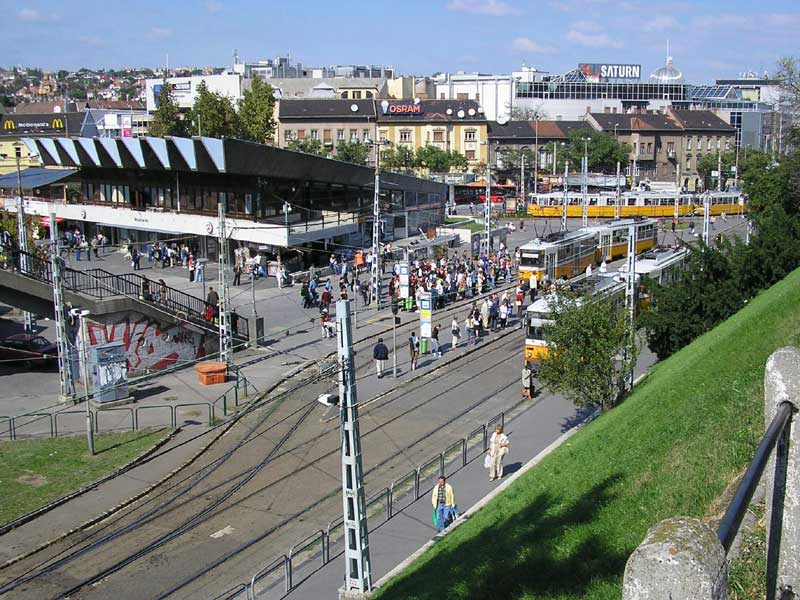
Mammut is depressingly like most other shopping centres in the world; glass, faux marble, lifts, adverts, toilets, predictable assortment of shops, cinema as you find in US malls; but it did have a supermarket in the basement and so I bought some apples and water (opportunity to try out Hungarian; seemed to work). I had by good fortune got hold of some sandwiches, a lunch which had been made up by our fixer in expectation of our timely arrival the afternoon before and handed out in the small hours as a welcome present. Being of the 'pack sandwiches and a flask' upbringing which had served me well over several hundred miles of hill walking, I'd brought them with me and now consumed an interesting mix of what I gradually realised to be soft cheese and paprika. By the time I'd finished, the people I came in with (and because my memory is still shot at this stage, I now can't remember at all who they were) had installed themselves in a Greek restaurant, which I tagged along with. Whether the following is a trait of Hellenic or Magyar cooks I am unsure, but by the end of the modest meal we had been given both complementary liqueur and watermelon slices by the staff, which pleased me much. By the time I was back on to the bus for the return journey to the hotel my sleep clock had returned to around the level of this time the day before - livable-with for now, but with short-term memory and some decision-making starting to suffer, wouldn't feel safe driving, etc. Startlingly, I recall being thrown into a rap improvisation somewhere on the way back and doing rather well at it, despite being on autopilot. That is to say, I appear - somehow -to have come up with some rhyme witty enough to raise a torrent of mirth and applause from my audience.
I decided not to try to sleep immediately but instead go for a wander round the neighbourhood. This ended up as having no sleep at all, although I can rationalise this in that I was doing moreorless alright at the time, and it would be better to sleep only at night. A large assortment of people were heading to a swimming pool at the end of the road (in fact it gives its name to the street; Pünkösdfürdő utca means 'street of the Pentecost Baths') so I moved with them. The street* had looked somewhat unattractive from the limited number of pictures I had seen prior to the trip, and indeed was still not the most endearing neighbourhood what with all the Soviet-era blocks and parched grass typical of Warsaw Pact suburbs, but neither was it a crime-racked dump (the 3rd district is considered one of the more affluent in the city) and it was quickly apparent there was no danger in walking the streets here. The Danube (the link is to a 360 panorama) dictated the end of the east-west street and beyond the point at which we stopped I could just make out the long island dividing the Szentendre channel from the river's main course. Just as I was contemplating striding over the mini-earthworks to have a proper look at the riverside (why am I so easily led away when there might be something interesting to look at round the corner?), a sub-group walked up to us and announced with visible annoyance that the open-air pool was closed 'because it had been raining earlier', something which was clearly not the case now. Anyway, there seemed to have been no possibility of persuading the place to re-open (I lacked the Hungarian to explain the shortcomings in this business model) so we set off back up the street.

And what should we happen upon, yards from our hotel, but a...bar.
Now this was in many ways a Good Thing, because hotel bars the world over are a rip-off, and now here was a place not two minutes' walk away where a korso of beer (about a pint) was 290Ft (less then £1) and the wine equally inexpensive. And it was also equally cheap to buy coffee - proper strong Hungarian kave like a double espresso in a little cup - which I decided then to be the best course of action. But- there's a butdo not be drunk at concerts and rehearsals. The climax of this paragraph is probably crashingly predictable. That's not to say everyone behaved irresponsibly, but let's not beat about the bush: people drank, some significantly, before a concert, which I just can't endorse as being advisable.
I've got a slight confession to make here. Having learned the 'ordering in a restaurant' section of my Complete Hungarian book, I bought my coffee using the vernacular, which pleased the barmaid greatly, This was overhead by a member of my party, who first tried to copy the sounds I told him would result in him getting beer, and then when this failed, me making these sounds to order his drinks for him. Having then clarified the vocab to my 'student' (he did pay, by the way) I can only assume I had now taught the entire orchestra the Hungarian for various alcoholic beverages, which somewhat contradicts the tone of the last paragraph. On the other hand, the bar staff understood the English terms too, so I'm not sure I really have much to be guilty about.
Actually, I didn't really stay long enough to find out. Having spun out the coffee and then increasingly abandoned any hope of conversation (Companion was nowhere to be seen, and I think she had done the sensible thing and slept for a bit) I quietly returned to my room to get concert clothes and other items necessary for the public performance of music on the violoncello. I do seem to have some kind of knack for leaving without being noticed when I want to, which comes in useful now and again. There is the usual rigmarole of forming-up in the lobby when departure nears; somebody is late, several people now rather merry, me glad I won't have to fight my instrument on to a bus this time.
 The journey through the suburbs is more familiar now and I can remember the route and landmarks from this morning, except now they are subtly different in the light of the late afternoon. It seems something of a mystery why there was no major school of Hungarian painting in the late nineteenth-century, for the quality of light would seem to be just as facilitating as that of Tuscany or northern France. Budapest castle was particularly conducive as can be seen from the pictures I took whilst we were waiting to enter the concert venue. The courtyard of the museum had a scattering of trees, statues and an old field gun which looked particularly good when framed artfully. There was also the strange intermingling of an English orchestra half in concert dress, instruments still in cases, mixing with the tail end of the Hungarian police, also half in uniform, half on ceremony. No conflict, you understand, but the sense of a transition between two very different cultures. Once we were inside the hall the atmosphere was relaxed. There was enough time to prepare for the concert gradually - indeed I sat and played through some Bach for a bit, partly to try and keep the skill in my fingers awake but partly for the hall's acoustic. Upstairs, the dressing room overlooked the northern side of the city, the Buda Hills (which I wanted to climb on the free day) and, perfectly installed as the foreground subject of a photograph, a single flagpole with the red, green and white flag of the Republic at its head. I waited until the breeze unfurled it against the sunset and pressed the shutter button for a 500th of a second. Perfect.
After a little conversation, I waited downstairs for us to walk on, gradually joined by the rest of the band. The hall had filled up considerably - in fact we were, to my delight, actually having to find extra chairs to allow the whole audience to fit in the hall. It was later explained to me that the concert was free and had been publicised hard by our Fixer, but this turnout was still something you would never expect in the UK, especially for a student orchestra. People simply don't care enough about the sort of music we perform back home, blighted by apathy, being told they must consider it snobbish and being too overworked to have enough time for culture. Tonight's programme: Beethoven Prometheus Overture; Haydn 'Clock' Symphony and Beethoven's Seventh. Perfect for the size of orchestra we're taking, and hopefully nobody will notice the second horn is actually a flugelhorn.
There is loud and warm applause from the assembled Hungarians as we enter. I notice something almost immediately - there is no conductor's podium. As I sit down in the principal cello's seat, I assume somebody must have forgotten bring it on and speculate how the Conductor will probably make a joke of having to carry it on himself. But no, here he comes, striding down to the semicircle of chairs with the projection of confidence that all musicians learn as part of our 'act', still with no podium in sight. Christ, I realise: he's actually going to conduct it from memory. The whole gig. All of it.
Now, as a sort of freeze-frame before the baton goes down, let's make it clear that I'm not, on principle, opposed to this. There is a long history of conductors doing ridiculously complicated pieces sans partition - Boulez and Rite of Spring is the most arresting example - but, as our conducting teacher impressed on us, the guy with the stick absolutely, positively has to have a completely watertight knowledge of the dots. It's a bit like overtaking: if you are even slightly in doubt about it, do not do it, because you have to be utterly certain there is going to be no possibility of failure. You will note that at this point I do not doubt our Conductor's intentions nor am I suggesting that he did not fulfil the above caveat; but the thing about Boulez and Rattle and all the others is that the musicians they had were crack professionals who had had as much rehearsal as they needed (admittedly that isn't much), had had normal sleep levels and knew the piece inside out. We were a student orchestra, doing this on our first, rushed, rehearsal in half a week, having had probably no more than about 6 hours' proper sleep in the last two or even three days and without having been forewarned of this. Oh, and did I mention some people had been drinking a couple of hours earlier...? What it comes down to is this: however prepared the Conductor might have been, we the players simply didn't have the mental resources at our disposal to deal with this at a whim, and cast aside our natural instinct that something was wrong here. What we needed in this situation was certainty and extra security. Just play it safe this time.
I won't lie: when the beat went down I was scared. Not quite as scared as the night I suddenly found myself speeding towards enough surface water to make my friend aquaplane into a tree a few minutes later, nor the occasion my housemate nearly choked to death on her own vomit after a horrific night's binge, but still decidedly uncomfortable. My thought process (sparing what mental RAM I could from the effort of translating dots into arm movements in my increasingly lethargic state) kept circling round 'I don't have confidence in the direction even though I should have, so I'm going to end up thinking about it so much and worry about making some massive error that I will actually make a massive error.' After a while I hit upon the idea of watching the leader rather than the conductor. I don't know if this improved my playing but it got me to focus enough that I avoided any serious mistakes and leading my section astray. I will refrain from speculating on how well other members of the orchestra were coping, although I couldn't spare much to watch for signs of danger.
There was, however, one definite high point, which was a truly extraordinary few minutes before the start of the Haydn symphony. For various reasons, one of our number, a gifted arranger, had made a version of the Tuba Mirum from Verdi's Requiem for nine trumpets, horns, bassoons and timpani. In the resonance of the hall it sounded like the end of the world, incredibly loud and spectacular and creating all the more astonishing an effect by segueing straight into the start of the Clock Symphony (the above video is, regrettably, not of us, but is about as close to conveying the awesomeness of the movement as any I could find. The Haydn began at 2'06). Incredibly (at least it seemed to me) we got through it all without communal mishap. I have no idea who bailed who out or if there was any bailing-out happening at all, but the Haydn danced along as it should (you know my opinions on Haydn) and the final chord was followed by as great a round of applause as had begun proceedings. We've made it this far - indeed a mantra that seems to sum up the tour.
Beethoven's Seventh was the second half. Yes, also directed from memory. The cello part is a monster at times with all the dotted triplet rhythms and string-crossing and it was probably a good thing I'd played most of it before, because I really wasn't enjoying the level of concentration I was having to put it by the end. This, too, was judged to be a success by the assembled throng, and meant we cold play an encore (I have little knowledge of how clap-happy audiences are in different countries, but am working on Hungarians needing the same quality of performance to demand an further items as we would back home).
The piece we played for the next three minutes changed everything. It made every event of the last three days worthwhile. The diminutive but perfectly crafted orchestration Béla Bartók made of his piano miniature Este a Székelyeknél contains little more than a few held notes for the violoncello section to play, but this mattered not. The simple melody, hung over a few carefully chosen chords, seemed to me far more poignant and pertinent than anything else I had heard in the concert. I don't know whether it was because it was closer to my own idea of what music should sound like, or simply that I had played and loved the piece in its many incarnations for years and years, but it caught my attention like nothing else, and offset every trial and setback we had suffered to get this far. And when we had finished, the audience simply wouldn't let us go, which I would like to think was because of their love of the piece and delight at hearing their own country's music, as well as for the rest of our playing. We bowed, the conductor bowed, walked off and back on; we stood up again, he bowed again; he stood up different sections individually, bowed again, walked off and on again, and still the whole hall applauded. I was thinking we'd have to play part of the Haydn again, but eventually we simply had to leave because we had a meal booked. I'm sorry, citizens of Budapest; we would gladly have played more but we were just too tired that night. Our appreciation of you is not diminished, rest assured.
It was dark by the time we were back on the bus. Dinner would be served presently on a river cruise on the Danube, although right at that moment I wouldn't have cared if it had been the nearest McDonald's because I was really starting to get hungry, a state in which I start to get profoundly uncomfortable in (an unholy alliance of metabolism and blood sugar levels if you must know, not helped by the potency of the coffee earlier). The civilised strains of the concert hall had given way to the furious noise of a student group gearing up for the evening, now amplified in the ugly acoustic of a MAN bus. I grabbed the frontmost seats and put the cello at the window side so I could grab it round corners. It turned out that we had a little time in hand, so before dinner we would drive up to the Citadella, on the great rock overlooking Budapest. I'd been up here on my last visit at night but didn't remember much apart from being told the place was crawling with pickpockets and quickly learning that there was no way I was going to take any serviceable photos with my primitive film camera in the dark. I'd been judicious with the cello, for the drive down Budai vár and up Gellért Hill to the fortifications felt like a rally special stage as we swayed round hairpin bends. I was first off the bus and followed our Fixer to the viewpoints. It was a clear night and here was the city spread out before me; the castle, the great river and its bridges, the dome of the St. István Basilica, the long avenues and lights of Pest and the peaks of Buda. I steadied my Olympus on some conveniently situated benches, turned the dial to 'night' and did the breathing-out thing to keep it steady whilst depressing the shutter. (The pictures came out alright). The rest of the group seemed equally impressed with the view.
Back onto the bus, noise level to bad-closing-on-torrid, and down the hill again, across the new bridge and along the embankment of downtown Pest. Presently we stopped somewhere upstream of the parliament building and were told not to get run down legging it across the road to a waiting river boat. It was a reasonably large vessel; bigger than anything you'd get up the Thames to the bit we'd come from, and on the lower deck we found a huge spread of hot and cold foodstuffs. I had to positively restrain myself from scoffing the whole table whilst the system for purchasing wine was explained. As it was after the concert, I had no qualms whatsoever about sharing a bottle of white with the friends I was sitting with, which turned out to be a very good decision because the stuff was delicious. As was the cuisine - I ate my first proper hot food in days; soup, meats, vegetable sides, cheese, fruit, all of it both welcome and satisfying. This was better. We shared the glasses of bőr around, me raising laughter by going through the motions of sniffing and chewing it (no, I don't know what wine buffs really get from these actions that you can't get just by drinking it normally) and made comments to the general opinion that the food was fairly excellent. Presently the deck cleared a little and we drifted upstairs, where our party were spread out round the open-sided observation deck. There were fantastic views to be had here to, albeit from a different angle, along with me obligingly photographing others to swell their Facebook albums (I really don't mind doing this though).
I was feeling decidedly better about things now, assuming that I would have a proper night's sleep ahead of me and that the rest of the tour would consist of spectacular concerts and memorable socialising and culture-soaking. OK, it's a shame one of our number vomited on the boat, and now enough individuals were fuelled with drink the din on the coach back was deafening, but I assumed this would be only a temporary foible. And yet...remind me, what's that quote about assumption from the (otherwise risible) film Under Siege?
Something was about to happen that would bring the whole chain of events to a head, and almost push me over the edge. But it happened after midnight, so it must wait until the next post...
Next time: Some decisive stuff happens, and I become intimately acquainted with the biggest acoustics in the world.
*This link is to possibly the most hilarious and pedantic blog I have ever come across, that of an irate Budapest resident who feels the need to share examples of outstandingly bad parking in his city with the world.
Wednesday, May 18, 2011
Mahler and me
Today, May 18th, is precisely 100 years to the day since Gustav Mahler breathed his last. This has chiefly been commemorated by musos through smart-arse Facebook statuses, something that I have wholeheartedly participated in. Top marks appear to have been taken by my former conducting teacher and doyen of Sunday-cricket , Levon Parikian (who maintains a superb blog, Runny Thoughts) for numerous witty gems.
But I'd like to talk seriously for a bit, if I may. I am, unashamedly, a Mahlerian. The core of his music contains a philosophy I agree with wholeheartedly (whilst still being just about able to appreciate why unenlightened people do not share my passion). For a start, Mahler's famous exchange with Sibelius (whom I equally admire) about the symphony 'being like the world' is at the heart of his conception of music, their very reason for existence. His symphonies don't last for an hour and a half or more just because they can, it's because they need such a time-scale in order to contain the hugely important and transcendent ideas he is trying to articulate. A Mahler symphony really is a world of its own, and possesses both an 'architectural' quality of form and an emotional range that journeys over a huge expanse of space. Interestingly, the equally lengthy symphonies of Anton Bruckner (who taught Mahler for a time) work in a completely different way, unfolding a concentrated nucleus gradually within a tight structural and colouristic scheme, rather than exploiting rapid changes from one particular extreme to the other as we are propelled through so many landscapes.
This last characteristic of Mahler's writing has been the cause of criticism, apparently too reliant on over-the-top, flashily orchestrated histrionics and 'ironic' symbolism within the musical material. My response is that; firstly, every note of his output is carefully crafted and coloured with exceptionally skillful deployment of the instrumental or vocal resources used; and secondly, Mahler's heart-on-sleeve approach to - well, everything in his music - is both provider of the individuality in his voice and the reason he is able to compare to the pantheon of great composers, for to play or listen to his music is to be utterly drawn into something that cannot help but have a compelling and profound effect, and it is the greatest music which creates the greatest effect. The hammer blows in the Sixth Symphony are not cheap film-music clichés, nor are they merely colouristic effects like the wind and thunder machines in Strauss' Alpine Symphony, they are the actual force the composer wished to depict, the mighty blows of fate striking down defenceless mortals.
I am a little uncertain as to when I first heard, and then really fell under the spell of, Mahler. I knew the Adagietto from the Fifth Symphony - probably the piece most people hear first - from when I was a teenager, but it was later before I became aware of the youthful exuberance and sweeping turbulence contained in the First Symphony, the Titan. Later still I discovered the rest of the Fifth, and then in my first year at university ULSO, the intercollegiate orchestra which I would soon join, played the Third, a concert I shall never forget. Aside from the sheer length of the work, I was completely possessed by the music, music that was more epic and more encompassing of everything than any piece I had heard before. I was lucky enough to hear the Third live again at last year's Proms, and relived everything I had felt the first time - from the doom-laden opening march, to the night-world of the fourth movement, the chorus of angels in the fifth and the almost unbearable depiction of complete resolution in the finale. But I think my most compelling Mahler experience was earlier in that year, when ULSO performed the Sixth in Cadogan Hall. Even after the read-through there was a feeling that we had been possessed by some strange dream, that we had lived the sound that was being lifted from the page. There is a moment in the finale where the turbulence suddenly subsides and the violins, harp and celeste leap up an octave out of the storm. It is as if one is suddenly lifted into the night sky and transported to a hillside under the stars, with cowbells and a solo horn glinting in the distance. I cannot think of any other composer who can paint so vivid a picture without the slightest mention of any actual programme in the score.
Earlier this year, I was lucky enough to take part in a performance of the Ninth Symphony, so like and yet so unlike any of the others. There was over a minute of silence after the last, faltering note in my section had died, the culmination (nearly) of not only eighty minutes of music, but a lifetime of vision as lofty as the mountains over the Attersee.
Saturday, March 19, 2011
Linkage
I almost certainly should have posted this sooner, but better late then never. St Andrew's University have created an entire section on their 600th Anniversary Composition Competition, so when an idle moment presents itself you can have a gander at what they have to say about my piece and the two I'm up against. Both my competitors seem to be considerably more experienced, not to mention a few years older, than myself, having had various works performed on Radio 3 and both having studied composition at music college. Also, my biography has been made rather short, not exactly bigging-up my comparatively modest achievements. Still, we are on an equal footing as far as the contest goes from now on.
I shall be travelling up to the concert forming the competition's final on 21st April. The orchestra have a month left to rehearse and, other than needing additional percussion parts, appear to have had no difficulties, which is a relief. The oft-told story of the disastrous première of Rachmaninov's First Symphony had entered my thoughts once or twice but I'm sure the orchestra and conductor will do a highly professional job. I am also determined not to interfere too much with the musicians' input into the performance - no last-minute alterations to the notes or outbursts of 'no, no NO, not like THAT!' during the final rehearsal. I do (generally) trust conductors, 'yer know...
Here's the main site for the competition: 600th Anniversary Competition
The concert programme
My piece: The Sun Rising
Saturday, November 13, 2010
One for the kids
Frankly, I think games console manufacturers have missed a trick.
By 'console' I speak, specifically, of the Wii (which I notice is now available in a 'Limited Edition!' red colour) and it's wireless controller. This clever little piece of electronic Japanese-ery allows the player to actually enact the movements their wish their on-screen avatar to make, rather than having to transmit their motor skills through pressing buttons. As a consequence, cars on the old Playstation that, despite one's most dexterous button-bashing, would always corner like Blenheim Palace, can now be made to follow the road almost effortlessly, without requiring the player to have the finger skills of a concert pianist. Sports games actually require a modicum of physical effort. Shooting games you can look down the gun. And so on.
However, one subject area remains untapped by the gaming industry, something the Wii was born for:
Conducting.
Frankly, the system is almost perfect for it. With a controller in each hand, the tempo and character of the music can be inferred by the console's motion-sensing system and translated into the playing of a virtual orchestra (who will, appropriate to Wii-person anatomy, lack legs and any apparent joining of limbs to body, but will still be able to hold instruments). Those familiar with the system will already have realised that the Wii controller is held in a near-identical fashion to the baton, further enhancing the learning curve for aspiring maestri. Players progress through several levels of difficulty, beginning with simple beat-keeping exercises (a Strauss polka or Sousa march), before progressing through larger excerpts of the orchestral literature which require multiple tempo changes and expressive gestures. (Additional bonus levels evoke more conventional beat-'em-up and shoot-'em-up gaming subjects, as the player uses the Wii controller first in 'negotiations' with the Musicians' Union over working hours, and then to dispatch airport security cretins who fail to distinguish between a trombone and a bomb).
The advantages are obvious: one no longer has to shell out to hire a full symphony orchestra and rehearsal venue, or the risk of egg meeting face for student conductors practising that tricky little corner in the finale of Bruckner Seven.
It will of course be necessary to have on the disc an appropriate selection of the orchestral literature, and more importantly for the computer to be able to interpret a wide range of gestures from the user. Fortunately the player will be able to use the setup menu to adjust the sensitivity of the motion sensors, which ranges from 'Klemperer' at one extreme to 'Bernstein' at the other. Be warned: the 'Gerghiev' and 'Rhosdesvensky' settings require additional CPU processing power.
As with any game, there exists the potential for all manner of cash-in sequels and 'expansion packs', and Wiiductor, as our creation shall henceforth be known, will be no exception. The 'Ba-rock! Expansion Pack (novelty wig sold separately) sees the player 'take on' the eighteenth century, first perfecting the Mannheim Rocket with a deft flick of the wrist, before progressing onto the court of Louis XXVXIVIIIII where the controller must be used to master double-dotted quavers without accidentally causing gangrene. The 'Stravinsky: Dissonance Unleashed' add-on culminates in perhaps the hardest level of all, the première of Rite of Spring in which aside from dealing with time signatures dreamt up by aliens, the player must dodge seats and other missiles hurled by the audience. (Gaming 'hack' rumour has it that completing this unlocks a secret level contining Le Marteau sans Maitre, which has been neither confirmed nor denied by the game's developers).
With the right development and marketing, I see no reason why this game won't be a best-seller. If ten million Chinese kids learn the piano, ten million Brits can wave the stick (even if it is comprised of invisible microwaves).
Subscribe to:
Posts (Atom)