Showing posts with label kettles of fish. Show all posts

Saturday, May 12, 2012

Small print


Dear customer,

Thank you for your booking. Please note that a surcharge will be added to your bill for any of the following requirements:

Performance of Pachelbel's Canon in D...........£20
Performance of Pachelbel's Canon in D truncated due to length of piece significantly exceeding time required to process down aisle and stand before alter, sparing couple and minister of religion present from having to twiddle thumbs whilst dry counterpoint works itself through................£30
Performance of Boccherini's Minuet in F..............£20
Performance of Beethoven's 'Fur Elise'  bagatelle............£20
Performance of (usually unfamiliar) pop song completely unsuited to ensemble/instrument(s) available, and which must be arranged prior to performance, making the best of a bad job........................£30
Piece/name of performer(s) spelt incorrectly or otherwise erroneously in programme/order of service............£10
Performance of All Things Bright and Beautiful as first hymn, as this shows a distinct lack of imagination.............£10
Venue's piano out of tune................£30
Venue's organ out of tune................£30
Use of recorded music for a piece I blatantly could have played...............£20
Accompanying of singer convinced their voice charms the birds from the trees, who in reality has only ever received feedback from close family members or other individuals too polite to break it to them that the death rattle of a chain-smoking porcupine is more melodious than their ill-tuned bellowing..............£40
Provision of seating too high/low/with arms/ otherwise unsuitable for a violoncello player...............£30
Provision of parking in muddy field resulting in inevitable application of soil to formerly spotless black car...................£20
Door locked after assurance via recent telephone call that it would be open..............£10
Timely invention of verbal response to comment(s) on how good/brave I am/we were,  managing to avoid outright impoliteness whilst making it clear that I/we kind of do this sort of thing for a living...............£20
Conversation with complete stranger on subject vaguely related to music.............£10
Conversation with complete stranger on subject not even vaguely related to music........£20
Either of the above when I really want to get home and consume steak and chips/watch The Killing/Southampton Football Club are leading Pompey 3-0..............................£35

Thank you for your custom.

Sunday, March 18, 2012

Neolexia

Things for which terms should exist, but don't:

  • The manoeuvre made by horn players whereby the instrument is spun around its centre axis several times until the condensation within dribbles out of the bell onto the floor.
  • The exaggerated follow-through gesture all string players, but notably cellists, make with their right hand after a pizzicato. There are varying degrees of this.
  • The dirty bit of the bow hair right next to the frog, which never sees either rosin or contact with a string.
  • That thing oboists and clarinettists do to clear water from a key, namely inserting a roll-your-own paper and blowing through the instrument in a faintly immature manner.
  • The duuu-yurrrrr-yumm bell-curve glissando commonly found in cockney music whenever trombones are involved.
  • The conductor's gesture of tapping the stick three times on the stand to get the musicians to shut up.
  • That quasi-arpeggio pattern of pitches trumpeters always do at the start of rehearsal.
  • The experience of only being able to play a rapid passage of notes correctly when one doesn't realise one is doing so.
  • The thing string quartet players (usually the leader) do where they nearly-but-not-quite jump up from their seat during moments of excitement.
  • A particularly necessary one: the layouts where the strings are laid out Vln1-Vln2-Vla-Vcl or Vln1-Vcl-Vla-Vln2. I use 'new/modern layout' and 'old/proper layout' in conversation but this can often confuse folks who have only ever seen the former.
  • The film canisters wind players carry and always have to go to the lavatories and fill with water to soak their reeds in.
  • The person who places the conductor's score, open at the first page, on the stand before a performance.
  • The person who presents the soloist with flowers (women) or booze (men).
  • A person who claps in the wrong place at the end of Sibelius Five.

Wednesday, February 29, 2012

Don't play it again, Sam

I get through a fair amount of piano music these days, with the various choirs, accompanying and other engagements I have.  Inevitably, one comes across things in piano music which are a little less than appropriate for the instrument, and so it's worth sharing a few to show that even the greats get it wrong sometimes.

At the risk of stating the obvious (which seems to be happening with increasing frequency on this blog), it is worth setting out clearly and briefly how the pianoforte works: The player presses down the keys and holds them there for the required duration of the note. This causes various components to move, releasing the damping mechanism and striking a hammer against the string(s), setting it ringing until the dampers are allowed to move back into place. What this means is that the only things the player can actually control are:
  1. The velocity at which the key is initially struck, and thereby the volume and tone of the note;
  2. The duration of the note;
  3. Whether a pedal is used to add or reduce resonance.
And that's it! The player cannot control the note after it has been sounded, cannot alter the decay of the vibrating string, and cannot alter the volume in mid-pitch.  With all this in mind, let's take a look at a few examples of absent-minded piano writing.

The first is this, from Dvorák's otherwise delightful Sonatina, Op.100:

Now that's just stupid, isn't it? As we've explained above, the note cannot be altered once it has been struck. So to expect the player to suddenly reduce the volume or the piano's natural decay to drop suddenly but then level off to produce this effect is silly. I have tried suddenly releasing the pedal but the resulting change in volume is mostly wishful thinking. I suppose what Dvorák was trying to show was that the pianist should be sensitive to the violin's fp when playing the E minor chord, but the fact remains that they can see it in the violin part above, and the effect is unplayable.

Sibelius next, and this from his own transcription of Finlandia:

Now, this is not necessarily an error. A pianist can play repeated notes quite rapidly (viz. Rachmaninov's celebrated Op.23 No.5 prelude) but it is inadvisable to write this many in succession, and not as a four-finger chord, especially bearing in mind the tempo of this passage. What makes it particularly fair game to criticise this, however, is that less than twenty bars later he writes the eminently more sensible:

The texture in the orchestral score this is derived from (trumpets, heavy brass) is near-identical in both bars, so it's not even necessary to differentiate between contrasting timbres.  The second version also reproduces the slight variation between chords one would hear from an orchestral brass section. 


Actually, I am loath to lay into this too much, as it's an otherwise fantastic transcription and actually reveals many details which are often overlooked in orchestral performances of this work.  Particularly striking is the variety of articulation markings in the central 'big tune', which may seem slightly odd in view of the lovely, but bland, legato lines so often heard.  There are also some dissonances which add interesting passing colour, yet are hardly noticeable when orchestrated.  Most of all, apart from the above example, the transcription is gloriously pianistic.  Not a small number of the articulations just mentioned correspond perfectly with where the fingers might need to leave the note early in order for the hand to move, and correct balence in chords and accompaniment figures is easy to achieve. Watch a better performance than I can currently produce here:http://www.youtube.com/watch?v=SaogrOWfnb8 (and he nails the repeated semis three times!)

Finally, a variety of piano parts for various pop songs, 'musical theatre' and show numbers. A lot of this music features successive complex chords - that is, damn near everything has a seventh or ninth or sus 6 added to it, resulting in waves of modal tone clusters which have to be splodged with the right hand (the left hand, meanwhile, usually plays some variant on successive parallel fifths to give the chords some semblance of having a pitch centre). I'm sorry if this is all a bit subjective and value-judgement-y, but I play a fair bit of this music and apart from finding it rather derivative and sentimental, it seems to completely disregard the principles of harmony and chord progression found in most tonal music.  The constant addition of extra tones to chords and the copious amounts of pedal required means the music is often just a mush of the same notes in different combinations ('all the white keys, all the time!') and lacks the variation in tension between degrees of dissonance.

Most of all, this results in some highly un-pianistic flailing about in order to play every single chord, because it seems making the notes lie at least reasonably under the hands just will not do.  A number from Wicked I've been doing with somebody recently has actually been harder to learn than the Polonaise from the Goldberg Variations, because despite its speed and hand-crossings, the Bach falls under logical fingering patterns and uses only one note per hand at a time. I realise much of this music is guitar-based, and these chords probably present themselves as relatively elementary if you have six strings and frets, but the piano is also pretty common in pop and stage music and thus should be written for accordingly. The fact that sheet music includes chord symbols as well as a written-out realisation (note to self: future blog post on similarities between this an baroque continuo) doesn't really make it any easier to play, as I seem to spend as much time groping for Cm sus2 (no third) as I would for some blobs on the lines.

Just as an example, consider the following. I need four fingers to play the first chord, and it seems logical to use 1,2,3,4 on it in order to use 5 on the semiquaver that follows. But reaching the chord on beat 2 is problematic. I'm now stuck with lifting the hand over my weakest and shortest finger to play the chord, making it impossible to have the fingers ready for it and make a smooth transition. Using another finger would break the legato between the first chord and the semiquaver.  About the best I can do in performance is shown on the right:

If the extra A were omitted, I could move the hand easily and play three acceptably smooth chords. As it stands, I risk playing a wrong chord entirely, due to having to scramble to get the little finger out of the way, and grab the third chord as quickly as I can, whilst using the pedal exactly for the purpose I was told not to by my piano teacher. There is simply no good fingering here.

But I'm 'classically trained'. What do I know?

Tuesday, February 7, 2012

The myth of elitism: Part 1

In this series of posts, I hope to demonstrate that the accusation that classical/concert music is 'elitist' is largely a myth and to propose some of the reasons why it persists.  In this first entry, several accusations commonly raised in the public sphere are rebutted.

Performances are governed by draconian rules regarding social etiquette.
Those 'rules' being: be quiet when the action's going on and (usually) don't applaud between movements. Not much to ask really, as it's little more than an extension of normal courtesy.  Exactly the same as for the theatre; the cinema; the minute or two minutes' silence for war commemorations; the memorial silences that seem increasingly common at the start of sporting matches; listening to any kind of speech or lecture; school classrooms; meetings; exams; funerals; watching snooker, golf, archery, shooting, chess and tennis matches; when an infant is asleep; and numerous other occasions. I suspect this taps into a deeper paranoia inherent in modern culture: we don't like being told what to do, we don't like being told our affairs are less important than something else, and we have a skewed idea of what actually deserves our respect.  But is it really too much to ask that you don't make unnecessary noise when the guy performing for you is working so hard?


Music is a pastime of the rich/'posh' people and is not 'accessible'
I have a pet theory that this is a self-fulfilling prophecy and influences public opinion simply because people keep crowing this tired line.  Surely not for financial reasons?  Show me a pop festival that lasts for two months and at whose every concert you can get within ten feet of its stars for a fiver.  Show me how many record labels offer eighty minutes of music for £6, how many bands offer a student scheme for concerts with a generous discount, and how many of them also allow their gigs to be broadcast free of charge on public radio and over the internet.  How much pop music is available out of copyright for free on the internet and has a massive online library to facilitate this?  How many professional bands are subsidised by arts organisations in order to keep ticket costs realistic?

There is no actual good reason why concert-going and music-making need be the preserve of the wealthy or the upper-class (not that this is even the case anyhow). Plenty of young people go to concerts at the moment, and by 'young' we do actually mean under-35's, including students and teenagers, and by 'concerts' we do actually mean the sit-down-and-hear Beethoven-and-Sibelius type, not 'classical club nights' as have been on the offering in London lately.  Admittedly a great amount of 'art' music was originally commissioned by wealthy patrons, but that hasn't stopped its successful presentation to mass audiences for a period of over 200 years.  Notwithstanding facts such as the huge number of people who attended Beethoven's funeral, concert music has had genuine popular appeal and genuine influence in recent times.  To take just a few examples: the 'message' of Shostakovich's Fifth and Seventh symphonies to Soviet audiences; Rostropovich's impromptu performance of Bach as the Berlin Wall came down and Bernstein's Beethoven that followed it, with the words changed; and projects such as El Sistema and the East-Western Divan Orchestra.  Importantly, it does not seem to take sides based on political persuasion or salary-level  either.  A recent account of the unlikely friendship between Occupy New York protesters and attendees at a performance of Philip Glass' Satyagraha at the Met drew the following from its author: 'the repeated myth of opera being elitist is one of the greatest lies of modern consumerist culture'. The fact that Philip Glass, classical composer, stood up and made a speech in support of the protest, at the risk of arrest, is surely the single biggest disproof of the 'elitist' myth to result from this happening. 

Finally, exactly the same accusation can be levelled at many other cultural artefacts. To take two examples, 'Gangsta' rap relies on a knowledge of a culture the fine detail of which is unknown to the majority of people, with its own dialect and - frankly fairly misogynistic and objectionable - subject matter. The Wire, a massively popular and (quite rightly) lauded television series, which is largely set within this culture, makes no concessions to the lack of specialist knowledge of its viewers and presents them with plot threads approaching the complexity of counterpoint, yet is accepted as being part of popular culture due to its subject matter and the form of its media.  Surely both these examples demonstrate the inconsistency of the accusation - if elitism means excluding those without sufficient knowledge of the cultural artefact in question, I think these examples would qualify as much as Bach or Beethoven supposedly do.

Only the rich can afford instrumental lessons for their children.
My response to this is two-pronged: First, learning anything costs money. Do we regard learning to drive as elitist because of the costs involved?  What about electric guitar and other 'pop' instruments' lessons?  Second, if you are lucky there was, and still is, public funding for music education, so anyone who objects to individuals' financial situations causing 'elitism' in this way should really blame the accountants and politicians who sanction cuts to music services. 

Classical musicians are snobs.
Some, perhaps, but the majority are just trying to earn a living doing something they actually like (we'll ignore for now those rank-and-file second violinists who 'gave up music years ago') and have the training for.  They have the same degree of work concerns as the rest of us - and often the additional burdens of hectic travel schedules and self-assessment tax returns - tempered by the satisfaction of producing a good performance.  The fact that some may ignore pop culture because they don't have time for it is not a personality fault and should not be regarded as a superiority complex. A brilliant essay by Aldous Huxley ('On Snobbery') points out that an individual can be a snob about almost anything - and also be a snob about not being/having something, too.  As an aside, I do not recall ever being tailgated by an aggressive second clarinettist who believes the new BMW his employer has just paid £35,000 for makes him a superior species to everyone else.

Culture of the past is not relevant to today's populace.
A slightly more considered accusation.  And yet still wrong.  Firstly, it stems from the mistaken belief that people in the past were more genteel, or more intellectual, or were somehow profoundly different in taste and mentality to today. History suggests that they weren't.  Most good jokes from the last thousand years are still funny today, because our sense of humour hasn't changed. (It also begs the question as to why 'intellectual' music should be more popular in the past when the average standard of education today is astronomically higher).  Secondly, although not universally adored, it would be foolish to think that modern society has no interest in the culture of antiquity.  A television adaptation of an Austin or Dickens novel, or Downton Abbey, will draw an audience of millions. The History Channel is a viable commercial entity as are cultural documentaries on other channels.  British Museum exhibitions frequently come close to selling out. Shakespeare seems to still be doing well as a crowd-puller.  In any case, great art can, and should, be able to stand even outside of the period it was written in. I do not see that it is really necessary to have more than a rudimentary understanding of eighteenth-century culture to enjoy, say, Mozart's music on its own.

Nasty squeaky atonal music is where is all went wrong. Classical musicians only have themselves to blame.  
Yes, if those modern composers hadn't been so selfish and instead had kept writing nice tunes it wouldn't have come to this, would it? I sense a whiff of shifting the goalposts here. On the one hand the music is accused of being old-fashioned, out of touch, not relevant to the times; and yet when it moves with the times (and serialism and its children probably did genuinely reflect the cultural mood of the times - hell, they invented eugenics and nukes in the same period) it's still not good enough. To be fair, I suppose there is some truth in this accusation; all the serialists safely tucked away in government-subsidised university departments could ignore public tastes and even act with outright hostility to them, which wasn't exactly endearing.  However today's contemporary composers are working in a massively diverse range of styles and influences.  In any case, there is comparatively little public rejection of equal doses of dissonance in such fields as cinema (where, ironically, grindingly dissonant music is not only accepted but near-essential to horror genres) and the visual arts.

Things like orchestras and ballet and art don't deserve public funding because they aren't popular. Public money shouldn't be spent on them when it could be used to give us cheaper council tax/cheaper petrol/more police on the streets.
Putting aside the sigh that inevitably results when encountering an individual with this attitude (which can be summarised as 'if it's not important to me, nobody should get it') this is largely a circular argument. If they were 'popular' (even though there is actually a healthy level of interest) they would make enough money on their own to not need public funding.  Ironically, if this were the case you'd probably be going to concerts and whatnot so you'd spend more on this than comes out of your tax at the moment (bear in mind many people will happily shell out hundreds of pounds a year for football season tickets).  I suppose if you don't care about culture it's very difficult to make the case for spending on anything beyond mundane practicalities, but it really shouldn't be a cause of contention given the minute amount each individual actually contributes to arts in real terms - it's pennies. As is often pointed out, state grants for the arts actually make money for the Treasury through ticket sales and employment, which means that we should really be talking about them as investments, not subsidies. If you're still annoyed I suggest looking down the back of the sofa and you'll probably be able to 'make back' what you've contributed.

Classical music is elitist because it's for 'intellectuals'.
This brings us back to where we started and also on to the next post in this series, as it opens up a wider problem, namely stigma of displaying intelligence. It's also a stupid way of thinking. I find it no more acceptable to dislike somebody for being intellectual than it is to dislike them for wearing a turban or having an artificial limb (and in my experience all of these bigoted mindsets can often be found in the same individual).  If you dislike people with intelligence that much you should be happy to do without iPods, auto airbags, microwaves and a plethora of other things they have given us.  And for the umpteenth time, the fact that somebody has a PhD and a professorship and likes Bach does not prohibit you from having the same taste. You can take what you wish from music without actually needing to understand or debate the finer academic points of it.  Note that; firstly, the same individual may also like pop and rock music, and that some of said pop/rock has also been subjected to serious academic study - does that curse it as 'elitist' too?  Once again it is a circular argument: classical music is 'only for intellectuals' only as long as you keep saying so.

Sunday, January 29, 2012

The Problem with Big Tunes

Everyone loves a great, memorable tune.  We're talking here not about just melody, but melody that can be elevated to being called a tune. Such things are usually tonal, regularly phrased, and featuring a melody-and-accompaniment texture, often chorale-like and generously orchestrated.  They are instantly recognisable, make audiences feel good and can assure a composer a place in musical history.  And yet they are also quite rare beasts.  So why doesn't every composer write one?

Well, for a start, coming up with a really good Big Tune is potentially a laborious process.  In a classic example of the symbiosis involved in composition, the effectiveness of the melody goes hand-in-hand with the skillful use of harmony - both must be devised simultaneously to compliment one another, Since a great number of Big Tunes are felt to arouse feelings of national pride or other gushing emotions, the achievement of sincerity in such an entity can only be achieved by a relatively narrow repertoire of gestures - for example starting with a stable harmony to establish gravitas, or later a move to the minor in one of the phrases, returning to the major as if in reassurance.  On the most simple level it can be hard to consciously set out to 'write a Big Tune like the one in [piece x]' and avoid sounding like a pale imitation of it.

Second, the definition of a Big Tune will confine a composer to a relatively narrow musical style unless the music is deliberately a college or pot-pourri of different influences.  Stravinsky couldn't simply introduce a four-square anthem into, say, Rite of Spring, as it would sound ridiculous in this context and be completely contrary to the aims of the music. 

Structurally and technically speaking, they present several problems. Chief amongst these is that the attraction of the thing is its completeness - that is, the tune is a sixteen-bar entity which one can sing along to and which follows recognisable lines.  This is fine if the tune is to be a thing-in-itself, but less so if it is to be used as part of a wider form such as a movement of a symphony. Percy Grainger's famous quip that 'the trouble with folk songs is that when you've played it once the only thing you can do is repeat it' rings true, for good tunes are awkward to do anything else with. The more memorable a tune is in itself, the more 'closed' an entity it is likely to be, probably ending with a nice neat cadence in the tonic.  For use in a larger form, it usually comes to just too satisfying and complete an end, meaning that the music has to stop and re-start, and that there is a lack of tension around which to build the remainder of the piece.  Apart from anything else it can be difficult to chop up the tune into smaller segments with which any development will be facilitated; particularly for the listener who, having been drawn to the piece by tune, will probably find the fragmented version less appealing than the initial whole. It is possible - the finales of Tchaikovsky's Fifth and Nielsen's Third, the first and last movements of Elgar's First and several parts of Dvorak's Ninth are famous examples that manage it by various means, mostly by following it with something contrasting and then eventually bringing the Big Tune back at the end to satisfy listeners.  Sibelius pulls it off in Finlandia, in oh-so-Sibelian fashion building the preceding material from fragments of the theme, then juxtaposing the last note of it with the start of the next section (cleverly avoiding the stasis that would have resulted from bringing it to a close) and finally presenting only the first phrase of the melody in the coda. Even when the theme is allowed to run in the central section of the piece it is carefully varied in orchestration and not allowed to become sentimentalised.

Actually, Finlandia throws up a number of interesting avenues related to this topic.  The work was originally introduced, in a slightly extended form, as the finale of the rather uninspiringly titled suite Music for the Press Celebrations.  As the general feeling of the time was explicitly nationalistic, it is no surprise that the stirring tone poem quickly became performed on its own as an anthem of independence, and was as quickly banned by the Russians for this reason.  With all this national feeling contained within, it was assumed that the work had been composed with the intent of being as 'Finnish' as possible and thus included national folk music.  Sibelius had to repeatedly state that both the theme and the rest of the piece were categorically not based on any folk-songs.  The assumption of this is quite telling.  Folk music is not all melody and even rarer still the neat four-in-a-bar, major-key type (Finnish music often features five beats in the bar).  Did the symphonic content making up the other 3/4 of the piece actually matter or would it have been enough to have just written the famous tune?  Was the big tune even written as a crowd-pleaser or just for structural purposes in the first place?  Sibelius went on to arrange the central theme for choir (twice, in fact) setting the patriotic 'Finland Awakes' and thus joining a tradition that continues to this day of putting words to likely tunes, appropriate or not.

And that brings us on to the English equivalent of Finlandia, and another issue with Big Tunes - they become appropriated for hymns, songs, 'crossover' cover versions, etc, regardless of the composer's personal beliefs or the original context of the cultural artefact - and also become overplayed.  Having seen his suite become a rare hit amongst his output, Gustav Holst eventually grew to hate the incessant elevation of The Planets to the neglect of his other music (despite it justifiably being his best work) and in particular the setting of the famous melody in Jupiter to the text of I Vow To Thee, My Country and its subsequent use at every kind of pompous nationalistic occasion. Apart from the fact that the work is more concerned with astrological connotations from Indian mysticism than the fruits of the scientific advancements of the European Enlightenment, Holst was both a pacifist and an atheist and conspicuously from an immigrant background - Sweden via Latvia.  He would have been either horrified by or, more likely, resigned to, today's appropriation of this melody by jingoistic military occasions and flag-waving nationalism, and the assumption that it was written by a Very British composer.  Elgar's Pomp and Circumstance March No.1 and the 'Nimrod' movement of the Enigma Variations suffer much the same problems.  Elgar was also born an outsider (a working-class Catholic, making the patriotic 'Land of Hope and Glory' text somewhat out of place) and the Enigma Variations written as a highly personal piece, albeit in a generally light vein.  Worse, in such an extended work as this, everyone wants to hear the Big Tune to the exclusion of the rest of the piece, and because the particular excerpt is what is most readily associated with the composer, they are in danger of alienating audiences with anything that departs from this.  Returning to an earlier example, if you only knew the tune from Finlandia, then Sibelius' final two symphonies and The Tempest music must sound mightily strange on a first hearing.  Holst put off audiences simply by not re-writing The Planets in subsequent orchestral outings, a perfectly natural thing for a composer to do.

There are two happy upshots from all this.  Film music manages to use the idea of the Big Tune more successfully, largely due to its role as accompaniment.  If the audience needs to attach a particular recognisable theme to a character then this is a highly effective way to do it without having to worry about symphonic development (which would be too distracting for the medium). Indeed, the skillful writing of Leitmotif that works both as a film soundtrack and as concert excerpts is what constitutes the craft of John Williams and similar composers.

Secondly, it had been demonstrated on numerous occasions (in fact the majority of frequently-performed symphonic output) that it is not at all necessary to write a Big Tune in order to compose a first-rate piece that will not only be melodic but have audiences positively singing along. Haydn repeatedly proves that motivic writing can still sound tuneful and produce a technically stimulating work. Verdi writes almost totally melodically, yet actual four-square tunes as described above are confined to one or two choruses per opera, maximising their effectiveness in music that sets out to be crowd-pleasing (yet loses no integrity or intellectual appeal in the process).

Edit: Curiously, contemporary pop music, which is also generally populist (if not by definition), seems to be equally shy of using easily memorable Big Tunes. With a few notable exceptions, it is older popular styles which tend to be more melodic, possibly as a result of their shorter evolutionary path from blues and music-hall genres, and the notion of a hummable melody is clearly anathema to punk, rap, metal and other such styles.

Sunday, December 18, 2011

Pianistic preferences

I am called upon to perform on both digital and acoustic pianos about equally in my working life.  Naturally, I press the keys on whatever is put in front of me without quibble, but if there is a choice I will always plump for a traditional acoustic piano. I have sometimes been questioned as to why, and at times this can appear a counter-intuitive option (I have played some pretty ropey pianos over the years) so I wish to make a case for why the traditional acoustic instrument is, at least in my experience, preferable to modern electronic keyboards.

We must begin by stating that electronic keyboards in general posses the following advantages:
  1. They do not go out of tune.
  2. If the function is supplied, they can be re-tuned to mean, Pythagorean, modal temperaments and baroque pitch at an instant.
  3. They are not susceptible to changes in temperature, humidity and movement in the way an acoustic piano is. In fact the only possible damage from these factors would be water ingress causing short circuiting.
  4. They are usually equipped with a moderate-to-wide range of timbral possibilities, albeit synthesised. This is probably the most significant advantage of the instrument.
  5. Other useful functions such as transposition and recording capacity are often fitted.
  6. They are cheaper to purchase, smaller and more portable than traditional pianos.
  7. On high-end instruments, the key and pedal action is weighted in an attempt to imitate that of an acoustic instrument, aiding the traditionally trained player. 
  8. They are easier to amplify as a PA system can be plugged directly into the instrument without the need for a microphone.
With all this in mind, one might wonder why anyone bothers with traditional pianos any more. By comparison, they are expensive to purchase and maintain properly, are difficult to move, can only produce one sound 'patch' and have no 'performance aids' other than three pedals and that the stool adjusts up and down.  Electronic keyboards work on the same principle as other electric instruments such as guitars: by creating a tiny sound (in this case small bars which are struck like chimes by the keys) and amplifying it, usually modifying the resulting wave as well. This means that a lot of delicate and temperamental components can be eliminated and replaced by circuitry. So why do I still prefer a 'real' piano?

Firstly, the instrument has a richness and sonority that is impossible to imitate digitally. Chiefly this is due to the effect of the strings vibrating in whatever acoustic space the instrument is played in, but also to do with the fact that the strings vibrate in sympathy with each other. The reason why this is nearly impossible to synthesise is that the additional overtones created thus, which depend on so many multiple factors - the exact notes played and the attack of each, what degree of pedals are being used, what strings may still be vibrating from the previous combination of pitches - that the memory and processing power required to store and activate the sample of each possible combination would be in the range of a supercomputer.  Even then, it is a difficult task indeed to make what is essentially an amplified glockenspiel sound like felted hammers hitting sets of metal strings.  The tone of electric pianos is almost always too fuzzy and boomy by comparison (a common problem with amplified instruments) and lacks the crispness one can get from a well-practiced staccato.  In addition, the percussive effect of the felt making initial contact with the string is difficult to synthesise, often replaced by sound of the plastic key thumping against rubber bearings and electrical contacts.  Pedal action remains a weak area, largely because of the above issue of sympathetic vibration and, on the other foot, so to speak, the fact that an una corda or due corde marking has acoustic implications far beyond simply reducing the volume a bit. I have yet to play a digital piano in which half-pedalling was at all satisfactory, and on most it was impossible as the sustain pedal was considered a binary switch which when on simply added a set amount of reverb.

As an addendum to the above, there are certain pieces which are absolutely impossible to perform on a digital piano as they require this sympathetic vibration as an essential effect. A piece titled simply 'Harmonics' in the fourth book of Bela Bartók's excellent pedagogical series Mikrokosmos is one example, requiring the player to depress keys without them sounding and then allow the strings to be set vibrating when other notes are struck. This simply could not be accomplished on a non-acoustic instrument.

The other, related, consideration is the feedback the player gets from the instrument.  Even the most sophisticated digital key mechanism cannot emulate the action of the 80-or so components that are needed to play even a single note on a strung instrument. When playing a real piano, one can directly feel, even in notes of short duration, something inside the instrument applying force to something else, changing centres of gravity and creating inertia, which provides valuable information on how the note will sound even before the sound reaches one's ears.  Electronic instruments lack much of this vital 'touch' due to there being essentially a short-cut in the action. (For much the same reasons, I dislike driving cars which have too much electronic intervention in the controls).  Furthermore, the key action often lacks sufficient resistance, meaning than when playing fast passages or using the position of one key to find another it is far too easy to accidentally sound the wrong note when passing the hand over it, as well as making chord voicing harder.  All these factors force the player to take time to adapt; whilst the musical results will probably not suffer having done so, it remains that the pianist is essentially learning a new type of instrument.

Finally, another issue which has not been satisfactorily solved by the manufacturers of synthesised instruments: volume. Not the amount of it, for most keyboards and electric pianos have a volume control in addition to touch-sensitive keys which provides more than adequate range, but the guesswork that must be undertaken to find the correct setting.  Of course this can be an advantage, as it allows the relative volume to be adjusted to suit a large or small space, but it is often a source of frustration when the player finds that what seems deafeningly loud to them comes across as feeble at the back of the room. A chief cause of this is that speakers howsoever positioned (usually under the main body or key rack) cannot synthesise a large soundboard reflecting string vibrations in a universal direction. As stated, this is less of an issue when a PA system with large speakers is connected to the instrument - but this instead creates the potential problem of the source of the sound being some distance away from the player and thus not in sync with the action of their fingers. When sitting at an acoustic piano one can always assume, to a reasonable degree of accuracy, what volume any given amount of force on the keyboard will produce.

The pipe organ is, of course, a separate instrument entirely, but has equally valid considerations in the electronic vs acoustic choice. A good full-size electronic church organ is as good as its traditional counterpart, but as far as I can see a small portable organ cannot compete - it'll simply never be as loud without excessive amplification.

Wednesday, December 7, 2011

What Happened in Hungary: Epilogue

And so we reach the end of the trip, essentially a run for home.  The sun was setting over the mountains as we joined the evening traffic heading west from Vienna.  After a few attempts I succeeded in snapping an 'Alpine Symphony cover'  - my term for any picture of mountainous terrain which would make suitable cover art for a CD of Strauss' masterly tone poem.  I put on some Sibelius chamber music and enjoyed a few drops of Hungarian white (albeit from a service station paper cup) as the day ended and Austria dissipated into darkness and artificial light for the second time in my travels.

I'm going to skip over most of the next twenty-four hours, as it involves the reliably tedious activity of sitting on a bus in much the same fashion as I have already described. If you really wish to get an idea of what this is like, imagine the monotony of driving at night but without most of the comfort/entertainment value of whatever car you usually inhabit.  A few incidental memories include my considerable annoyance in having to give a €2 coin to provide the c.€0.50 needed for the toilet somewhere in Germany, due to my inability to ask for change; and the delicious alacrity of changing drivers in the very same lay-by in Aschaffenburg where we had spent so many agonising hours on the way out. I suppose we may even have started a tradition of using this spot as a convenient changeover point, such that in the future the town may acquire a large bus station due to the actions of some nameless idiot of a mechanic who failed to check that an alternator wasn't about to be 'slightly on fire'.  I think, although I can't be sure, that I slept a little because I don't remember the transition from darkness to early morning, although I do remember that shortly after waking I noticed that the cars now had yellow license plates and there were a lot of cyclists on the urban roads, meaning that we had entered the Netherlands. we were only in the country for about fifteen minutes, crossing the very southern salient of the country around Maastricht and Genk.  Breakfast was at a dull service station somewhere short of Brussels, after a heroic five-hour night shift by our new driver had taken us all the way across Germany. I had coffee, some pastries and a waffle, although to honest you could have given me the packaging as I couldn't really taste much. Still no messages from home, although many false alarms due to the over-fastidiousness of my phone provider, thinking fit to notify me by text whenever I crossed into a new network area.

I remember looking at a faded map on a wall of Benelux highways with a friend and trying to work out where we were and how much further we were going. I do like to actually have an idea of where I am in relation to the rest of the planet's geography rather than being content with 'somewhere in Germany'. The obvious thought is to estimate how long remains: based on the outward journey and some dividers-and-compass navigation I try to work out what mileage remains through the Low Countries.  Perhaps another four hours to Calais?  It turns out to be about right: we hit queues going round Brussels (the absence of which prevented us being even later on the way out) and I remember having a long conversation with the fixer about my travel guide to Hungary. He remarked after reading certain passages that it was generally very accurate but that there were a few glaring errors, which brought him to the surprising conclusion that the author had some kind of pro-Jewish axe to grind. In general he seemed to note mine and Companion's level of perception. 'You are sometimes too negative' he remarked to me ' but you are the ones on this tour who know the most.' I'm not sure I shall ever forget these words.

Belgium became a barely distinguishable part of France and in another hour we rolled up at the Eurotunnel terminal in Coquelles.  Almost nothing now stood between us and home - that is, apart from the UK Border Agency, possibly amongst the most objectionable people in existence. Their recently erected fortifications at every point of entry to the UK are largely the result of panicky political rear-guard action (fend off tabloid hysteria about millions of asylum seekers hanging off the bottom of trains et al) and they serve little useful purpose other than that the passport control building usually incorporates a public urinal.  And no, I don't mean the inspection desk, although one could be forgiven for mistaking the contents of the two. Get in line, minions.

Lest this seem like disgruntled arch-libertarianism, there are two very good reasons why musicians should loathe border guards and state agents of all types: firstly the criminal actions of the soldier who shot Anton Webern and the US immigration official who ordered Britten to destroy his music for fear it was an enemy coded message - these types deserve every kind of slow painful death possible - and, secondly, that on a more general level their job (which of course they are 'only doing') is utterly incompatible with the remit of music and art. In a shameful display of knee-jerk reactionism, the acclaimed Iranian director Abbas Kiarostami was first refused a US visa to visit the 2002 New York Film Festival, then resigned a commission to direct at English National Opera after refusing to put up with the 'disgraceful' bureaucracy he was subjected to by the UK Border Agency (they were implying that he might disappear or try to claim asylum once here, withdrew his visa for no reason and forced him to give two sets of fingerprints to get another. The border police, presumably steered by the hand of politics, arrogantly refused to apologise for their procedures and trotted out the party line that this was necessary to catch criminals). 'It is the job of border guards and authorities to put up barriers, and it is our job to break them down'. It is the latter organisation I am forced to jump through hoops for now - and to whom I cheerfully wish all kinds of terminal illnesses upon - having to queue up and present a passport to a humourless drone, who seizes upon the chance to tell us what to do with some nonsense about not crossing a faint line on the floor, in order to enter my own country. This is all the more remarkable given that I have been able to cross what was the Iron Curtain without so much as leaving the vehicle. The cretins search the bus and berate the driver for not properly locking some minor luggage hatch - as if an illegal would have anywhere to hide inside the fully loaded compartment! I suspect they say the same to everyone, savouring their moment of power over others and the chance to get even with society just because their parents wouldn't let then stay up and watch Top Gear when they were small. (I think that's just speculation - ed).

Anyway, despite the best efforts of Kafka's field staff, we made the next train. Another half-hour in a tunnel, then another motorway except this was one I recognised, even felt familiar with, and so I knew how little of the journey we had left. It was only a few minutes before we pulled over at a dreary service area outside of Folkstone where I bought a sandwich, checked the nation was still at rights - oh no, wait, the Coalition are still on the throne - and felt a little depressed by the percentage of other customers who were of pensionable age. The next stop was Clacket Lane services where our fixer and his daughter were met a by a friend with a taxi, and went off to London for (presumably) tea at the Ritz with His Jenkinsness and some other fixer-y types. I knew the next forty miles off by heart and was once again cheered to recognise the bits of the North Downs Way going past.

We made as unceremonious a return as our departure.  The bus smacked over a speed bump (hopefully shortening its life expectancy a bit) and glided into a shaded car park.  I'd done the usual thing of stuffing al the possessions I'd spent the last day spreading about the cabin back into one bag, made a last check round and got off to retrieve my things.  I called Best Mate and asked him to bring the Meg over, as I knew how to fit all the cases in it. He was a little surprised I was actually letting him drive it, but he safely navigated the black Renault into a vacant space, got out and declared, simply, 'Brilliant'.  I said goodbyes to friends old and new, got the back seats down and loaded everything we'd brought on the way out as well as various unused drinks from the bus. In fact it wasn't really a farewell at all as quite a few people were coming back to the house where I was staying.

And that was pretty much that.  My sister gave birth to a little boy at about seven in the evening, just as I was sitting down to enjoy a chicken tikka masala with my companions, and I drove home the next day to be at somebody's birthday party and see the newborn child when I returned. Then I sat down at my computer, clicked to open Blogger on my favourites tab, and - well, you know the rest...

Loose ends

The previous posts in this series can all be found here: Day One; Day Two; Day Three parts One and Two; Day Four; Day Five; Day Six and Day Seven

I've put together an approximate chart of this adventure which you can view below. (Google Maps Maker is a marvellously adept bit of technology - I'd not used it before - and will automatically generate a path along roads from just a start and end point, even to the extent of recognising one-way streets, roundabouts and motorway ramps).  I have endeavoured to include placemarks for most of the locations mentioned in this account, whilst the rest should be obvious from where the lines start and end (zoom into Budapest, Eger and the Lake Balaton area).


View Hungary 2011 in a larger map

Other burning questions:
  • Was it really that bad sitting on the bus for so long? I mean, surely it would've been far more tiring to drive it yourself, even in some hired Teutonic barge with a humongous diesel engine up front?  You know, I couldn't have put the question more succinctly myself.  I suppose taking a private bus is non-stressful and reasonably comfortable.  However, I can't really recommend coach travel for more than a day-long journey.  There are many advantages to it, notably: no baggage weight restrictions; no extra costs for carriage of large instruments; having a vehicle for use once at your destination; still cheaper than all but the most budget airlines provided the group can fill the bus. However, there are a number of significant disadvantages - it takes much, much longer than flying and a considerable amount longer than same distance by car or train; usually necessary to drive through the night as a hotel stop will wipe out any cost advantage over flying; large right-hand-drive coaches (especially those with ski boxes) are less than ideal for negotiating narrow streets in foreign countries/Eurotunnel trains; coach toilets can fill up very quickly (particularly when members of your party spend much of the journey in very determined drinking), start to smell and cannot be emptied easily, meaning regular potty breaks are a must (as well as keeping to driving time regulations) which lengthens journey times still further; breakdowns are considerably more lengthy and costly than on modes of public transport. In addition, it got very cold and uncomfortable once we were stuck for the night.  On balance I would advocate that it is probably worth paying a little more to facilitate the 'jet and Transit' approach, whereby a van sets off with everyone's instruments to the destination a day or two early and the players then fly out to meet it there. It isn't a perfect solution by any means, but I have found it from past experience to be the best compromise.
  • Wasn't it a bit unreasonable to expect acres of sightseeing time on a concert tour, particularly one only a few days long?  Yes, I was probably a bit ambitious with my projected 'tourist' schedule. In Hong Kong, we had three concerts in over a week; Berlin the same in eight days. I should therefore have probably not been disappointed by the amount of time I didn't have to see Eger, towns near Balaton and many areas of Budapest, simply because it wasn't possible doing three gigs in four-and-a-half days.  The business of unloading a coach, setting up, rehearsing, changing, doing the gig and packing up again naturally takes up a considerable proportion of time in a day - and that's before factoring in driving two hours or more to the location itself. However I still want to re-visit everywhere again without an instrument in tow and my wristwatch weighing heavy on me, and actually have the time to appreciate everything.
  • Was the effort of learning (admittedly basic) Hungarian worth it? Let me be clear I didn't do it just to show off (ok, at least not to start with) and whatever the motive it was thoroughly vindicated.  I suspect my accent was moderately terrible. But every Hungarian I spoke even a few words to - shop vendors, toilet attendants, hotel staff, ticket windows - seemed delighted and gratified that I'd tried to learn their language. English visitors seem more and more to take the lazy and even contemptuous approach of not even bothering to learn any of the vernacular tongue when abroad. Of course we're not expecting fluency for a short visit, but Hungarian is not that difficult compared to, say, Cantonese or Bo, and even a few basic phrases will do wonders for goodwill and convenience.  Anyway, when members of your party come up and offer to pay for your drink if you'll order for them, you know you've done something right.
  • You went to Hungary before, didn't you? What did you think of it the second time around?  My fears that the destination would fail to live up to expectations were, happily, unfounded.  Hungary is one of the places that actually fulfils much of the myth-making I tend to do before actually visiting somewhere and did not disappoint.  Budapest is as beautiful as you can imagine. The lake we visited really did have milky pink waters at sunset. The food and wine were superb and plentiful.  What I was really concerned by was the notion that since my last visit Hungary would have become too much like Old Europe, and become filled with generic multinational-corporation adverts, fast-food and fast-coffee shops, cars and glass towers. Naturally I would not begrudge the old Warsaw Pact countries that which we enjoy under democracy, but neither would I like to see the individuality of a nation subsumed by outside influences. Happily, the balance between modernity and preservation seems to be about right. The EU flag sits aside the red, white and green tricolour on the town hall, yet the hall itself otherwise looks exactly as it did in 1900. Outside, a new Ford is parked in between a still-running Trabant and Wartburg.  The refurbished Metro 2 still runs old Russian-built stock (almost all clean as a whistle) with globular light fittings and chrome bars on the carriage sides. Of course, I did learn via our fixer several less proud aspects of the country - every nation has its embarrassing bits - corruption; heavy-handed authority; the government's treatment of ethnic minorities, in particular the Roma. But this is all outweighed firstly by the splendid treasure-house of cultural artefacts that Hungary, in all its various geographical stages, has left to the world, and secondly by those of today: food, wine and, still, music. It's a good country, as they go.
  • I'm getting the impression that you're starting to prefer holidays to tours. And quite right you are.  This is, for me, significant.  In the old days, I used to think that playing concerts put us above the regular tourists, as we were actually contributing something to the host country above buying stuff with foreign wealth. Now I'm not so sure. Having had the financial and cultural means to take both normal holidays and participate in tours, I am starting to feel that if I visit somewhere new, it should be for the purpose of actually seeing the place and appreciating it properly.  Beside, I get enough playing done at home that the attraction of doing it in front of a foreign audience has diminished somewhat - although the fact that most other countries do not share the UK's philistine attitude towards concert music is still a draw. 
  • I can't help thinking that all your mithering over others' drinking was somewhat over the top.  Look, I consider myself pretty liberal and certainly don't delight in moralising at others.  I have no problem with people getting completely cream-crackered as long as it doesn't bother me. When somebody whom you have never exchanged even a greeting with suddenly explodes into your personal space at an ungodly hour of the night, however, I consider it quite reasonable to tell him in no uncertain terms where he can stick it and what is going to happen if he doesn't. In addition, I was rudely awakened to the fact that even a group with a cultural purpose can still behave like louts, somehow flirting with two apparently contradictory worlds.  Probably the most apt metaphor for this less admirable aspect of our visit was the (nameless) individual who opened the bus' emergency door to vomit on a World Heritage Site.  Another, who is otherwise a fine tenor, thought fit to walk over a car and apparently narrowly avoided arrest for it. I've said before that the English in particular have a literally fearsome reputation abroad. Other countries get merry and (usually) manage to refrain from causing carnage. Why can't we?
  • How have you been able to remember all this? Other than having a reasonably exceptional memory and a penchant for noticing things in general, I was writing notes-cum-prose most of the way which totalled about 40 pages in all (my handwriting isn't particularly miniscule). I tend to keep such a document quiet, as on announcing one is writing a diary people tend to assume it's full of gossip-y personal stuff (rarely the case but not unknown) and then get rather disappointed when it's a description of an interesting coloured duck on a bridge or what I had for dinner. Which brings us to...
  • This blog has been going on for ages and the posts are massive!  One does one's best.  Not including this coda - no, in fact, let's include it - the word count is a healthy 29,000 words over nine posts, give or take. Obviously I've not written this all in one go, although sections were already formed in my mind even before we returned, but I've stuck at completing it and thus it's probably about the most complete account suitable for the medium. I could have written even more detail, given the time, although I think without a real plot it would have been a little unsuited to this breakthrough into novella territory.  Still, I judge it all to have been worthwhile via the message from a composer in the US who '...immensely enjoyed [the] blog, by the way. It is engaging and very readable.'
  • Did your wine get home safely? Yes, thank you; indeed it did, largely due to the absence of dealings with any jobsworth baggage handlers. I sampled the white as an accompaniment to a chicken-based meal some time ago and found it as agreeable as the first time. But, as I stated at the time of purchase, the '08 Merlot is being saved for a very special occasion...
Vislat.

        Sunday, October 23, 2011

        The golden rules of blogging

        1. Always post something interesting

        This goes without saying, really. I happen to seek 'interestingness' in everything even if its precise definition is somewhat woolly.  Perhaps it means less regular updates, but hey, quality not quantity. 


        2. Never post something that people can get elsewhere

        There must be millions of blogs about fashion, dogs, aimless musings on life and other trivia. Why would the average surfer pick one over another?  On the other hand, if you write quality material about Gambian and Senegalese stamp collecting, your life as a deckhand on a ship made from recycled chair legs or, in the case of ITM, classical music and other unique tidbits, it is more likely your blog will be unique enough to attract a small but regular band of readers.

        3. Check your facts

        Laziness in researching a subject, credulity that leads one to unthinkingly reproduce myths and a general lack of scrutiny blight much journalism today.  When done well, this point often feeds nicely into #1, for research often throws up further interesting facts and ideas.

        4. Check presentation, spelling and grammar

        Again, goes without saying. There's a spell-checker in Blogger, so it's not unreasonable to expect its use, along with a few minutes proofreading.  I find sloppy editing a real turn-off, although I would tentatively suggest that we should allow one error every now and then just to convince oneself the prose has been written by a human. Likewise, the layout of content should be condusive to readability and consistancy of style.  (Incidentaly, I've inserted one spelling or grammatical error in every sentence of this item - post any spotted in the comments box).

        5. Never link to anything unnecessary

        Very tempting to pepper a post with all manner of links - less easy to find the best one to illustrate the point.  Links should provide something the text can't, be that a picture, a diagram, more specialist knowledge of a subject or simply an interesting aside.

        6. Care about what you're doing

        This covers all the above.  Unsurprisingly, if I were to draw up a 'golden rules of composition' or indeed of anything I suspect they would be remarkably similar to the above.  When it comes to quality, the same principles apply to most things.  In short, good blogging is that which is professional, necessary and done with integrity.  All of my favourite blogs in the sidebar stick to these principles, and I strive for this one to do so too. 

        Friday, September 30, 2011

        What Happened in Hungary: Day Five

        The Independence Monument
        Monday morning arrived and with it my usual cup of strong coffee.  This was the only day of the tour we'd not be playing a concert, meaning I could lighten my bag down to a modest selection of stuff I'd actually need rather than all the extras for music. We finally were able to use our English bus, meaning I could resume my seat behind the driver on the lower deck. (Upstairs would probably have given better views but most people had gravitated to where they'd sat on the way out, meaning there was no room and anyway, I like to sit close the the road if only to be at the level of everybody else in the city streets). The morning's sightseeing tour was most welcome and reminded me once again of the last time I'd been here. I also took great advantage of having a far superior camera on this visit and photographed most things of interest and a few 'arty' shots (might have got a bit snap-happy at times).  First we went back up to the Citadella to see the city in the day, and, with the aid of an artillery piece as a prop, our Fixer explained the hammering Budapest took from both sides at the end of WWII and the construction of the massive pillar at the top of the hill. It is often mistakenly referred to as the Liberty Monument when in fact it's no such thing - it's the Independence Monument and it was largely erected by the Soviets. Next, Buda castle and all the associated paraphernalia (Matyas Church, History museum, Fisherman's Bastion) nearby. Sheesh, it was narrow enough coming up here on a 'normal' bus the other day, let alone a gigantic six-wheeled twin-decker.  We hopped out through the emergency door (wrong side of the road, remember) and were given half an hour to wander round the hilltop; not really enough as Companion and I had to write off going inside the church (I've been before, lots of effigies of dead kings and usual churchy stuff) and still hurry round the battlements. I took great delight in finding the statue of Zoltán Kodály, still sitting on the end of a bench, cigar in hand, which I and several other members of my youth orchestra had been photographed with seven years ago. Companion went for a comfort break whilst I looked round the cobbled streets and painted houses and then the giant eagle overlooking the city next to the Museum.  At the other side of the square there is a balcony overlooking the Buda Hills (the climbing of which is another thing I won't have time to do...) and a row of Hungarian flags which were most photogenic.

        Back on to the bus, and down the hill again to cross the river into Pest.  Budapest is, unsurprisingly, made up of Buda and Pest (and technically also the area round the hotel called Obuda, 'Old Buda') with the former being old and castle-y and the other being metropolitan and very Austro-Hungarian Empire. We will omit the Soviet bits in the suburbs.  The metropolitan-ness was immediately apparent in the number of grand mansions and the trams running on the river embankment.  It was wonderful until both the road and said tramway had to pass under the pillars of the Széchenyi Chain Bridge (a scaled-down version of which I crossed in Marlow on my Thames Path adventure) in a very narrow tunnel with a bend in it. Large buses are equipped with reversing cameras but not ones indicating the roof clearance and so the drivers had to trust that the suspension was down at lowest. Even then there was an added problem of the tunnel having buttresses at the sides which forced us into the middle of the road. You can imagine how pleased many Hungarian commuters were at our creeping forward through the cavern.  Once out (without any further damage to the ski box) we headed up the river towards the commendably over-the-top Parliament building, based on the design of our own seat of democracy. I hopped across another tramway to hear the history given by our Fixer on the 1956 uprising, something I remember well from my last visit and GCSE History.  There is a block of pink marble containing an eternal flame as a monument to the Hungarians killed in the street fighting, although it might as well be for the entire nation whose hopes of greater freedom had to wait another 35 years to be realised.

        The reminder of this most important event makes me consider what the country actually is and was. Hungary seems to have been for most of its history both proudly individual and yet under some kind of foreign hold - the lesser name in the title of Austro-Hungary, ostensibly an independent country yet under the grip of Russia, a people and language whose origins lie far from Europe. And yet one thing that I was delighted to find on my return here was that Hungary today is both a modern state and yet has kept outside, depersonalising influences at an acceptably low level. There are comparatively few signs in English compared to the touristy bits of Italy or Greece. People drive foreign makes of cars but closer inspection reveals they are mostly models actually built in Hungary or Romania. Corner shops and supermarkets are not all owned by Tesco or other foreign chains. Hungarians, for the most part, keep their culture their own. We rolled through more of Pest, more sights, more life, past the Synagogue and the Eastern Station and round the football stadium, and more and more I liked it here.

        The end of the little tour came when we rolled into the car park next to Heroes' Square and the driver performed a superb feat of reverse parking the massive bus.  We were now free for the rest of the day - no, you read that correctly. The plan was that the bus would stay here and then take people back to the hotel at 6 so they could change for dinner and then a possible visit to the Gödör Klub (which is actually, and I'm-not-making-this-up-actually, pronounced Giuuuuurdduuuhhhh).  This was, luckily, optional and I had every intention of staying in the city all day to maximise my sightseeing time. Possibly slightly dazed by the onset of boundless freedom, our party all drifted in the general direction of the bright yellow Széchenyi thermal baths (Mr Széchenyi was a prolific lender of his name to public building projects, it seems), which wasn't a bad idea as they were a good way to spend the afternoon and they had a small restaurant. We hacked out a plan for the afternoon over lunch - she would go for a swim and I would go exploring before meeting up and climbing over Margit sziget (Margaret Island), then use various modes of public transport to meet the people going to the hotel and back.

        Companion and I agreed on a time to re-convene and went our separate ways. I was, if not exactly as gleeful as someone who has been given the keys to a garage full of powerful automobiles, considerably relishing the chance to actually get some sightseeing done at my leisure. The first thing to do was to descend a rather unassuming set of concrete steps in the corner of the park.  A clue to what made this seemingly mundane entrance rather more special was the yellow wrought-iron sign above them which read 'Földalatti'. This is a nickname that's become almost an official term, rather like using 'Tube' for 'Underground'. In fact the analogy is a perfect one, for what lies at the bottom of the steps has quite a few names: the Millennium Underground, the M1, 'the yellow metro', MillFAV, but the sign above the entrances translates endearingly as 'little subway'. Stand back from the platform edge, there's a (small) train coming.

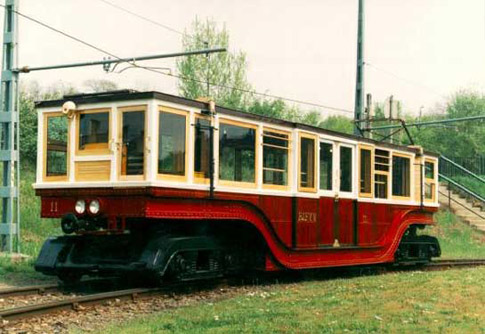
        I rather like sampling the public transport systems of foreign cities, especially if they have an idiosyncratic style and some historical significance, and Budapest's certainly qualifies on both counts. For a start, both the metro line and the street above are a UNESCO World Heritage Site (the only underground railway to hold such status) and recent restorations have preserved the stations' Art Nouveau look - wooden panelling and the glazed ceramic tiles which had been found to be such a good material on the only subway that preceded it, London's Metropolitan. In fact the Földalatti of 1896 was in some ways more advanced than the Metropolitan Line: it was built as a proper underground railway, not just a mainline that went in a tunnel through the city centre, it had electric trains from the very start and the engineers did a very clever job of fitting the whole thing in between the street above and the sewers below (the track is only 3 1/2 metres below the tarmac). You can see how narrow the tunnel is by the fact there's practically no platform - the train carriages only have wheels at the ends and the floors sit just above track level.  It's pity that the current rolling stock are dull Soviet-era boxes, for the original cars were as lovely as the stations - those belonging to one of the two companies originally running the railway had mahogany cladding and included a private carriage for the Hungarian emperor and the royal family (I doubt the London Underground has ever had a 'Royal Train'!). They have one preserved in working order, and still get it out for a special trip down the line every now and again.

        I bought a day pass for considerably less than the London equivalent and stood on the southbound platform at Széchenyi fürdő. A boxy little yellow train breezed in and played a jingle when the doors opened (not quite so nice was the harsh buzzing sound when they closed) and then proceeded down the line. I decided to alternate between subway and surface so I got off at Hősök tere and walked along the avenue to Bajza utca (try pronouncing that after half a bottle of Unicum), then M1 another stop to Kodály Korund, where Andrassy út starts to get interesting.  The avenue was built in parallel with the Földalatti as a grand boulevard from down-town Pest to the gardens of the Varosliget, and is a reminder that at the time Budapest was as modern and prosperous a city as London, Paris or Vienna, being the centre of the huge Austro-Hungarian empire.  The ornate and sometimes over-lavish residences along the avenue and its side streets cancel out any notion of it having been a provincial backwater or Soviet-era concrete jungle, at least in this part of town.

        I felt not only safe but remarkably at home strolling down the quiet service roads separated by trees from the main 6-lane highway.  Having said all the above, I started to think that the overall architectural style was a mix of borrowings from other capitals - the arches and mansard roofs of the Parisian streets, columns and porticoes from Italy and the stone and plaster walls in a more Germanic fashion. Presently I came to the first 'sight' of the street (assuming on is walking towards the river) the House of Terror. This is the former HQ of the secret police where first Communists, then Fascists and finally anyone who was politically problematic would end up for questioning and worse.  Further down, beyond the busy road intersection of the Oktogon and the long, thin Jokái tér, was the next Millennium Underground station to be named after a landmark - the Opera.  Budapest obviously needed a landmark opera venue what with all the rich music-making going on there, but the Viennese faction prohibited it from being grander than that in the imperial capital and so it's not quite as large as it might be.  It's still pretty ornate, with decorated ceilings and a statue of Liszt sitting in an alcove with a large book, as if he's waiting for it to stop raining. I had a peek into the foyer, which did not disappoint either.

        Further along, Andrassy út ends at a junction with Bajcsy-Zsilinszky út (I'll get back to you about the correct pronunciation of that) and so I detoured a little to see the Szent István Basilica, the city cathedral of Pest. I'd been inside on my last visit and thought about going up the dome but decided it would be better with more time so I made do with the outside and went back south towards Erzsébet tér and eventually arrived at the riverside. The M1 ends near here at Vörösmarty tér so I'd have an easy journey back up to the baths to meet Companion.  Where I'd ended up was the far side of the Széchenyi Chain Bridge (leading over to the castle and the tunnel under it) and Roosevelt tér which had a great view of said castle and the funicular.  Downriver to the left were the Citadella and the modern Erzsébet bridge. I wandered round the nearby streets onto Vörösmarty tér - and then it was time to get back on the little yellow train for nearly the entire length of the line back to the baths.

        Liszt, outside the Opera
        Companion arrived presently, looking very refreshed - in fact the water seemed to have given her almost a glow from all the minerals it contained.  I related to her all that I'd seen and she though it remarkable enough to warrant looking for herself, so with another day pass in hand we went straight back down the line several stops to see the Opera and mansions and whatnot before returning - again - to Széchenyi fürdő.  The next part of our journey was to get the tram to the north-west to Margit Island. I had a good idea of where the closest stop was so we set off across the park, past the funfair and the whining, ancient trolleybuses until we came to a stop on the side of a major thoroughfare. Because of the space available to post-war town planners, the tram lines run in the space between the two carriageways and thus the tram stops are in the middle of the road rather than adjacent to the pavements. I could see the stop but no obvious way to reach it. There was no bridge and no sign of a tunnel (and tell me, do you really want to use a subway in a rather less attractive part of an East European city?) and the traffic was coming fast; at least 70km/h.  Worse, the road layout was a large free-flowing junction with flyovers and ramps.  We got across two subsidiary lanes reasonably easily but had to wait ages on the verge whilst the near-constant traffic on Hungaria Körut sped by.  Eventually some combination of factors engaged to create a big enough space for us to leg it across the road and tram line, over the grass and onto the island platform. And imagine my annoyance at seeing at the far end there was a subway after all.

        The No. 1 came shortly and we got on board the yellow and white vehicle, standing at the rear of the middle car of three. It was an old tram, probably built well within the Communist era, slow and with firm suspension under the high floor, but with plenty of character and surprisingly quiet.  It rumbled through four or five stops until we got off on one side of Arpid hid, a long bridge over the river. There's no traffic allowed on most of Margaret Island so the bridge incorporates the entrance to a car park at the northern end.  The island is long and thin with a bridge at each tip, and trails all over its woods and gardens. It is Budapest and yet not Budapest and has had various uses in its history; a convent, a harem, formal gardens, a diving complex, an art galley, hotels and a running circuit. We soon came to a bandstand by the fish pools which seemed to play music even in the absence of a band and then the water tower which peeps above the trees. It was too late for it to be open but had it been we could have ascended the stairs and taken some great pictures of the city from the top.

        The rest of the island is mostly either woods or gardens. A steady stream of joggers came past on the perimeter path so we headed down the middle of the island, past a ruined priory and the diving complex.  There's a music festival held on the lawns every year although the island was peaceful at the moment. Eventually after about an hour's wandering we came out onto the other end by a fountain that played to the musical accompaniment of Kodály's Háry János suite.  From there it was a short walk to catch the No.4 tram on Margit hid.
        Parliament building from Margaret Bridge/ Margit hid

        The new tram was huge; in fact they're the longest in the world.  We were only going down the road to the Nyugati pályaudvar (western station) and could almost have just walked down the tram.  From the Italianate façade of Nyugati it is only a few stops on the M3 to Deák Ferenc tér.  The line is completely different to the Földalatti - a full-size metro in proper 1970s Soviet style, complete with ancient-but-clean Russian rolling stock. It was nearly dark when we emerged from the underground station and sat in the square trying to make contact with the rest of the orchestra. A couple of text messages and several circuits of Erszebet tér later we found our friends coming along the street by the St István basilica. From there we went en masse to find our dinner. I need hardly add I had walked perhaps seven or eight miles and my stomach was really on empty by this point.

        The restaurant was an amazing place. I remember describing an all-you-can-east buffet near Atlanta as a temple of food, but this beat that back several miles.  The décor was ultra-cool, the tables packed and the servery was piled with every type of food you can imagine and many you can't.  There were entire separate areas devoted to sushi, salads, Hungarian specialities, cakes and breads.  And the food was, genuinely, extremely good. I must admit I did feel slightly underdressed for the occasion.  Companion and I had waltzed in wearing walking shoes and with rucksacks, water bottles and such like, and sat down with a satisfied but weary we've-had-a-nice-trip-but-the-feet-hurt-a-bit-now-and-we-wouldn't-mind-some-National-Trust-tea sigh whilst a number of the others who had been back to the hotel were in elegant evening dress (actually, it was mostly the girls).  On the other hand, they'd been unadventurous, I thought.  Anyway, let's go through what I ate...

        First up was a bowl of gulyas soup with some bread the likes of which I'd never had before.  I was so hungry this was gone before most people had even got back to the table. Next I decided to go for all the Hungarian stuff including braised duck and red cabbage, delicious Hortobágy-style meat pancakes, paprika chicken, all kinds of stuff.  This was washed down with wine and water in equal measure.  Now I was into my stride I had, for contrast, a sushi course (California rolls; the big ones with the red eggthings inside; the prawn's tail on a block of rice; copious amounts of wasabi and ginger so you can feel it come through my nose).  Next was another cold course, a sample of all the various game and meat - veal roulades, miniature pies, pastries, interesting cheese creations, exotic salad.  I could have had ox tongue as well, but coming from a northern background I'd been eating this since before I could walk so it wasn't really anything special (to my amusement several people seemed to think it was something to nom because ohmigod thats like so disgusting i cant believe it ive got to have it just to say that i ate some, which i thought was faintly ridiculous).  I was considering winding up the hot courses and starting work on the deserts when somebody - who will remain nameless but will nonetheless have my eternal gratitude - made it known that the grill had shark!  I was over there in a flash.  'Seretnék cápa ak afrikai hars...harc...oh, the catfish thing!' I cried with considerable relish (that is, I ordered it in a manner that I relished, not that I had it with Gentleman's Relish or a similar condiment) for they did indeed serve African Catfish, cooked before your very eyes. The two types of fish were subtly different; the shark more meaty and strong and the catfish softer and more subtle, like plaice.  Nom-nom-nom.

        A short pause after I had put the fish away to sip more wine. Now for puddings (and if you haven't been keeping count, I am now on my sixth course).  I took a bowl and proceeded to sample - as well as I can remember - a generous portion of profiteroles (I didn't take more than other people; the portions were just generous by default), a nice little chocolate and icing thing called an Esterházy cake (which makes it on my list of Musical Foods for the Haydn connection), and some tiramisu.  I may also have been offered more profiteroles when this was finished. Finally, watermelon slices and other fruits.  Some people would die from just looking at that much food. I had simply been very, very hungry when I started.

        Although I'd considered it at times I'd never really been that fussed about going to the Gödör*.  I was pleased that my decision was eventually justified on two counts: first because even at not-yet-11pm there were nasty-looking characters hanging around outside and people who were scarily drunk (and not in a merry plate-stealing way like our lot; they really weren't cheerful) and second because everyone who went said it was a massive disappointment - apparently there was no live music (some reports say no music at all) and most of them dispersed home or to other centres of entertainment in a short time.  I found a few other folks who were equally disinclined and headed through the cosy streets and not-so-cosy drunks back to our waiting bus outside the Basilica. We had the front of the top deck to ourselves, which I always like (especially on the London buses which have panoramic windows up top) and could see the streets and avenues of Pest by night.

        Next time: Some people play music using sandpaper, and we put a big coach on a small boat...

        * Gödör means 'pit' and that's what the club is: a former underground bus station under Erszebet tér which has now been turned into a multiplex music venue.