Yesterday I was able to travel to London and go to the Science Museum. Whilst such an undertaking may seem ill-advised on a Saturday in school holidays, I needed to visit now because it was my only chance to see Universe of Sound: The Planets, an exhibition featuring Esa-Pekka Salonen and the Philharmonia performing Holst's eponymous suite, as well as a new commission from Joby Talbot entitled Stars, Systems, Worlds, Infinity. All this was intended to demonstrate the workings of the symphony orchestra and its constituent instruments, and as such each section of the orchestra has its own curtained 'chamber' with the surround sound and video matched to give the impression of sitting amongst the players at that location.
I'd initially been alerted to its existence by a friend who is working as a guide at the exhibition, and who was very pleased to see me there. It turned out I'd fortuitously arrived during a lull in visitors (apparently it can become quite busy with families, and indeed the installation was extended by a month to cope with visitor numbers) and was able to try my hand at percussion in Mars and Venus, playing along to the suite. This is harder than it might seem even for a seasoned performer, not least counting tens of bars in rests or held rolls and then coming off at the right moment (snare drum technique is also not nearly as intuitive as it looks). Anticipating that many visitors will not necessarily read music, there are helpful video screens in which players from the orchestra explain what you need to do and guide you in with the help of some Guitar Hero-style graphics. I gave the tam-tam a resounding whack and then played some gentle glockenspiel notes before my guide showed me over to the conducting pods. 'These are really cool' he explained, demonstrating how the motion sensors would detect my hand movements as I followed the beats on the 'conductors-eye' screen. The simulator is limited to controlling volume and showing accuracy of beating; the music will continue even if you stop and there is no way to control tempo or interpretation. (I suspect no current technology is sophisticated enough to interpret the nuances of a conductor's direction in the way human players do, and indeed the facial and non-beating gestures I made were pointless). But it is a good way of demonstrating what the conductor must do.
Even as somebody who regularly plays in several orchestras there was a great deal of interest in walking round to a different section to my own, and hearing the sound of the orchestra from another point - wind, brass, organ. The curators had helpfully put out the instrumental parts in their respective chambers for those who could read them, so I would spend each Planet following what I though was most interesting - harps in Saturn, upper strings in Uranus, horns in the Talbot piece. Possibly the most interesting part was a split-screen showing variously the horn, bassoon, trumpet, violin and timpanist. Below them was a continuous commentary of their thoughts as they were playing the piece (presumably transcribed from listening through afterwards). This included a little banter over virtuosic passages, but also fascinating insights into the actual business of performing the music - the trumpeter explaining how the repeated notes in Mars became uncomfortable to play by the end, the violinist explaining how he watches both the conductor and the leader at once, the timpanist counting rests and the conductor watching his stick. The most touching was the principal horn trying to articulate what it was like to play the solo that opens Venus, how she just let herself play it and trusted she had judged the acoustic of the room and the other players that followed her. It was a wonderfully intimate moment to see the other players responding appreciatively and her satisfaction at performing what was essentially just four notes, but notes of such significance which had been entrusted to her. Next to this screen was another showing Esa-Pekka Salonen conducting and, in a similar vein, his thoughts on the music and its merits. 'In two minutes he has changed the character utterly' he mused, a little after the aforementioned horn solos in The Bringer of Peace. Also insights into the business of conducting: 'Muti used to watch for the brass players' embouchure to place the downbeat - sometimes the conductor is led by the orchestra'; 'what makes the rhythm avoid becoming repetitive is that he is always changing what is happening around it...sometimes it's 3+2 and sometimes 2+3...you have to be very controlled and not get carried away by the excitement of the music'. Best of all; 'the sound of the symphony orchestra...something you cannot get from anything else' and 'People who don't really listen to classical music, don't know much about the orchestra - they still know The Planets'.
I must have spent nearly two hours - two complete performances of all the music - in the gallery and eventually left back through the clocks and hourglasses to eat lunch. I was very pleased to discover that although a little out of the way on the first floor, the installation is right above the main ground floor gallery which is open to the roof, and so Holst was being broadcast right over all the cars and steam locomotives and rockets where most of the museum's visitors were. Whilst one might, being critical, wonder what a piece of music based on astrology is doing in a science museum, I am tempted to include this brief summary of the exhibition in my 'myth of elitism' series, as it is yet another laudable method of opening up to the public the joy and wonder of classical music and the amazing worlds of sound created by the orchestra. The Planets, although overplayed in parts (I'm thinking especially Mars and Jupiter), deserves the fame it has achieved, and has always been a favourite piece of mine, particularly Neptune with its glittering textures, chilling dissonances and that extraordinary use of voices (something I pay homage to in A Child of the Snows, and which also featured in the Talbot piece). I hope Holst's music, for all his later misgivings about its popularity, will continue to bring many more souls under the spell of the orchestra.
Having picked up some reduced-price chamber music from Chappells (I wanted a score of Holst, but they only had big ones which were overpriced) I then raced home and got back in enough time to see the Olympic Torch being carried through my city. Yes, it was historic. Yes, we all briefly felt part of something big, proud that our largely unremarkable town was a small part of a huge event. But I have to say I will remember the exhibition with more affection than the minutes spent on a street corner, with all the vapid sponsors' stooges faking a party in the drizzle and finally a man with a surprisingly small gold stick running past in few seconds. For all its ceremony, the Olympic relay felt ordinary and mundane; Holst, by contrast, seemed otherworldly and transcendental, filled with wonder and fascination. Better still, it is more accessible. One does not have to wait in the rain or fight through a crowd to experience the music, it is available to anyone as long as there are ears to hear it. That, surely, is the more lasting and generous legacy?
Showing posts with label orchestral. Show all posts
Showing posts with label orchestral. Show all posts
Sunday, July 15, 2012


Tuesday, April 17, 2012
The concert
A week ago I had the chance to take part in one of the many Titanic commemorative events taking place around the country. We've already covered how closely linked Southampton is to the ship, so it was quite appropriate that the City of Southampton Orchestra were doing a special concert in the docks. It was a good one.
We all, orchestra and choir, dutifully arrived at Dock Gate Four on Monday evening for the rehearsal. I'd long wanted to drive past the barriers at the entrance and go inside, so was very pleased to be let through and allowed to drive along the access road to the cruise terminal. It was a pretty rough night, strong winds and heavy rain heightening the machined, industrial character of the place with everything either floodlit or picked out by small points of light. This whole area is artificial, concrete deposited into the Solent at the end of the nineteenth century to expand the port, and is imposing rather than picturesque; conceptually united, if we can be generous enough to suggest an artistic element in discussing it, by the fact that most objects are very big. On the left is the smaller Ocean cruise terminal, whilst ahead to the right rows and rows of Hondas and, in a car park MINIs. After crossing a single track of railway line, a huge diesel locomotive looms up alongside the road, sitting somewhat ominously with its lights on and coupled to a rake of auto-carriers. Cars are a major import here, but there are also giant rolls of cable, dumper trucks and, at the end of the promontory, two huge grain silos.
After driving a good half-mile, I find the venue. The concert to be held in the grand arena of the Queen Elizabeth II cruise terminal, next to which is the exact spot Titanic sailed from and where Cunard liners still depart from to this day. The building is a bland modern block, which is a particular shame as what preceded it was the wonderful 1950 Ocean Terminal, built in Art Deco style with modern innovations such as power gangways to the ship and conveyor belts for luggage. In an exceptional act of cultural vandalism, Associated British Ports bulldozed the entire structure on inheriting it via privatisation of the docks in 1983. Had it survived, it would actually have made a fantastic venue for the museum if it weren't for the commercial interests of the port keeping the public out. A few rare pictures of it are here.
In fact commercial interest has struck again, as our previously arranged parking spaces inside the terminal had now been grabbed as storage by [German luxury automobile manufacturer*] meaning we have to fight over the space outside. I'm lucky and get Meg about as close as possible to the door outside in the inclement weather. Inside the long shed the first 100 yards is a parking and drop-off area, bedecked with Union flags and about 100 new saloons and coupés, still without registrations and with protective plastic and factory tracking numbers attached. There must have been close to a million pounds' worth of middle-management tailgating equipment in there. No time to gawp, as we now have to locate a means of getting up to the departure lounge on the second floor. After fruitlessly trying to find stairs I eventually opt for walking up a static escalator. My first impression of the concert room is that it's not particularly inspiring. It's basically an airport lounge but with comfier chairs and a lack of marked-up shops. There's a marginal attempt to acknowledge the heritage of the site with reproduction posters of the White Star and Cunard liners, and models of the QE2 and Queen Mary, but this is very much a place that exists for waiting in to go somewhere better. Unlike at the time of the Titanic, or even fifty years later, there's little attempt to dazzle the passengers with luxury from the moment they arrive. It's symbolic of the fact that nowadays, as with flight, cruising and ship travel is a practical rather than a prestige-minded industry. Expense definitely gets spared in the current climate.
Still, there's a semicircle of chairs for the orchestra and risers for the choir, and the lounge seats have been arranged in quite a lot of rows for an audience of considerable number (we sold out a month ago) so it at least looks like a concert venue. There are some windows on the far side overlooking the water but not much of a view apart from some cranes and the Hythe pier, and the rain hammering away outside and the white of the waves breaking. Incredibly there are more cars parked outside on the quayside, so if you're thinking of buying one bear in mind that it might have been left exposed to the elements on a Southampton dockside for an indefinite period of time. Presently the majority of the orchestra and choir arrive and we begin the rehearsal with Depart...to depart, a new piece which has been specially written for the occasion and will receive its première tomorrow night. The first issue was to turn off the noisy heating system, which took some minutes, in the process of which the fire alarm was set off, quickly being joined in rhythm by the percussion section. About half the choir started to get out quick and had to be called back whilst the rest and the orchestra just laughed and waited for it to be silenced - we were clearly not 'slightly on fire'. 'This is all part of the general 'danger' theme of the concert...' remarked the composer of the first item. I can't really comment much on what went on for the rest of the evening, suffice to say that we rehearsed the new piece (which I like) for a bit and then moved on the the Sea Symphony (which I liked even more). We had the soloists here tonight, so the plan was basically to run the whole thing and only stop if necessary. The additional noises of the rain, seagulls and particularly the wind whistling through the roof made for a rather atmospheric performance. Out in the gloom ships would roll past the windows, constellations of lights rising and falling together. I have to say I got more than a flavour of what it must have been like to sail on the Titanic through the dark of the North Atlantic.
Tuesday night was completely different - sunny, a little damp from previous precipitation but bright and the sea calm. I parked up at about 5.30 at the foot of the grain silos with the rest of the orchestra, and got a few pictures in before anybody security-looking might have seen me and made a fuss. There was a truly enormous car carrier moored at the other side of the dock, ramp up and ready to depart.
Rehearsal was necessarily brief, as the audience were starting to queue up outside. A female reporter and her cameraman burdened with equipment stayed for a bit to film the orchestra and choir for the evening news. They got two takes of the opening of A Sea Symphony, which not only gave a flavour of the concert but provided an excellent of shattering the idea that classical music is all quiet. We top and tail a few bits before there's a tea break. Quick, the punters are coming in.
Practice over, I wolfed down the sandwiches we'd been supplied with for tea and took the cello downstairs, taking great delight in romping the wrong way through the security room unhindered with it. It was time to entertain the crowds with some jolly numbers from the White Star Line Song Book (and Nearer, My God, to Thee). The 'palm court' was a corner of the room with some trees that almost resembled palms, but not quite well enough. In fact this hardly mattered as there were plenty of other distractions for the waiting audience; chiefly the bar, but also four giant ship's funnels that had made an appearance at a previous Titanic-related concert; costumed actors and actresses and us palm court musicians ourselves - when the trombonist arrived and we could start, that is. The conductor gave my arrangements of I Do Like to Be Beside the Seaside and The Glow-Worm (no, I didn't think many of you would remember that one) several outings, interspersed with other bits and bobs he'd arranged from the WSLSB, which made the now-arrived trombonist jolly pleased as he could have multiple goes at the duuur-uuur-ur! glissando I'd written.
Thirty minutes later we all run back upstairs to do the rest of the concert. It's a full house: we sold out a month in advance. Our conductor, John, enters the podium and allows Ian to introduce his piece Depart...to depart, with an explanation of all the different songs from the different classes of the ship he's based the piece around, as well as the sounds of the Titanic's whistle and machinery and other parts of the ship depicted in the music. I rather like it actually, and we give a good account of the dots for ten minutes or so. After the applause there's some faff time whilst the choir come on, which a chunk of the audience take as a cue to re-visit the bar. We also put some jobsworth carrying buckets past the stage in his place so he doesn't disturb the rest of proceedings. One settled down again, there's a dedication-cum-prayer by the Dean of Southampton remembering those on the ship and all who work in the port (this goes on a bit). Then Mark Oldfield and Jane Streeton, who are our vocal soloists, enter to more applause. Now for the main event - once the seagulls on the roof have shut up.
John is on the podium. The brass and horn sections all have instruments poised ready for the downbeat...
BAAAAAAAAA!!! BA-BA-BA BAAAAAAAAA! BAAAAAAAA!!!!!!
'BE-HOLLLLLD.......the...SEAAAAA!!!!' CRASH!!!!
And so begins surely one of the best openings to any symphony ever written, let alone somebody's First. The general aim of this is to knock people clean out of their seats with the volume and splendour of it all, in much the same way as the Verdi we did on tour. After all the luscious strings and blowing brass the piece moves on to a faster bit, then the baritone enters, then...well, space does not permit a blow-by-blow account of the whole piece, you'll just have to listen to it all. There are two - three, in fact - very good reasons for choosing to perform this other than the above; first, it's British and sea-related; second it was composed at around the same time as the Titanic was built; and thirdly, the Walt Whitman poem Vaughan Williams sets in the first movement includes the most apt lines for this week of commemorative events:
'Token of all brave captains
And of all intrepid sailors and mates
And of all who went down doing their duty'
The last movement the symphony is Mahler-length, nearly half an hour, and deals with the ongoing quest of geographical and metaphysical exploration. Its opening is vast and cosmic, the first bit of sustained reflective calm in the whole symphony, later more exotic and questing as the text demands. In places it's almost like high-quality epic film music, at others one can hear clearly how much of a French influence the composer picked up (one achingly lovely passage accompanying the solo baritone is scored for muted horns, solo flute, oboe, cor, clarinet and solo violin and viola). The coda is a stroke of genius, with a false ending suddenly restarting as a gradual fade-out on two, then a single chord which is lost in the heights of the choir and the depths of the celli and basses. Trust a seagull to nearly ruin it...
It was a triumph. The orchestra played superbly; the choir were perfectly tuned and by turns gloriously powerful and magically subtle. Best of all, we have had mountains of messages and emails praising the performance. I'd like to think that somewhere, far away, the Titanic's band were listening, cheering us on...
We all, orchestra and choir, dutifully arrived at Dock Gate Four on Monday evening for the rehearsal. I'd long wanted to drive past the barriers at the entrance and go inside, so was very pleased to be let through and allowed to drive along the access road to the cruise terminal. It was a pretty rough night, strong winds and heavy rain heightening the machined, industrial character of the place with everything either floodlit or picked out by small points of light. This whole area is artificial, concrete deposited into the Solent at the end of the nineteenth century to expand the port, and is imposing rather than picturesque; conceptually united, if we can be generous enough to suggest an artistic element in discussing it, by the fact that most objects are very big. On the left is the smaller Ocean cruise terminal, whilst ahead to the right rows and rows of Hondas and, in a car park MINIs. After crossing a single track of railway line, a huge diesel locomotive looms up alongside the road, sitting somewhat ominously with its lights on and coupled to a rake of auto-carriers. Cars are a major import here, but there are also giant rolls of cable, dumper trucks and, at the end of the promontory, two huge grain silos.
After driving a good half-mile, I find the venue. The concert to be held in the grand arena of the Queen Elizabeth II cruise terminal, next to which is the exact spot Titanic sailed from and where Cunard liners still depart from to this day. The building is a bland modern block, which is a particular shame as what preceded it was the wonderful 1950 Ocean Terminal, built in Art Deco style with modern innovations such as power gangways to the ship and conveyor belts for luggage. In an exceptional act of cultural vandalism, Associated British Ports bulldozed the entire structure on inheriting it via privatisation of the docks in 1983. Had it survived, it would actually have made a fantastic venue for the museum if it weren't for the commercial interests of the port keeping the public out. A few rare pictures of it are here.
In fact commercial interest has struck again, as our previously arranged parking spaces inside the terminal had now been grabbed as storage by [German luxury automobile manufacturer*] meaning we have to fight over the space outside. I'm lucky and get Meg about as close as possible to the door outside in the inclement weather. Inside the long shed the first 100 yards is a parking and drop-off area, bedecked with Union flags and about 100 new saloons and coupés, still without registrations and with protective plastic and factory tracking numbers attached. There must have been close to a million pounds' worth of middle-management tailgating equipment in there. No time to gawp, as we now have to locate a means of getting up to the departure lounge on the second floor. After fruitlessly trying to find stairs I eventually opt for walking up a static escalator. My first impression of the concert room is that it's not particularly inspiring. It's basically an airport lounge but with comfier chairs and a lack of marked-up shops. There's a marginal attempt to acknowledge the heritage of the site with reproduction posters of the White Star and Cunard liners, and models of the QE2 and Queen Mary, but this is very much a place that exists for waiting in to go somewhere better. Unlike at the time of the Titanic, or even fifty years later, there's little attempt to dazzle the passengers with luxury from the moment they arrive. It's symbolic of the fact that nowadays, as with flight, cruising and ship travel is a practical rather than a prestige-minded industry. Expense definitely gets spared in the current climate.
Still, there's a semicircle of chairs for the orchestra and risers for the choir, and the lounge seats have been arranged in quite a lot of rows for an audience of considerable number (we sold out a month ago) so it at least looks like a concert venue. There are some windows on the far side overlooking the water but not much of a view apart from some cranes and the Hythe pier, and the rain hammering away outside and the white of the waves breaking. Incredibly there are more cars parked outside on the quayside, so if you're thinking of buying one bear in mind that it might have been left exposed to the elements on a Southampton dockside for an indefinite period of time. Presently the majority of the orchestra and choir arrive and we begin the rehearsal with Depart...to depart, a new piece which has been specially written for the occasion and will receive its première tomorrow night. The first issue was to turn off the noisy heating system, which took some minutes, in the process of which the fire alarm was set off, quickly being joined in rhythm by the percussion section. About half the choir started to get out quick and had to be called back whilst the rest and the orchestra just laughed and waited for it to be silenced - we were clearly not 'slightly on fire'. 'This is all part of the general 'danger' theme of the concert...' remarked the composer of the first item. I can't really comment much on what went on for the rest of the evening, suffice to say that we rehearsed the new piece (which I like) for a bit and then moved on the the Sea Symphony (which I liked even more). We had the soloists here tonight, so the plan was basically to run the whole thing and only stop if necessary. The additional noises of the rain, seagulls and particularly the wind whistling through the roof made for a rather atmospheric performance. Out in the gloom ships would roll past the windows, constellations of lights rising and falling together. I have to say I got more than a flavour of what it must have been like to sail on the Titanic through the dark of the North Atlantic.
Tuesday night was completely different - sunny, a little damp from previous precipitation but bright and the sea calm. I parked up at about 5.30 at the foot of the grain silos with the rest of the orchestra, and got a few pictures in before anybody security-looking might have seen me and made a fuss. There was a truly enormous car carrier moored at the other side of the dock, ramp up and ready to depart.
Rehearsal was necessarily brief, as the audience were starting to queue up outside. A female reporter and her cameraman burdened with equipment stayed for a bit to film the orchestra and choir for the evening news. They got two takes of the opening of A Sea Symphony, which not only gave a flavour of the concert but provided an excellent of shattering the idea that classical music is all quiet. We top and tail a few bits before there's a tea break. Quick, the punters are coming in.
Practice over, I wolfed down the sandwiches we'd been supplied with for tea and took the cello downstairs, taking great delight in romping the wrong way through the security room unhindered with it. It was time to entertain the crowds with some jolly numbers from the White Star Line Song Book (and Nearer, My God, to Thee). The 'palm court' was a corner of the room with some trees that almost resembled palms, but not quite well enough. In fact this hardly mattered as there were plenty of other distractions for the waiting audience; chiefly the bar, but also four giant ship's funnels that had made an appearance at a previous Titanic-related concert; costumed actors and actresses and us palm court musicians ourselves - when the trombonist arrived and we could start, that is. The conductor gave my arrangements of I Do Like to Be Beside the Seaside and The Glow-Worm (no, I didn't think many of you would remember that one) several outings, interspersed with other bits and bobs he'd arranged from the WSLSB, which made the now-arrived trombonist jolly pleased as he could have multiple goes at the duuur-uuur-ur! glissando I'd written.
Thirty minutes later we all run back upstairs to do the rest of the concert. It's a full house: we sold out a month in advance. Our conductor, John, enters the podium and allows Ian to introduce his piece Depart...to depart, with an explanation of all the different songs from the different classes of the ship he's based the piece around, as well as the sounds of the Titanic's whistle and machinery and other parts of the ship depicted in the music. I rather like it actually, and we give a good account of the dots for ten minutes or so. After the applause there's some faff time whilst the choir come on, which a chunk of the audience take as a cue to re-visit the bar. We also put some jobsworth carrying buckets past the stage in his place so he doesn't disturb the rest of proceedings. One settled down again, there's a dedication-cum-prayer by the Dean of Southampton remembering those on the ship and all who work in the port (this goes on a bit). Then Mark Oldfield and Jane Streeton, who are our vocal soloists, enter to more applause. Now for the main event - once the seagulls on the roof have shut up.
John is on the podium. The brass and horn sections all have instruments poised ready for the downbeat...
BAAAAAAAAA!!! BA-BA-BA BAAAAAAAAA! BAAAAAAAA!!!!!!
'BE-HOLLLLLD.......the...SEAAAAA!!!!' CRASH!!!!
And so begins surely one of the best openings to any symphony ever written, let alone somebody's First. The general aim of this is to knock people clean out of their seats with the volume and splendour of it all, in much the same way as the Verdi we did on tour. After all the luscious strings and blowing brass the piece moves on to a faster bit, then the baritone enters, then...well, space does not permit a blow-by-blow account of the whole piece, you'll just have to listen to it all. There are two - three, in fact - very good reasons for choosing to perform this other than the above; first, it's British and sea-related; second it was composed at around the same time as the Titanic was built; and thirdly, the Walt Whitman poem Vaughan Williams sets in the first movement includes the most apt lines for this week of commemorative events:
'Token of all brave captains
And of all intrepid sailors and mates
And of all who went down doing their duty'
The last movement the symphony is Mahler-length, nearly half an hour, and deals with the ongoing quest of geographical and metaphysical exploration. Its opening is vast and cosmic, the first bit of sustained reflective calm in the whole symphony, later more exotic and questing as the text demands. In places it's almost like high-quality epic film music, at others one can hear clearly how much of a French influence the composer picked up (one achingly lovely passage accompanying the solo baritone is scored for muted horns, solo flute, oboe, cor, clarinet and solo violin and viola). The coda is a stroke of genius, with a false ending suddenly restarting as a gradual fade-out on two, then a single chord which is lost in the heights of the choir and the depths of the celli and basses. Trust a seagull to nearly ruin it...
It was a triumph. The orchestra played superbly; the choir were perfectly tuned and by turns gloriously powerful and magically subtle. Best of all, we have had mountains of messages and emails praising the performance. I'd like to think that somewhere, far away, the Titanic's band were listening, cheering us on...
* Hint: It's not Mercedes-Benz, Audi, VW or Porsche.
Sunday, March 18, 2012
Neolexia
Things for which terms should exist, but don't:
- The manoeuvre made by horn players whereby the instrument is spun around its centre axis several times until the condensation within dribbles out of the bell onto the floor.
- The exaggerated follow-through gesture all string players, but notably cellists, make with their right hand after a pizzicato. There are varying degrees of this.
- The dirty bit of the bow hair right next to the frog, which never sees either rosin or contact with a string.
- That thing oboists and clarinettists do to clear water from a key, namely inserting a roll-your-own paper and blowing through the instrument in a faintly immature manner.
- The duuu-yurrrrr-yumm bell-curve glissando commonly found in cockney music whenever trombones are involved.
- The conductor's gesture of tapping the stick three times on the stand to get the musicians to shut up.
- That quasi-arpeggio pattern of pitches trumpeters always do at the start of rehearsal.
- The experience of only being able to play a rapid passage of notes correctly when one doesn't realise one is doing so.
- The thing string quartet players (usually the leader) do where they nearly-but-not-quite jump up from their seat during moments of excitement.
- A particularly necessary one: the layouts where the strings are laid out Vln1-Vln2-Vla-Vcl or Vln1-Vcl-Vla-Vln2. I use 'new/modern layout' and 'old/proper layout' in conversation but this can often confuse folks who have only ever seen the former.
- The film canisters wind players carry and always have to go to the lavatories and fill with water to soak their reeds in.
- The person who places the conductor's score, open at the first page, on the stand before a performance.
- The person who presents the soloist with flowers (women) or booze (men).
- A person who claps in the wrong place at the end of Sibelius Five.
Sunday, September 11, 2011
What Happened in Hungary: Day Three Part Two
The staff of ITM return from a summer break to relate the remainder of the epic tale of the trip to Hungary. It gets interesting and perhaps controversial from now on, honest...

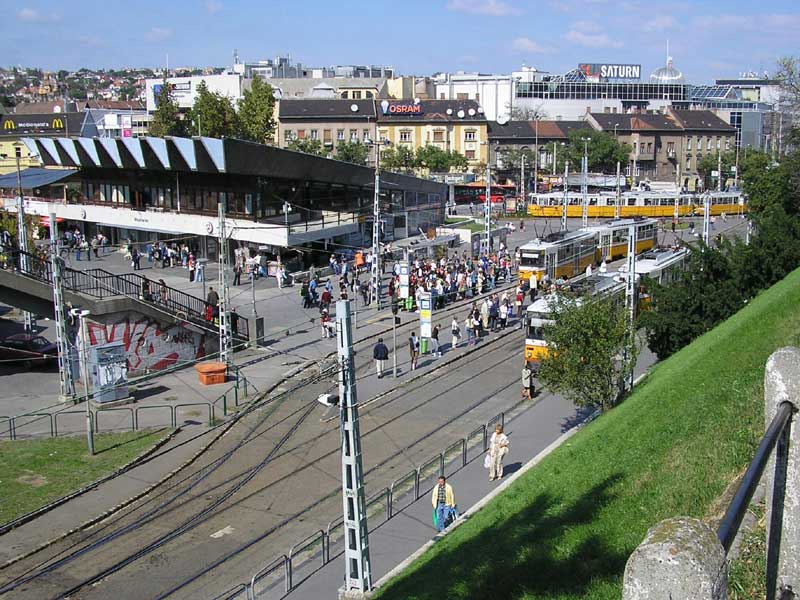
Mammut is depressingly like most other shopping centres in the world; glass, faux marble, lifts, adverts, toilets, predictable assortment of shops, cinema as you find in US malls; but it did have a supermarket in the basement and so I bought some apples and water (opportunity to try out Hungarian; seemed to work). I had by good fortune got hold of some sandwiches, a lunch which had been made up by our fixer in expectation of our timely arrival the afternoon before and handed out in the small hours as a welcome present. Being of the 'pack sandwiches and a flask' upbringing which had served me well over several hundred miles of hill walking, I'd brought them with me and now consumed an interesting mix of what I gradually realised to be soft cheese and paprika. By the time I'd finished, the people I came in with (and because my memory is still shot at this stage, I now can't remember at all who they were) had installed themselves in a Greek restaurant, which I tagged along with. Whether the following is a trait of Hellenic or Magyar cooks I am unsure, but by the end of the modest meal we had been given both complementary liqueur and watermelon slices by the staff, which pleased me much. By the time I was back on to the bus for the return journey to the hotel my sleep clock had returned to around the level of this time the day before - livable-with for now, but with short-term memory and some decision-making starting to suffer, wouldn't feel safe driving, etc. Startlingly, I recall being thrown into a rap improvisation somewhere on the way back and doing rather well at it, despite being on autopilot. That is to say, I appear - somehow -to have come up with some rhyme witty enough to raise a torrent of mirth and applause from my audience.
I decided not to try to sleep immediately but instead go for a wander round the neighbourhood. This ended up as having no sleep at all, although I can rationalise this in that I was doing moreorless alright at the time, and it would be better to sleep only at night. A large assortment of people were heading to a swimming pool at the end of the road (in fact it gives its name to the street; Pünkösdfürdő utca means 'street of the Pentecost Baths') so I moved with them. The street* had looked somewhat unattractive from the limited number of pictures I had seen prior to the trip, and indeed was still not the most endearing neighbourhood what with all the Soviet-era blocks and parched grass typical of Warsaw Pact suburbs, but neither was it a crime-racked dump (the 3rd district is considered one of the more affluent in the city) and it was quickly apparent there was no danger in walking the streets here. The Danube (the link is to a 360 panorama) dictated the end of the east-west street and beyond the point at which we stopped I could just make out the long island dividing the Szentendre channel from the river's main course. Just as I was contemplating striding over the mini-earthworks to have a proper look at the riverside (why am I so easily led away when there might be something interesting to look at round the corner?), a sub-group walked up to us and announced with visible annoyance that the open-air pool was closed 'because it had been raining earlier', something which was clearly not the case now. Anyway, there seemed to have been no possibility of persuading the place to re-open (I lacked the Hungarian to explain the shortcomings in this business model) so we set off back up the street.

And what should we happen upon, yards from our hotel, but a...bar.
Now this was in many ways a Good Thing, because hotel bars the world over are a rip-off, and now here was a place not two minutes' walk away where a korso of beer (about a pint) was 290Ft (less then £1) and the wine equally inexpensive. And it was also equally cheap to buy coffee - proper strong Hungarian kave like a double espresso in a little cup - which I decided then to be the best course of action. But- there's a butdo not be drunk at concerts and rehearsals. The climax of this paragraph is probably crashingly predictable. That's not to say everyone behaved irresponsibly, but let's not beat about the bush: people drank, some significantly, before a concert, which I just can't endorse as being advisable.
I've got a slight confession to make here. Having learned the 'ordering in a restaurant' section of my Complete Hungarian book, I bought my coffee using the vernacular, which pleased the barmaid greatly, This was overhead by a member of my party, who first tried to copy the sounds I told him would result in him getting beer, and then when this failed, me making these sounds to order his drinks for him. Having then clarified the vocab to my 'student' (he did pay, by the way) I can only assume I had now taught the entire orchestra the Hungarian for various alcoholic beverages, which somewhat contradicts the tone of the last paragraph. On the other hand, the bar staff understood the English terms too, so I'm not sure I really have much to be guilty about.
Actually, I didn't really stay long enough to find out. Having spun out the coffee and then increasingly abandoned any hope of conversation (Companion was nowhere to be seen, and I think she had done the sensible thing and slept for a bit) I quietly returned to my room to get concert clothes and other items necessary for the public performance of music on the violoncello. I do seem to have some kind of knack for leaving without being noticed when I want to, which comes in useful now and again. There is the usual rigmarole of forming-up in the lobby when departure nears; somebody is late, several people now rather merry, me glad I won't have to fight my instrument on to a bus this time.
 The journey through the suburbs is more familiar now and I can remember the route and landmarks from this morning, except now they are subtly different in the light of the late afternoon. It seems something of a mystery why there was no major school of Hungarian painting in the late nineteenth-century, for the quality of light would seem to be just as facilitating as that of Tuscany or northern France. Budapest castle was particularly conducive as can be seen from the pictures I took whilst we were waiting to enter the concert venue. The courtyard of the museum had a scattering of trees, statues and an old field gun which looked particularly good when framed artfully. There was also the strange intermingling of an English orchestra half in concert dress, instruments still in cases, mixing with the tail end of the Hungarian police, also half in uniform, half on ceremony. No conflict, you understand, but the sense of a transition between two very different cultures. Once we were inside the hall the atmosphere was relaxed. There was enough time to prepare for the concert gradually - indeed I sat and played through some Bach for a bit, partly to try and keep the skill in my fingers awake but partly for the hall's acoustic. Upstairs, the dressing room overlooked the northern side of the city, the Buda Hills (which I wanted to climb on the free day) and, perfectly installed as the foreground subject of a photograph, a single flagpole with the red, green and white flag of the Republic at its head. I waited until the breeze unfurled it against the sunset and pressed the shutter button for a 500th of a second. Perfect.
After a little conversation, I waited downstairs for us to walk on, gradually joined by the rest of the band. The hall had filled up considerably - in fact we were, to my delight, actually having to find extra chairs to allow the whole audience to fit in the hall. It was later explained to me that the concert was free and had been publicised hard by our Fixer, but this turnout was still something you would never expect in the UK, especially for a student orchestra. People simply don't care enough about the sort of music we perform back home, blighted by apathy, being told they must consider it snobbish and being too overworked to have enough time for culture. Tonight's programme: Beethoven Prometheus Overture; Haydn 'Clock' Symphony and Beethoven's Seventh. Perfect for the size of orchestra we're taking, and hopefully nobody will notice the second horn is actually a flugelhorn.
There is loud and warm applause from the assembled Hungarians as we enter. I notice something almost immediately - there is no conductor's podium. As I sit down in the principal cello's seat, I assume somebody must have forgotten bring it on and speculate how the Conductor will probably make a joke of having to carry it on himself. But no, here he comes, striding down to the semicircle of chairs with the projection of confidence that all musicians learn as part of our 'act', still with no podium in sight. Christ, I realise: he's actually going to conduct it from memory. The whole gig. All of it.
Now, as a sort of freeze-frame before the baton goes down, let's make it clear that I'm not, on principle, opposed to this. There is a long history of conductors doing ridiculously complicated pieces sans partition - Boulez and Rite of Spring is the most arresting example - but, as our conducting teacher impressed on us, the guy with the stick absolutely, positively has to have a completely watertight knowledge of the dots. It's a bit like overtaking: if you are even slightly in doubt about it, do not do it, because you have to be utterly certain there is going to be no possibility of failure. You will note that at this point I do not doubt our Conductor's intentions nor am I suggesting that he did not fulfil the above caveat; but the thing about Boulez and Rattle and all the others is that the musicians they had were crack professionals who had had as much rehearsal as they needed (admittedly that isn't much), had had normal sleep levels and knew the piece inside out. We were a student orchestra, doing this on our first, rushed, rehearsal in half a week, having had probably no more than about 6 hours' proper sleep in the last two or even three days and without having been forewarned of this. Oh, and did I mention some people had been drinking a couple of hours earlier...? What it comes down to is this: however prepared the Conductor might have been, we the players simply didn't have the mental resources at our disposal to deal with this at a whim, and cast aside our natural instinct that something was wrong here. What we needed in this situation was certainty and extra security. Just play it safe this time.
I won't lie: when the beat went down I was scared. Not quite as scared as the night I suddenly found myself speeding towards enough surface water to make my friend aquaplane into a tree a few minutes later, nor the occasion my housemate nearly choked to death on her own vomit after a horrific night's binge, but still decidedly uncomfortable. My thought process (sparing what mental RAM I could from the effort of translating dots into arm movements in my increasingly lethargic state) kept circling round 'I don't have confidence in the direction even though I should have, so I'm going to end up thinking about it so much and worry about making some massive error that I will actually make a massive error.' After a while I hit upon the idea of watching the leader rather than the conductor. I don't know if this improved my playing but it got me to focus enough that I avoided any serious mistakes and leading my section astray. I will refrain from speculating on how well other members of the orchestra were coping, although I couldn't spare much to watch for signs of danger.
There was, however, one definite high point, which was a truly extraordinary few minutes before the start of the Haydn symphony. For various reasons, one of our number, a gifted arranger, had made a version of the Tuba Mirum from Verdi's Requiem for nine trumpets, horns, bassoons and timpani. In the resonance of the hall it sounded like the end of the world, incredibly loud and spectacular and creating all the more astonishing an effect by segueing straight into the start of the Clock Symphony (the above video is, regrettably, not of us, but is about as close to conveying the awesomeness of the movement as any I could find. The Haydn began at 2'06). Incredibly (at least it seemed to me) we got through it all without communal mishap. I have no idea who bailed who out or if there was any bailing-out happening at all, but the Haydn danced along as it should (you know my opinions on Haydn) and the final chord was followed by as great a round of applause as had begun proceedings. We've made it this far - indeed a mantra that seems to sum up the tour.
Beethoven's Seventh was the second half. Yes, also directed from memory. The cello part is a monster at times with all the dotted triplet rhythms and string-crossing and it was probably a good thing I'd played most of it before, because I really wasn't enjoying the level of concentration I was having to put it by the end. This, too, was judged to be a success by the assembled throng, and meant we cold play an encore (I have little knowledge of how clap-happy audiences are in different countries, but am working on Hungarians needing the same quality of performance to demand an further items as we would back home).
The piece we played for the next three minutes changed everything. It made every event of the last three days worthwhile. The diminutive but perfectly crafted orchestration Béla Bartók made of his piano miniature Este a Székelyeknél contains little more than a few held notes for the violoncello section to play, but this mattered not. The simple melody, hung over a few carefully chosen chords, seemed to me far more poignant and pertinent than anything else I had heard in the concert. I don't know whether it was because it was closer to my own idea of what music should sound like, or simply that I had played and loved the piece in its many incarnations for years and years, but it caught my attention like nothing else, and offset every trial and setback we had suffered to get this far. And when we had finished, the audience simply wouldn't let us go, which I would like to think was because of their love of the piece and delight at hearing their own country's music, as well as for the rest of our playing. We bowed, the conductor bowed, walked off and back on; we stood up again, he bowed again; he stood up different sections individually, bowed again, walked off and on again, and still the whole hall applauded. I was thinking we'd have to play part of the Haydn again, but eventually we simply had to leave because we had a meal booked. I'm sorry, citizens of Budapest; we would gladly have played more but we were just too tired that night. Our appreciation of you is not diminished, rest assured.
It was dark by the time we were back on the bus. Dinner would be served presently on a river cruise on the Danube, although right at that moment I wouldn't have cared if it had been the nearest McDonald's because I was really starting to get hungry, a state in which I start to get profoundly uncomfortable in (an unholy alliance of metabolism and blood sugar levels if you must know, not helped by the potency of the coffee earlier). The civilised strains of the concert hall had given way to the furious noise of a student group gearing up for the evening, now amplified in the ugly acoustic of a MAN bus. I grabbed the frontmost seats and put the cello at the window side so I could grab it round corners. It turned out that we had a little time in hand, so before dinner we would drive up to the Citadella, on the great rock overlooking Budapest. I'd been up here on my last visit at night but didn't remember much apart from being told the place was crawling with pickpockets and quickly learning that there was no way I was going to take any serviceable photos with my primitive film camera in the dark. I'd been judicious with the cello, for the drive down Budai vár and up Gellért Hill to the fortifications felt like a rally special stage as we swayed round hairpin bends. I was first off the bus and followed our Fixer to the viewpoints. It was a clear night and here was the city spread out before me; the castle, the great river and its bridges, the dome of the St. István Basilica, the long avenues and lights of Pest and the peaks of Buda. I steadied my Olympus on some conveniently situated benches, turned the dial to 'night' and did the breathing-out thing to keep it steady whilst depressing the shutter. (The pictures came out alright). The rest of the group seemed equally impressed with the view.
Back onto the bus, noise level to bad-closing-on-torrid, and down the hill again, across the new bridge and along the embankment of downtown Pest. Presently we stopped somewhere upstream of the parliament building and were told not to get run down legging it across the road to a waiting river boat. It was a reasonably large vessel; bigger than anything you'd get up the Thames to the bit we'd come from, and on the lower deck we found a huge spread of hot and cold foodstuffs. I had to positively restrain myself from scoffing the whole table whilst the system for purchasing wine was explained. As it was after the concert, I had no qualms whatsoever about sharing a bottle of white with the friends I was sitting with, which turned out to be a very good decision because the stuff was delicious. As was the cuisine - I ate my first proper hot food in days; soup, meats, vegetable sides, cheese, fruit, all of it both welcome and satisfying. This was better. We shared the glasses of bőr around, me raising laughter by going through the motions of sniffing and chewing it (no, I don't know what wine buffs really get from these actions that you can't get just by drinking it normally) and made comments to the general opinion that the food was fairly excellent. Presently the deck cleared a little and we drifted upstairs, where our party were spread out round the open-sided observation deck. There were fantastic views to be had here to, albeit from a different angle, along with me obligingly photographing others to swell their Facebook albums (I really don't mind doing this though).
I was feeling decidedly better about things now, assuming that I would have a proper night's sleep ahead of me and that the rest of the tour would consist of spectacular concerts and memorable socialising and culture-soaking. OK, it's a shame one of our number vomited on the boat, and now enough individuals were fuelled with drink the din on the coach back was deafening, but I assumed this would be only a temporary foible. And yet...remind me, what's that quote about assumption from the (otherwise risible) film Under Siege?
Something was about to happen that would bring the whole chain of events to a head, and almost push me over the edge. But it happened after midnight, so it must wait until the next post...
Next time: Some decisive stuff happens, and I become intimately acquainted with the biggest acoustics in the world.
*This link is to possibly the most hilarious and pedantic blog I have ever come across, that of an irate Budapest resident who feels the need to share examples of outstandingly bad parking in his city with the world.
Friday, July 29, 2011
What Happened in Hungary: Day Three Part One
Another midnight passes on a bus. We should be asleep in a hotel now, refreshed and well-dined rather than digesting resthaus schnitzels from a cramped seat, still with 50km of Austria and half of Hungary to go. Vienna is unrecognisable from the ring road. No trace of what heights of art and imperial history the city represents can be inferred from the power stations, gas holders and lights of the airport, visible when the road is allowed to surface for air from the many tunnels it takes under the outer districts. Once again, such a landmark invites wildly optimistic speculation over how much longer the journey will be. Less than an hour to the A-H border, surely, and then perhaps two to Budapest?
There was a gentle slowing-down and I realised we were - perhaps, yards, feet? - from Hungary itself. I had no knowledge of the border procedure, assuming that despite remaining in the EU, at the very least a passport check would be required to enter the former Warsaw Pact (this had been the case at a Poland-Slovakia crossing five years previously). Nothing. We paused, then drove on straight past buildings that were clearly no longer used - as if to emphasise the nature of what had changed here, one of the greatest divides of history was now little more than a cafe. Some indeterminate time later we made another short stop. I remember deciding that a little fresh air would be a good idea and taking a few steps outside the bus in the dark. I was so drowsy the chill of the night air and the breath of traffic going by seemed detached from my senses but this temporarily alleviated the dry throat and cough that occurs after breathing in an air-conditioned environment for too long. People are beginning to feel ill now, which is unsurprising given that there are numerous contributing factors available. Every time I almost sleep my brain wakes me up because it's still aware that there is motion and I am not properly lying down. Hungary is simply darkness beyond the glass, and offers no clue as to how much of herself remains to traverse.
Somehow, at 4am I was not only still alive but was actually at the (metaphorical) gates of Budapest. I rank this amongst completing a Masters' degree, writing The Sun Rising and cooking perfect crispy duck pancakes as one of my greatest achievements. In fact the previous 40 hours ceased to matter at that moment, not so much because we had reached our destination but because of what the destination was, a city I had been aching to go back to for nearly seven years. Driving through the streets of Buda again was enough to restore all of my downtrodden optimism about this trip. I started to recognise with delight places I'd known before - trams in Moskva tér, the great statue high up on the citadel, the Danube river which had shadowed us all the way from Germany (and what a distance that seemed like now) - and with equal delight saw they had not changed at all for the worse but were every bit as magisterial as I has remembered them. Better still, sleep would be coming, hours of sleep after which I would be restored pretty much to full health and ready to consume the glories of the city.
If all this sounds rather gushing, it is partly for dramatic effect. Because what actually panned out wasn't quite so encouraging. We reached the hotel in the north of Buda with no further delay. Looks alright, lots of wood and palm trees in the lobby. And then the plan of what would be happening tomorrow was announced. It should be explained at this point that the becalmment in Aschaffenburg had put us behind by approximately fourteen hours. As the time was now 4.30am, we would have arrived on the original plan at about 3pm, and then had a few hours to sleep, relax and take stock before having a dinner cruise on the river and then a full night's rest. Obviously there was no chance of any of this happening now - but to top that, it was explained that tomorrow's schedule (technically today's, but the sense of what hour belonged to what day had become either blurred or irrelevant by now) had to go ahead as planned. This involved leaving at 9.30 to get to a rehearsal at the Museum of Military History, a rehearsal which cannot be postponed because the Hungarian Police need the building for a ceremony of some kind. There was a largely silent but very apparent collective groan from the orchestra as this was announced. A maximum four hours' sleep was being offered to us after over two days of restlessness. I didn't wait to hear much more and stood in line to get the keys. The room was a little basic with the obligatory mysterious stain on one wall and arcane shower system, but it wasn't a high priority right now. The thin pillow didn't make much difference either.
Breakfast is ample enough; a big cup of coffee (but disappointingly weak and of poor quality for Hungary; read more about this later), bread and the cold cheeses and meats typically offered on the continent. Let's be honest, I am functioning - meaningful conversation is possible and I feel as if I will just about be able to play today's concert. The early start is offset by news that a previously scheduled sightseeing tour being postponed to another day, so that we can at least return here and rest in the afternoon. This makes things work a little better. We are also told that the rehearsal will be like a good haircut - short and efficient - and that we will have a little leisure time afterwards to get lunch. I have the impression that the orchestra is generally unperturbed by all the disturbances and lack of sleep and is prepared to just go at it and see what happens, but I can't be sure.
Still, we have to go and rehearse now, because it's our only opportunity to do so. Stepping out into the bright daylight of Budapest for the first time, we find that the stature of our transportation has shrunk still further, as we now have a squat red bus that's basically the same as those in service round the city (although markedly younger and rust-free) which makes fitting the entire ensemble and all hangers-on even more of a challenge. The cello goes next to me by the window; it's survived six years of being carried in a Corsa and the worst of Austrian roads in it's case; it will cope with this. Predictably, we get 100 yards and have to turn back for somebody who ignored the departure time, but it's little matter. We swing out again onto a wide avenue with dense trees in the island between roadways and the railway on the far side. I can see far more detail and character of Budapest than in the dark a few hours ago. We come out of the northern suburbs, past the amphitheatre and colonnades of Aquincum, Budapest's Roman predecessor, and the green-painted stations of the HÉV suburban railway, over a junction where yellow trams (the same Soviet-era models that had been rumbling along the streets for ever) crossed under road viaducts, and then onto the riverside. Over the water is the unmistakable umber dome and Gothic pinnacles of the Parliament building, and beyond it the suspension bridge and, where a gap in the skyline allows a view, the castle mount where we are headed. I'm already trying to take pictures from the bus window, albeit with limited success, so take in the more immediate surroundings. The landscape is a pleasing mixture of the Germanic and also something more Eastern: churches have yellow walls but also onion domes at the base of their spires, signage is ostensibly in the Latin alphabet but spelling words and vowel sounds that are baffling and exotic in equal measure. Not only do I remember the correct pronunciation for all the diacritic marks, I actually learn a few new words in Hungarian just by reading shop signs and street names. I am starting to love this city and culture.
We make a sharp right turn at another place I remember well: the Buda end of the Chain Bridge, which leads either over the water, further along the riverside or into a tunnel under the Budavári-hegy (vár means castle; hegy a hill), but we are going on neither. Instead we make the climb up a switchback road that ascends above the rooftops into the castle district. The final turn brings us past Fisherman's Bastion and onto cobbled streets, crowded with visitors and officials for whatever ceremony is happening later. It's a jolting ride for the last few hundred yards and then we shove each other off the bus as soon as the doors are open. The Museum of Military History is at the far end of the elongated hilltop, and occupies three-and-a half sides around a courtyard, with the far wall partly open above a sunken garden to reveal a panorama of the city. Last time I played here the venue was an outdoor stage, but this is no longer in evidence and we are shown into a hall with a high roof and a long and somewhat romanticised painting of a cavalry charge by a Magyar army of antiquity. It is impressed on us that speed is of the essence and we waste no time in setting up a semicircle of chairs and unpacking. I'm relieved to see that my instrument is none the worse for the journey; in fact it's even (almost) in tune.
I try to set out that I'm taking care of my section, making sure they have sufficient room to play (something that should be instilled into everyone who ever sets out a stage) and are comfortable. Our Conductor has brought along our fixer, and briefly introduces him, to much appreciation by the players. We now have one hour - exactly - to rehearse the entire programme. We breeze through the Beethoven Prometheus overture (a short and easy piece) and then I finally find out the reason why we have brought such a huge amount of trumpeters for the repertoire we are performing - eight in total. it is this: as a prelude to the Haydn symphony (the Clock, No.101), they will be performing an arrangement of the Tuba mirum for Verdi's Requiem. By the time all the players have entered, it is biblical in volume and spectacle, the mighty force of the sound amplified and swept around in the hall's reverberating space. The redundant string players gazed in delighted awe until, as the last chord rolled away, the Conductor readied us to start the symphony - a unlikely transition that turned out to be utterly convincing. It also worked wonders for confidence about our performing ability - if we sounded like that even now, then clearly sleep levels weren't too relevant. And so through the Beethoven symphony (No.7) right up to the hour. With five minutes to go, the coffee wore off.
There was a gentle slowing-down and I realised we were - perhaps, yards, feet? - from Hungary itself. I had no knowledge of the border procedure, assuming that despite remaining in the EU, at the very least a passport check would be required to enter the former Warsaw Pact (this had been the case at a Poland-Slovakia crossing five years previously). Nothing. We paused, then drove on straight past buildings that were clearly no longer used - as if to emphasise the nature of what had changed here, one of the greatest divides of history was now little more than a cafe. Some indeterminate time later we made another short stop. I remember deciding that a little fresh air would be a good idea and taking a few steps outside the bus in the dark. I was so drowsy the chill of the night air and the breath of traffic going by seemed detached from my senses but this temporarily alleviated the dry throat and cough that occurs after breathing in an air-conditioned environment for too long. People are beginning to feel ill now, which is unsurprising given that there are numerous contributing factors available. Every time I almost sleep my brain wakes me up because it's still aware that there is motion and I am not properly lying down. Hungary is simply darkness beyond the glass, and offers no clue as to how much of herself remains to traverse.
Somehow, at 4am I was not only still alive but was actually at the (metaphorical) gates of Budapest. I rank this amongst completing a Masters' degree, writing The Sun Rising and cooking perfect crispy duck pancakes as one of my greatest achievements. In fact the previous 40 hours ceased to matter at that moment, not so much because we had reached our destination but because of what the destination was, a city I had been aching to go back to for nearly seven years. Driving through the streets of Buda again was enough to restore all of my downtrodden optimism about this trip. I started to recognise with delight places I'd known before - trams in Moskva tér, the great statue high up on the citadel, the Danube river which had shadowed us all the way from Germany (and what a distance that seemed like now) - and with equal delight saw they had not changed at all for the worse but were every bit as magisterial as I has remembered them. Better still, sleep would be coming, hours of sleep after which I would be restored pretty much to full health and ready to consume the glories of the city.
If all this sounds rather gushing, it is partly for dramatic effect. Because what actually panned out wasn't quite so encouraging. We reached the hotel in the north of Buda with no further delay. Looks alright, lots of wood and palm trees in the lobby. And then the plan of what would be happening tomorrow was announced. It should be explained at this point that the becalmment in Aschaffenburg had put us behind by approximately fourteen hours. As the time was now 4.30am, we would have arrived on the original plan at about 3pm, and then had a few hours to sleep, relax and take stock before having a dinner cruise on the river and then a full night's rest. Obviously there was no chance of any of this happening now - but to top that, it was explained that tomorrow's schedule (technically today's, but the sense of what hour belonged to what day had become either blurred or irrelevant by now) had to go ahead as planned. This involved leaving at 9.30 to get to a rehearsal at the Museum of Military History, a rehearsal which cannot be postponed because the Hungarian Police need the building for a ceremony of some kind. There was a largely silent but very apparent collective groan from the orchestra as this was announced. A maximum four hours' sleep was being offered to us after over two days of restlessness. I didn't wait to hear much more and stood in line to get the keys. The room was a little basic with the obligatory mysterious stain on one wall and arcane shower system, but it wasn't a high priority right now. The thin pillow didn't make much difference either.
As in real-time I am sleeping, now might be a good point to take stock of events up to this point. We have reached our hotel fourteen hours behind schedule. Our English bus is still in Germany being repaired and will not be available for us for another two days at best. At the request of Companion, I had been making notes on the times of various events (border crossings, pit stops), knowing that I'd not be able to remember things accurately. Applying as much mental arithmetic as I can manage, I work out that I have been awake for some 45 hours, far longer than my previous effort of 36 going to Hong Kong a few years ago. In addition, Hong Kong was spent on the relative calm of an airliner and ended in a very comfortable hotel. By the second day there I was fully adjusted even for the eight-hour time difference. Here, the fact that I have now actually slept should not be confused with any pretence of feeling rested. It has simply put the level of tiredness back by perhaps a day, similar to how I was feeling in Aschafenburg. In practical terms, this means that I would feel decidedly unsafe about driving, my playing ability will be noticeably diminished and my patience with any irritations lacking. But worst of all, it means I have to delay proper sleep by yet another 24 hours, and arguably have a more strenuous day to get through (although I have long questioned whether travelling, even as a passenger, is ever stress-free). But back to the real world...
Breakfast is ample enough; a big cup of coffee (but disappointingly weak and of poor quality for Hungary; read more about this later), bread and the cold cheeses and meats typically offered on the continent. Let's be honest, I am functioning - meaningful conversation is possible and I feel as if I will just about be able to play today's concert. The early start is offset by news that a previously scheduled sightseeing tour being postponed to another day, so that we can at least return here and rest in the afternoon. This makes things work a little better. We are also told that the rehearsal will be like a good haircut - short and efficient - and that we will have a little leisure time afterwards to get lunch. I have the impression that the orchestra is generally unperturbed by all the disturbances and lack of sleep and is prepared to just go at it and see what happens, but I can't be sure.
Still, we have to go and rehearse now, because it's our only opportunity to do so. Stepping out into the bright daylight of Budapest for the first time, we find that the stature of our transportation has shrunk still further, as we now have a squat red bus that's basically the same as those in service round the city (although markedly younger and rust-free) which makes fitting the entire ensemble and all hangers-on even more of a challenge. The cello goes next to me by the window; it's survived six years of being carried in a Corsa and the worst of Austrian roads in it's case; it will cope with this. Predictably, we get 100 yards and have to turn back for somebody who ignored the departure time, but it's little matter. We swing out again onto a wide avenue with dense trees in the island between roadways and the railway on the far side. I can see far more detail and character of Budapest than in the dark a few hours ago. We come out of the northern suburbs, past the amphitheatre and colonnades of Aquincum, Budapest's Roman predecessor, and the green-painted stations of the HÉV suburban railway, over a junction where yellow trams (the same Soviet-era models that had been rumbling along the streets for ever) crossed under road viaducts, and then onto the riverside. Over the water is the unmistakable umber dome and Gothic pinnacles of the Parliament building, and beyond it the suspension bridge and, where a gap in the skyline allows a view, the castle mount where we are headed. I'm already trying to take pictures from the bus window, albeit with limited success, so take in the more immediate surroundings. The landscape is a pleasing mixture of the Germanic and also something more Eastern: churches have yellow walls but also onion domes at the base of their spires, signage is ostensibly in the Latin alphabet but spelling words and vowel sounds that are baffling and exotic in equal measure. Not only do I remember the correct pronunciation for all the diacritic marks, I actually learn a few new words in Hungarian just by reading shop signs and street names. I am starting to love this city and culture.
We make a sharp right turn at another place I remember well: the Buda end of the Chain Bridge, which leads either over the water, further along the riverside or into a tunnel under the Budavári-hegy (vár means castle; hegy a hill), but we are going on neither. Instead we make the climb up a switchback road that ascends above the rooftops into the castle district. The final turn brings us past Fisherman's Bastion and onto cobbled streets, crowded with visitors and officials for whatever ceremony is happening later. It's a jolting ride for the last few hundred yards and then we shove each other off the bus as soon as the doors are open. The Museum of Military History is at the far end of the elongated hilltop, and occupies three-and-a half sides around a courtyard, with the far wall partly open above a sunken garden to reveal a panorama of the city. Last time I played here the venue was an outdoor stage, but this is no longer in evidence and we are shown into a hall with a high roof and a long and somewhat romanticised painting of a cavalry charge by a Magyar army of antiquity. It is impressed on us that speed is of the essence and we waste no time in setting up a semicircle of chairs and unpacking. I'm relieved to see that my instrument is none the worse for the journey; in fact it's even (almost) in tune.
I try to set out that I'm taking care of my section, making sure they have sufficient room to play (something that should be instilled into everyone who ever sets out a stage) and are comfortable. Our Conductor has brought along our fixer, and briefly introduces him, to much appreciation by the players. We now have one hour - exactly - to rehearse the entire programme. We breeze through the Beethoven Prometheus overture (a short and easy piece) and then I finally find out the reason why we have brought such a huge amount of trumpeters for the repertoire we are performing - eight in total. it is this: as a prelude to the Haydn symphony (the Clock, No.101), they will be performing an arrangement of the Tuba mirum for Verdi's Requiem. By the time all the players have entered, it is biblical in volume and spectacle, the mighty force of the sound amplified and swept around in the hall's reverberating space. The redundant string players gazed in delighted awe until, as the last chord rolled away, the Conductor readied us to start the symphony - a unlikely transition that turned out to be utterly convincing. It also worked wonders for confidence about our performing ability - if we sounded like that even now, then clearly sleep levels weren't too relevant. And so through the Beethoven symphony (No.7) right up to the hour. With five minutes to go, the coffee wore off.
Next time: we climb across some boats, and how things started to go bad again...
Saturday, March 19, 2011
Linkage
I almost certainly should have posted this sooner, but better late then never. St Andrew's University have created an entire section on their 600th Anniversary Composition Competition, so when an idle moment presents itself you can have a gander at what they have to say about my piece and the two I'm up against. Both my competitors seem to be considerably more experienced, not to mention a few years older, than myself, having had various works performed on Radio 3 and both having studied composition at music college. Also, my biography has been made rather short, not exactly bigging-up my comparatively modest achievements. Still, we are on an equal footing as far as the contest goes from now on.
I shall be travelling up to the concert forming the competition's final on 21st April. The orchestra have a month left to rehearse and, other than needing additional percussion parts, appear to have had no difficulties, which is a relief. The oft-told story of the disastrous première of Rachmaninov's First Symphony had entered my thoughts once or twice but I'm sure the orchestra and conductor will do a highly professional job. I am also determined not to interfere too much with the musicians' input into the performance - no last-minute alterations to the notes or outbursts of 'no, no NO, not like THAT!' during the final rehearsal. I do (generally) trust conductors, 'yer know...
Here's the main site for the competition: 600th Anniversary Competition
The concert programme
My piece: The Sun Rising
I shall be travelling up to the concert forming the competition's final on 21st April. The orchestra have a month left to rehearse and, other than needing additional percussion parts, appear to have had no difficulties, which is a relief. The oft-told story of the disastrous première of Rachmaninov's First Symphony had entered my thoughts once or twice but I'm sure the orchestra and conductor will do a highly professional job. I am also determined not to interfere too much with the musicians' input into the performance - no last-minute alterations to the notes or outbursts of 'no, no NO, not like THAT!' during the final rehearsal. I do (generally) trust conductors, 'yer know...
Here's the main site for the competition: 600th Anniversary Competition
The concert programme
My piece: The Sun Rising
Thursday, January 20, 2011
Good stuff
I was going to finish the account of the river Itchen today, but the ITM press has had to be held for some very good news. I had a phone call last night from the staff at a major Scottish university to tell me that the orchestral piece I'd submitted to their competition had been shortlisted in the final four. Whether I win overall or not, it will now be performed on 21st April this year as part of their 600th anniversary celibrations by the Music Society orchestra, which actually feels like the more valuable prize. What's more is that the judging panel has some pretty big names on it, including Sally Beamish, so I'm getting my work seen by professionals.
Now all that remains is to send the parts and book a Southampton-Edinburgh flight (and finish the orchestral piece for my old uni orchestra).
Now all that remains is to send the parts and book a Southampton-Edinburgh flight (and finish the orchestral piece for my old uni orchestra).
Thursday, November 25, 2010
Composition
Am working at the moment on an orchestral work for a competition (eek - the deadline is Jan 7th) which is actually coming along alright, although I need to keep up the work rate despite all the Christmas stuff I have to do. As the competition in question is a) for a student orchestra and b) for an anniversary celebration I've tried not to write anything too heavy or too difficult, the rules advising that it 'should be suitable for performance by a good student orchestra'. At the moment I have the first 4 minutes, the last 2 1/2 minutes and a fair amount of 'stuff' in between, most of which has been sufficiently refined to merit staying in the piece. Structurally, it's in a sort of arch form, ABCBA, with the second B somewhat varied from the first. I rarely have the entire structure thought out in much detail when I start to write, and it often develops as I get notes down and spin them out into phrases and sections. This is probably a good thing as it means the music is not contrained by being made to fit into particular proportions. By the stage of the process I am now at I have pretty much finalised what goes where and how the narrative of the music proceeds. My task now is to fill out the gaps and link together the bits I have using the motivic materials within it.
Saturday, November 13, 2010
One for the kids
Frankly, I think games console manufacturers have missed a trick.
By 'console' I speak, specifically, of the Wii (which I notice is now available in a 'Limited Edition!' red colour) and it's wireless controller. This clever little piece of electronic Japanese-ery allows the player to actually enact the movements their wish their on-screen avatar to make, rather than having to transmit their motor skills through pressing buttons. As a consequence, cars on the old Playstation that, despite one's most dexterous button-bashing, would always corner like Blenheim Palace, can now be made to follow the road almost effortlessly, without requiring the player to have the finger skills of a concert pianist. Sports games actually require a modicum of physical effort. Shooting games you can look down the gun. And so on.
However, one subject area remains untapped by the gaming industry, something the Wii was born for:
Conducting.
Frankly, the system is almost perfect for it. With a controller in each hand, the tempo and character of the music can be inferred by the console's motion-sensing system and translated into the playing of a virtual orchestra (who will, appropriate to Wii-person anatomy, lack legs and any apparent joining of limbs to body, but will still be able to hold instruments). Those familiar with the system will already have realised that the Wii controller is held in a near-identical fashion to the baton, further enhancing the learning curve for aspiring maestri. Players progress through several levels of difficulty, beginning with simple beat-keeping exercises (a Strauss polka or Sousa march), before progressing through larger excerpts of the orchestral literature which require multiple tempo changes and expressive gestures. (Additional bonus levels evoke more conventional beat-'em-up and shoot-'em-up gaming subjects, as the player uses the Wii controller first in 'negotiations' with the Musicians' Union over working hours, and then to dispatch airport security cretins who fail to distinguish between a trombone and a bomb).
The advantages are obvious: one no longer has to shell out to hire a full symphony orchestra and rehearsal venue, or the risk of egg meeting face for student conductors practising that tricky little corner in the finale of Bruckner Seven.
It will of course be necessary to have on the disc an appropriate selection of the orchestral literature, and more importantly for the computer to be able to interpret a wide range of gestures from the user. Fortunately the player will be able to use the setup menu to adjust the sensitivity of the motion sensors, which ranges from 'Klemperer' at one extreme to 'Bernstein' at the other. Be warned: the 'Gerghiev' and 'Rhosdesvensky' settings require additional CPU processing power.
As with any game, there exists the potential for all manner of cash-in sequels and 'expansion packs', and Wiiductor, as our creation shall henceforth be known, will be no exception. The 'Ba-rock! Expansion Pack (novelty wig sold separately) sees the player 'take on' the eighteenth century, first perfecting the Mannheim Rocket with a deft flick of the wrist, before progressing onto the court of Louis XXVXIVIIIII where the controller must be used to master double-dotted quavers without accidentally causing gangrene. The 'Stravinsky: Dissonance Unleashed' add-on culminates in perhaps the hardest level of all, the première of Rite of Spring in which aside from dealing with time signatures dreamt up by aliens, the player must dodge seats and other missiles hurled by the audience. (Gaming 'hack' rumour has it that completing this unlocks a secret level contining Le Marteau sans Maitre, which has been neither confirmed nor denied by the game's developers).
With the right development and marketing, I see no reason why this game won't be a best-seller. If ten million Chinese kids learn the piano, ten million Brits can wave the stick (even if it is comprised of invisible microwaves).
By 'console' I speak, specifically, of the Wii (which I notice is now available in a 'Limited Edition!' red colour) and it's wireless controller. This clever little piece of electronic Japanese-ery allows the player to actually enact the movements their wish their on-screen avatar to make, rather than having to transmit their motor skills through pressing buttons. As a consequence, cars on the old Playstation that, despite one's most dexterous button-bashing, would always corner like Blenheim Palace, can now be made to follow the road almost effortlessly, without requiring the player to have the finger skills of a concert pianist. Sports games actually require a modicum of physical effort. Shooting games you can look down the gun. And so on.
However, one subject area remains untapped by the gaming industry, something the Wii was born for:
Conducting.
Frankly, the system is almost perfect for it. With a controller in each hand, the tempo and character of the music can be inferred by the console's motion-sensing system and translated into the playing of a virtual orchestra (who will, appropriate to Wii-person anatomy, lack legs and any apparent joining of limbs to body, but will still be able to hold instruments). Those familiar with the system will already have realised that the Wii controller is held in a near-identical fashion to the baton, further enhancing the learning curve for aspiring maestri. Players progress through several levels of difficulty, beginning with simple beat-keeping exercises (a Strauss polka or Sousa march), before progressing through larger excerpts of the orchestral literature which require multiple tempo changes and expressive gestures. (Additional bonus levels evoke more conventional beat-'em-up and shoot-'em-up gaming subjects, as the player uses the Wii controller first in 'negotiations' with the Musicians' Union over working hours, and then to dispatch airport security cretins who fail to distinguish between a trombone and a bomb).
The advantages are obvious: one no longer has to shell out to hire a full symphony orchestra and rehearsal venue, or the risk of egg meeting face for student conductors practising that tricky little corner in the finale of Bruckner Seven.
It will of course be necessary to have on the disc an appropriate selection of the orchestral literature, and more importantly for the computer to be able to interpret a wide range of gestures from the user. Fortunately the player will be able to use the setup menu to adjust the sensitivity of the motion sensors, which ranges from 'Klemperer' at one extreme to 'Bernstein' at the other. Be warned: the 'Gerghiev' and 'Rhosdesvensky' settings require additional CPU processing power.
As with any game, there exists the potential for all manner of cash-in sequels and 'expansion packs', and Wiiductor, as our creation shall henceforth be known, will be no exception. The 'Ba-rock! Expansion Pack (novelty wig sold separately) sees the player 'take on' the eighteenth century, first perfecting the Mannheim Rocket with a deft flick of the wrist, before progressing onto the court of Louis XXVXIVIIIII where the controller must be used to master double-dotted quavers without accidentally causing gangrene. The 'Stravinsky: Dissonance Unleashed' add-on culminates in perhaps the hardest level of all, the première of Rite of Spring in which aside from dealing with time signatures dreamt up by aliens, the player must dodge seats and other missiles hurled by the audience. (Gaming 'hack' rumour has it that completing this unlocks a secret level contining Le Marteau sans Maitre, which has been neither confirmed nor denied by the game's developers).
With the right development and marketing, I see no reason why this game won't be a best-seller. If ten million Chinese kids learn the piano, ten million Brits can wave the stick (even if it is comprised of invisible microwaves).
Friday, November 5, 2010
On arrangement
I have, as of today, finished an arrangement of The First Nowell that I've been commissioned to write for a concert in December. It's a rather unusual scoring; two flutes, two oboes, three trumpets, timps, harp, organ and strings (and chorus) - basically the baroque orchestra that will play in the Bach Magnificat earlier on. The inclusion of the harp, and indeed the arrangement, is explained by Finzi's In Terra Pax being in the concert, a piece that quotes the carol, albeit tentatively. Admittedly a slightly odd ensemble to write for, one saving grace is that the absence of the bottom half of the the wind section, horns and heavy brass is made up for by the large modern organ in the church where the arrangement will be performed. This instrument is more than capable of filling in the weight these instruments would otherwise provide (and playing quietly when needed), and in any case such a small string section would be overwhelmed by too much sound from the back of the stage.
As with arranging folk songs, the obvious problem of having a strophic melody-and-accompaniment carol is that it really only has the words to provide any ready-made variance. The arranger must pull out every trick available to keep the tune sounding as fresh as possible, the difficulty of which increases exponentially with the number of verses. Often the text is the most useful starting point to creating contrast, as that the arranger can highlight the significance of certain lyrics or verses in the ancient art known as word-painting. Thus in the second verse of Nowell, which describes the star moving towards a certain stable in central Palestine, the loud full-ensemble texture of the first verse is replaced by the chorus in harmony, solo violin, solo flutes, and harp, with the strings entering softly at the chorus. Likewise, the third verse uses the trumpets, oboes and a reedy registration on the organ to suggest the exotic origins of the wise men (the carol perpetuates the perennial idea that there were three of them, despite there being no confirmation of the number in any of the Gospels) as well as little turns and arabesques which I hope, remain the sensible side of cliche.
However, where the arranger can really inject their individual stamp is in the last verse. This is usually, in the church music tradition, sung with the voices in unison, allowing the organist, or whatever other accompaniment is playing, to provide an 'alternative' harmonisation for the verse. As the choir and congregation are all singing the tune (one hopes at roughly the same key/place/words) there is no obligation to follow the bass line or the rest of the four-part harmony that will be found written out in the hymn book and thus pretty much 'anything goes' in the harmony. Obviously the aim is usually to make the thing sound spectacular (and wake the neighbours/shatter windows/cause seismograph needles to jump with the force of the sound) whilst not being so 'way out' that the congregation cease to follow the tune and disaster ensues. In the case in hand, I have instructed the organist to draw as many stops as grabbable before jumping simultaneously on two pedals both tuned to the note D natural, making a noise like Brian Blessed blowing through a ship's hooter; and then play as series of mildly dissonant ascending chords aided by the strings playing tremolo (moving the bow back and forth so fast it's a blur). At the second stanza the harmony starts taking excursions into all sorts of exotic key areas, with harp and strings playing arpeggios - there's little point making them compete for the melody in their lower register with all the other noise going on. Finally, the last chorus appears in more conventional harmony (high descant doubled by flutes, great upward scales in the strings), big slow down; then organ, drums and trumpets into overdrive for a high-volume frenzy of D major in the coda. Bang-crash-wallop. Bosh. Mahler never even came close.
The above description is probably very confusing and peppered with muso jargon. A simpler explanation for the layman is that it will sound good and be very loud. Both of which are commendable aims in composition.
As with arranging folk songs, the obvious problem of having a strophic melody-and-accompaniment carol is that it really only has the words to provide any ready-made variance. The arranger must pull out every trick available to keep the tune sounding as fresh as possible, the difficulty of which increases exponentially with the number of verses. Often the text is the most useful starting point to creating contrast, as that the arranger can highlight the significance of certain lyrics or verses in the ancient art known as word-painting. Thus in the second verse of Nowell, which describes the star moving towards a certain stable in central Palestine, the loud full-ensemble texture of the first verse is replaced by the chorus in harmony, solo violin, solo flutes, and harp, with the strings entering softly at the chorus. Likewise, the third verse uses the trumpets, oboes and a reedy registration on the organ to suggest the exotic origins of the wise men (the carol perpetuates the perennial idea that there were three of them, despite there being no confirmation of the number in any of the Gospels) as well as little turns and arabesques which I hope, remain the sensible side of cliche.
However, where the arranger can really inject their individual stamp is in the last verse. This is usually, in the church music tradition, sung with the voices in unison, allowing the organist, or whatever other accompaniment is playing, to provide an 'alternative' harmonisation for the verse. As the choir and congregation are all singing the tune (one hopes at roughly the same key/place/words) there is no obligation to follow the bass line or the rest of the four-part harmony that will be found written out in the hymn book and thus pretty much 'anything goes' in the harmony. Obviously the aim is usually to make the thing sound spectacular (and wake the neighbours/shatter windows/cause seismograph needles to jump with the force of the sound) whilst not being so 'way out' that the congregation cease to follow the tune and disaster ensues. In the case in hand, I have instructed the organist to draw as many stops as grabbable before jumping simultaneously on two pedals both tuned to the note D natural, making a noise like Brian Blessed blowing through a ship's hooter; and then play as series of mildly dissonant ascending chords aided by the strings playing tremolo (moving the bow back and forth so fast it's a blur). At the second stanza the harmony starts taking excursions into all sorts of exotic key areas, with harp and strings playing arpeggios - there's little point making them compete for the melody in their lower register with all the other noise going on. Finally, the last chorus appears in more conventional harmony (high descant doubled by flutes, great upward scales in the strings), big slow down; then organ, drums and trumpets into overdrive for a high-volume frenzy of D major in the coda. Bang-crash-wallop. Bosh. Mahler never even came close.
The above description is probably very confusing and peppered with muso jargon. A simpler explanation for the layman is that it will sound good and be very loud. Both of which are commendable aims in composition.
Subscribe to:
Posts (Atom)